R Eric. Thomas Swears His New Show “Backing Track” Is Not Autofiction, It’s Fan Fiction

Interviews

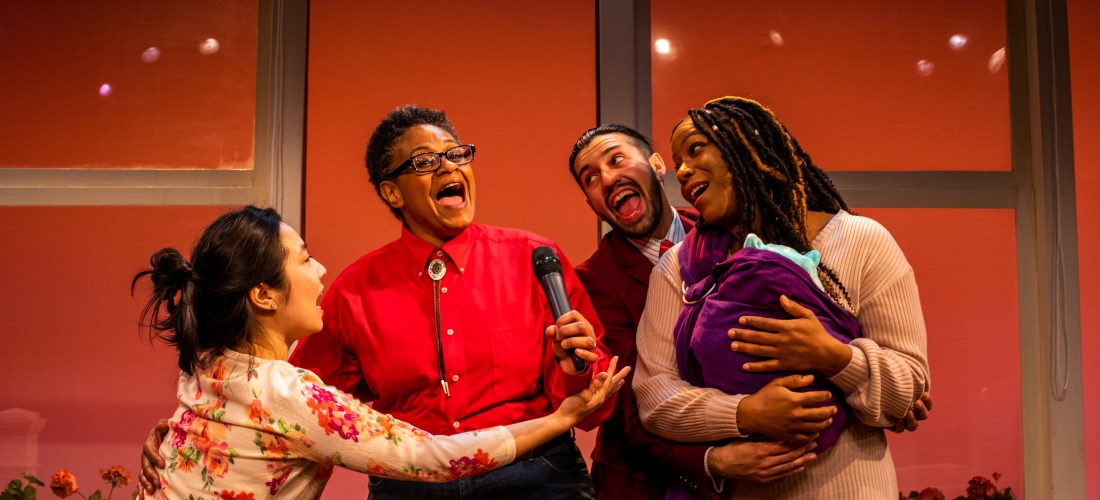
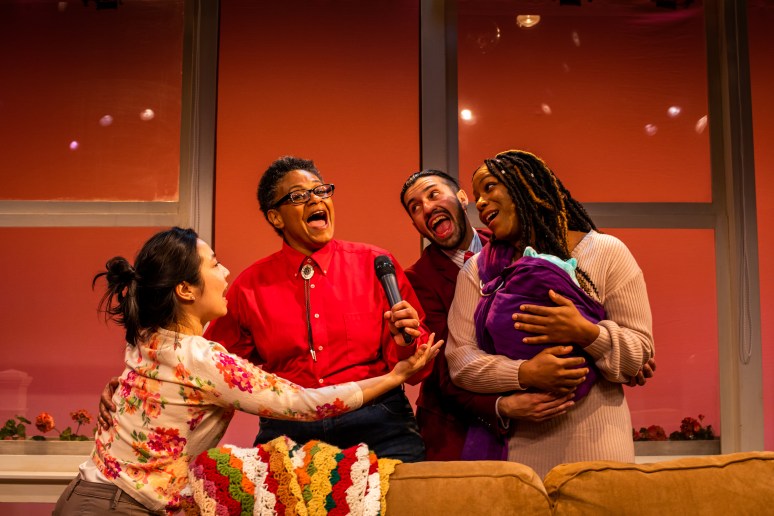
Bi Jean Ngo, Melanye Finister, Joseph Ahmed, and Danielle Leneé in BACKING TRACK at Arden Theatre Company.

The Rebecca Wright directed production of R. Eric Thomas’ Backing Track at the Arden Theatre made the case that finding queer love in a banal suburb is possible, a radical opinion for some, and that processing grief can also be a joyous practice.

The show is episodic and paced by a mixtape of songs and quotes that lay out the process of how a family has come to terms with the loss of their co-matriarch, Mel. The show carried the energy of a live sitcom recording and I was happy to be part of the laugh track.

Thomas’ swears that this play isn’t autofiction but that the show’s gay romance is fan fiction. It’s easy to see what he means when you watched Avery (Brenson Thomas) and Abraham (Carl Hsu) find love in spite of their scrolling through the abyss of headless torsos. When they first meet on Grindr, Abraham is shrouded in darkness, his face unabashedly hidden despite their texts conveying an emotional intimacy that some would assume requires at least two talking heads. Watching Abraham go from carefully curated angles of his biceps to typical suburban gay man that shops at Target, was refreshing. You wouldn’t believe that this could happen especially, with Avery guarding his heart, which is very much on his sleeve, but their romance is insistent and endearing.

Even if the play was fan fiction, we got into the very real politics of the queer Philly scene. I was shocked to learn that Woody’s had a computer station for you to dutifully check your Adam for Adam profiles. I didn’t realize how much of a technological slow burn it was to reach our current state of queer dating apps, an oversaturated market that seems to take us farther and farther from human connection. Can’t wait until I can go to Woody’s on the Metaverse.

You can catch Backing Track at the Arden Theatre through April 10th or can stream it online from April 11th-24th. Buy tickets here.


Alexi Chacon: You’re writing, and this particular play Backing Track deals a lot with memory. In this show, you flesh out the process of grief and memorializing someone after death. Your biography on Representative Maxine Waters’ life, cements legacy while the person is living instead of memorializing someone after the fact. Did you have a different approach to writing about memory for each of these works?

Eric Thomas: That’s a really interesting question. One of the things that animates Backing Track is that Miriam, the character who has passed away before the play begins, is such a huge presence in these people’s lives. The grief that they are dealing with is separate from her, which is one of the stumbling blocks that they come around to realizing. When working on the book about Representative Waters, I had the opposite challenge. People started calling her Auntie Maxine, based on something that I wrote and the challenge that Halina and I had in the book was trying to not lean into stereotype and instead uplift everything that she had done while making it present for the reader in in the moment. We wanted to give her, her flowers while she’s alive.

AC: This show also focuses a lot on property ownership. It’s one of the first plays I’ve seen where two people of color own property, and are not, like in Raisin in the Sun, working towards property ownership to achieve that “American Dream.” Was that an intentional kind of departure from how people of color are portrayed in relationship to property ownership?

REC: I’m very much always trying to touch the hem of the garment of Lorraine Hansberry, Alice Childress, and August Wilson. I grew up, reading and going to see those plays and understanding myself as a Black person in that world. As I became an adult, and I started to go to the theater, then I was seeing plays like Clybourne Park, and I wanted to have a conversation because there was something missing. It’s partially about the way that we structured how we understand contemporary theatre to work and how we think those characters are supposed to exist in the theatrical world, particularly characters of color. I wanted to upend that apple cart. If Esther as a character, who is your neighborhood association president is a white woman, comes in and demands that the yard appear cleaner, it’s a very different context. But it’s one that we expect. We expect white characters on stage to represent a sort of maintaining of order or to have the upper hand. That tone changes by making Esther a person of color in the show.

AC: The show has an Airbnb owner, Abraham played by Carl Hsu, who encroaches on the neighborhood by snapping up homes left and right. Does making Abraham a person of color justify his neoliberal girl-bossin’ success at the expense of our own community? Do you think that conversation starts to be supported by the play itself?

REC: As a playwright, I’m not necessarily interested in judgment, but I am interested in the conversation that you have when you get dessert after the play. The American Dream is about hanging your shingle. Well, that’s not the big bad, but the idea that we have to take things, take property, take pieces of land, and turn them into money in order to prove our worth in this country is explored in the play. I think the play opens up both possibilities, where Abraham can be grappling with the implications of him pursuing the American dream while also being humanized as the romantic lead. He’s Meg Ryan in “You’ve Got Mail” and he’s also Tom Hanks.

AC: I loved Avery and Abraham’s relationship. It was refreshing to see queer romance that was not based on intense yearning. It was just two people living life in the suburbs who fell in love. But of course, they are gay and so they met on Grindr. Understandably, Avery kept internally wondering whether romance was dead in our queer hyper-sexualized culture. What would you tell him? Is there is there hope for romance in hyper sexualization, as we experience it, within queer culture?

REC: The way that Grindr works in this play is so ridiculously romantic. Avery and Abraham show that it is absolutely possible to have a delightful tête-à-tête with somebody on the apps. But I’m a huge fan of being in the room and staying in the room with people, I am going to make myself sound like the old queen sitting at a piano bar in Province Town, but when I first started going out, I would go to Woody’s, which back then was a gay bar, and just talk to people. Then they started having computers at Woody’s that you could go to, to check your online profiles. Some people would stand at those computers all night checking their profiles instead of talking to people. When the apps came out, they got rid of the computers because everybody had the computer in their hands.

It’s deeply scary to strike up a conversation with somebody, it’s very scary to say this is this is who I am on the inside. But instead we’ve traded it for this is who I am on the outside. It is so strange to send yourself out piecemeal over the internet. Here’s a here’s a chest, here’s other things. And here’s my face if you need that. I get it. I’m a person. But one of the things that is really exciting to me about this play is that it highlights inherent and insistent romance. The conversations that Avery and Abraham have are conversations that I think so many of us are yearning for. I knew that some of my friends in Philly would see the show and they would see the romance that we dreamed about, that we talked about, that we wished for. Avery and Abraham work because they are two people being 100% themselves. They think they have nothing to lose because they think this app is just body parts. And then they fall into it, in love.

AC: I had no idea that Woody’s had computers to check your profiles. What if you spilled your drink on the computer?

REC: Our computer literacy was so underdeveloped that we might have not realized that water breaks computers. The smaller bar looked like a FedEx Kinkos and people would send messages on Adam for Adam. You’re at Woody’s right now, just turn around and meet someone?

AC: I’m picturing a desktop computer on the piano at Tavern on Camac.

REC: The first produced play I had in Philly was called Time Is On Our Side and is essentially about Tavern on Camac and ultimately how we find each other as queer people.

AC: I’m definitely going to read that; Tavern is one of my favorite places.

Miriam has such a huge presence on the show even when she has no speaking lines, and no physical presence on stage. I wanted to delve deeper into Miriam as a character. It’s clear that Avery gets his humor and wit from his mother Mel. What parts of Avery come from Miriam?

REC: Oh, that’s a great question and I thought about that a lot. Even though Avery is cantankerous in the way that Mel is he’s also a community maker in the way that Miriam was. Miriam was a member of the neighborhood association and helped create that community. He creates these cabaret-karaoke communities on his cruise ship gig that people keep booking because he is a showman and pulls people toward him. Oh, I love Avery. He’s just so great.

AC: A lot of this play spoke to the Black queer experience and the Black familial experience. Was any of it autofiction?

REC: You would get a very different answer if you asked my parents this. They would say oh, yeah definitely. None of it is autofiction and some of it is fan fiction. It’s about the way I wish my dating life had gone. I’ve made people mixtapes but never got them. I would have killed to have a conversation as delightful as Avery and Abraham’s. Avery is not me. Avery is a character that I play on the internet sometimes. But Avery is so much bigger than I am. And I don’t write about problems that I have, that I haven’t already worked through. That’s how you get messy plays. If there’s any sort of similarity it’s the portrayal of a family that has really sharp idiosyncratic relationships with each other.
“Night, Mother” Still Expands Conversation On Mental Health Today

Reviews

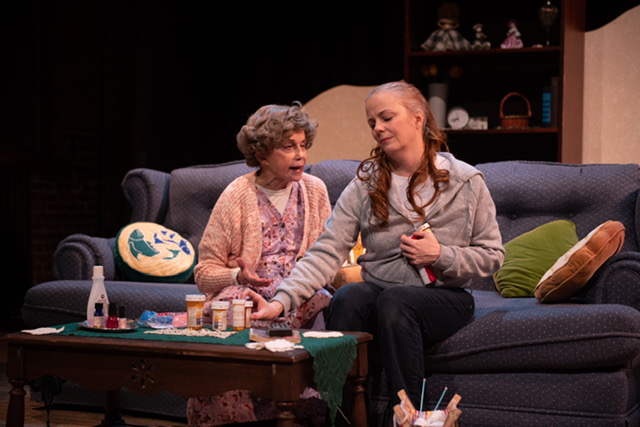
Photos courtesy of Renee Richman-Weisband

In ISIS Productions’ “Night, Mother” by Marsha Norman, Jessie makes the case with a singular clarity that she wants to end her life with dignity, even in a world without the resources to do so. By the end of the show I realized, this was her choice to make and not a choice that I have a place in passing judgement on.

It’s a typical Saturday night, and Thelma (Renee Richman-Weisband) is ready to have her nails manicured by her daughter Jessie (Kirsten Quinn). They have a routine, and at first, it seems like both people have settled into this comfortable domesticity. Suddenly, Jessie asks where’s Daddy’s gun and Thelma learns that Jessie plans to end her life. Over the course of 90 minutes it becomes clear that this decision is not rash, and her decision is resolute. There is no frenzy in her voice, Jessie is precise and purposeful as she explains to her disoriented mother why the decision to end her life is the right one.

The dialogue between this mother and daughter is unadorned. Jessie is very matter of fact as she lists out the mundane details behind the chores that she typically completes, that her mother will now have to manage. Jessie’s words, stripped down to its bare meaning communicates one thing: that she does not fear dying, but instead fears the sadness she must bear if she stays alive.

In this Neil Hartley directed production, the door leading to Jessie’s room takes center stage and provides the nail-biting tension that the dialogue sometimes lacks. The room is where Jessie plans on ending her life and its door is a threshold that Jessie is physically trying to cross, and Thelma is blocking with all her will. As the evening goes on, both move closer and closer to the door, a gravitational pull towards a decision that Jessie is steadfast in, and that Thelma cannot deter her from.

Richman-Weisband’s performance as Thelma is an ode to the caregivers of those who suffer from mental health issues. Richman-Weisband captures the growing desperation of a caregiver who has little left to give but wishes she could give more. But this desperation gives way to bullying as Thelma tries to inflict the same pain she feels herself by telling Jessie that she was considered the runt of the family. But she delivers these words without bite, bumbling through the insult and quickly realizing she didn’t mean what she said. Thelma is clearly grappling with the misunderstood low-hanging fruit of the situation: if her daughter wants to die then she must not be enough as a mother, a friend, as a support system.

Neither character is being fair to the other. It isn’t fair for the mother to assume that her wellbeing is reason enough for Jessie to stay alive and it isn’t fair for Jessie to ask Thelma to be a bystander in her suicide. It’s unfairness borne out of desperation and its heartbreaking to watch.

Jessie’s struggle with epilepsy sheds a light on a very common struggle with mental health faced by chronically ill people. Chronically ill individuals are at higher risk of experiencing depression, with an increased prevalence ranging from 9.3% to 25%, depending on which study you look at. Chronic symptoms, such as Jessie’s frequent seizures, can impact quality of life and lead to a sense of helplessness along with a low sense of self-worth.

“Night, Mother” won the Pulitzer Prize for Drama in 1983, 14 years before Physician Assisted Suicide (PAS) was legalized in Oregon, the first U.S, state to do so. Switzerland, Belgium and the Netherlands allow PAS where “the patient’s suffering must be unbearable with no prospect of improvement” also noting that “the suffering need not be related to a terminal illness and is not limited to physical suffering.” Jessie’s decision today now has a systemic solution to navigate through, despite all of its barriers. If Jessie was one of the few who get approved for PAS she could have been supported and facilitated by healthcare professionals, demonstrating the foresight that Marsha Norman had in her portrayal of suicide.

Personally, that is what makes Jessie’s suicide so horrifying. I did not question her decision but felt so pained to see her carry out that decision without the resources that could have made the process humane and dignified for both Thelma and Jessie.

Night Mother is on at Neighborhood House until March 27th. You can buy tickets here.

How Justen Ross Brought His Full Self As Pharus in “Choir Boy”

Interviews

Photo by Mark Gavin

Justen Ross currently plays Pharus in the Jeffrey L. Page directed production of “Choir Boy” at the Suzanne Roberts Theatre. Pharus is a student at Charles R. Drew Prep School for Boys, an institution with one mission: to ensure that all students obediently fit into an outdated conception of masculinity, which is readily enforced by Headmaster Morrow (Akeem Davis). The show focuses on five students who are in the school choir, led by Pharus, who is anointed as the best singer in the group.

This coming-of-age story centers on Pharus accepting his queerness and figuring out if he can express that side of himself while also still being a “Drew” man.  His classmates have decided that those two sides of Pharus cannot co-exist and are determined to make Pharus choose between the two.

I spoke with Ross to discuss the parts of himself he brought to his portrayal of Pharus. Our conversation was healing, and you can get tickets to his performance here. Choir Boy runs at the Suzanne Roberts Theatre until March 13th.

Read our conversation below:

Alexi Chacon (AC): When I saw the show, I noticed that there was a large emphasis on what it meant to be a “Drew” man, and how it was steeped in some regressive conceptions of masculinity. Do you find yourself challenging those same regressive, outdated forms of masculinity in your own day to day life outside of your character?

Justen Ross (JR): Absolutely. Growing up, my father was an assistant principal of a charter school named Charles R. Drew. I went to a Catholic high school, so I know what it’s like to be in an all-black, all male institution where piety is at the center of its values. It had a big influence on me, especially having a father figure like Headmaster Morrow play out in real life. I know what it’s like to constantly have that male gaze that oppressive dated, gaze of masculinity on you. I know what it’s like, and I am on my healing journey. Now, as a queer man, I’m figuring out what’s the value in being a man if there’s any.

Growing up, it was survival. You wear the Jordans’ and a hoodie and a hat. For me, that’s how I survived, instead of being loud with my crop top. That’s how I maintain my status and my safety within the community that I was brought up in. To this day, I still struggle with wanting to wear certain things and wanting to talk a certain way, but I have to keep my safety at the front of my mind. But as I’m healing, I’m learning that I’m beautiful the way that I am in whatever way I want to express myself. But it does take a little extra work to feel safe in those expressions.

AC: You brought so much of yourself into your portrayal of Pharus. How did you take care of yourself after a performance where you had to re integrate yourself into a prior mindset and then play out the worst outcome of navigating those really dangerous environments?

JR: Thank you, first of all, thank you for asking that. Theater has been co-opted by white supremacy in so many ways. And one of the ways that theatre has been co-opted is we as actors are taught how to prioritize warming up, but we aren’t taught how to prioritize warming down, and how to come out of something. So I appreciate you for asking that. When I was younger, I was more straight passing, and it was because I changed myself and I tweaked myself. When Headmaster Morrow says tighten up, I tightened up and I tightened up so tight, my muscles are tight, even now I’m struggling to release them from all the years of carrying that baggage of just sucking it in. So coming to the role of Pharus has been so liberating. There is a lot of myself in it. And I would say a lot of myself that has been lying dormant. This has been a process where I’ve been able find my voice truly and find out what the voice sounds like when it is loud and proud and warming down.

When I warm down I daydream a little bit and give  myself three things that Justin is grateful for in his life right now. So at the moment, I’m grateful for my mother in ballroom and how often she checks in. I’m grateful that my three friends who are here and staying with me. And I’m also grateful that I got through that show safely. That’s a little bit of what warming down looks like to me. And then I walk back into the world as Justin, and I feel safe, and my cast mates help with that. They’re just the best.

AC: I wanted to ask more about the cast as well, because in the play, within this group of students there are clear divisions based on homophobia despite their shared experiences as black boys. They’re so afraid to be emotionally intimate with each other. I assume that didn’t translate over to the friendships you developed as a cast. Tell me more about that. How did the rapport develop?

JR: I was doing the first the first week of rehearsal on Zoom. I was at home while all the boys were rehearsing in Philadelphia. I felt isolated from the boys in the same way that Pharus feels during the show. The moment I touched down in Philly, the boys said let’s meet up. And they asked if we could sing through some songs and just instantly the melody was like butter. When we were together it was like The Temptations or the Jackson Five, it was beautiful.

We hang out every night after the show, we watch movies together, we see other plays together, we go out to eat together, we share stories about our life, we are family, those are my brothers. It makes this show much easier because we have a lot of intimate moments on the stage, cursing slurs, intimate touch. And it makes it so much more comfortable because we all really love each other. And we’re invested in each other’s well-being offstage.

AC: I want to touch back on mentorship. It’s clear that Headmaster Morrow in this show both deeply cares and recognizes some of the best parts of Pharus. But, in an effort to protect Pharus also tears down aspects of himself that are integral to who Pharus is. It was painful to watch some of that mentorship, play out on stage. Can you tell me maybe about some positive mentors in your life that built you up, who recognized the best aspects of yourself and amplified them?

JR: I gotta give the trophy the black women in my life. My mother, my auntie, my Nana, my mentor, Jade Lambert Smith. The first person to tell me that I was enough was a black woman. The men in my life, they like to bring that structure and the realism in their guidance, they want to make things tangible. And the women in my life taught me how to dream. They taught me how to value myself and value things that I can’t see or can’t feel. That’s so important because in the show Pharus is having his dreams snatched from him, time, and time, and time again.

One person I’d like to highlight in particular is Jade Lambert Smith, acting coach, and teaching artist in Atlanta, Georgia. She is the reason that I’m here today. She’s the first person to tell me that I could do it. She trusted me. A lot of kids need that. She’s the reason for it all. I have about 1000 Moms Alexi and she’s one of them. Black women are my rock.

AC: It’s so important to, to dream, especially for communities of color, because to dream is an act of resistance. I have my own people who have taught me to dream and to not be afraid. I was going through the playbill, and I read that y’all have an Equity Diversity and Inclusion Officer and Intimacy Consultant, which I think is so critical to the topics being explored in this play. How did she make tangible changes in the show to make sure that everyone felt safe?

JR: I don’t know if we would feel as comfortable and as safe in the show if it was not for Miss Noelle. This black woman who came in and was the rock and held it down. What she did. She came in and made sure we were all in agreement on what our community guidelines were.  What do we expect from each other when we’re working on stage and off? What parts of our bodies are okay to touch? You can come to me, and I can share anonymously, if you ever have a problem with something. That was her job. And our director Jeffrey L. Page is somebody I love working with, but he can move really quick. Her job was to make sure that in the midst of all of that urgency, that we were moving at the speed of trust with one another, so that we don’t move too fast, slip up and harm one another. And if there was ever a day we were uncomfortable, she had a plan B for us. She’s so important.

AC: What’s next for you? What can we expect?

JR: I’ll be doing a short film with Donja R. Love, an amazing HIV-positive playwright, the first week of April. I think that’s all I can disclose. ‘m writing a television series/web series. It can be done in many mediums. I write poetry and I’ll be in Atlanta performing at poetry slams, and I’m also a ballroom girl so I’ll be practicing my voguing as part of the Juicy Couture Chapter in Atlanta.

Flaky Allyship and Bad Romance Co-Exist in “This Bitter Earth”

Reviews

Courtesy of Interact Theatre Company

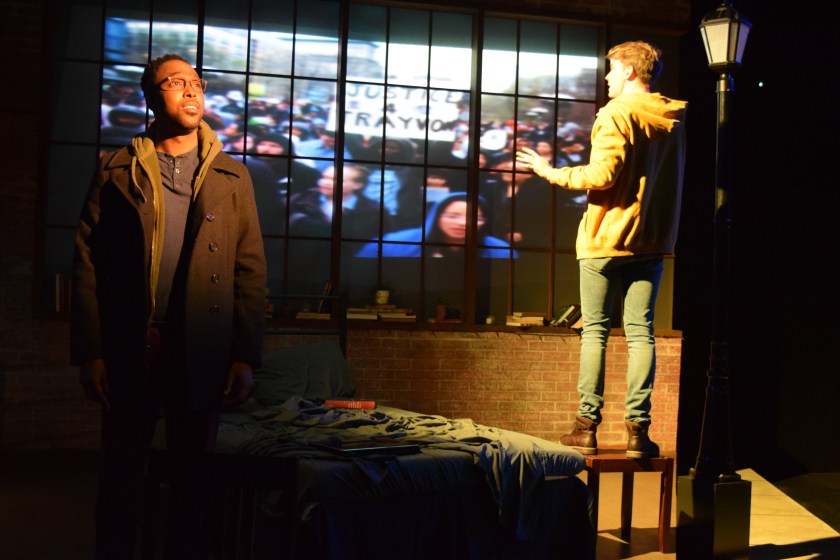
This Bitter Earth, Harrison David Rivers’ play directed by Tyrone L. Robinson, chronicles the labor of two men trying to make their interracial relationship work and leaves you questioning what allyship actually looks like.

The play opens with Jesse, a Black Ph.D. student from Kansas played by David Bazemore, delivering a monologue on his inability to keep his balance. Ready to knock him off his feet (and not necessarily in the good way) is his love interest Neil, played by Gabriel Elmore, an overeager, capital W, white man who’s ready to do the work of an ally.

Their relationship is backdropped by the near-constant slaughtering of Black men over the course of several years, starting in 2012. Each new murder throws Jesse and Neil into an interrogation of the racial politics at play within their own relationship. An unsurprising pattern quickly emerges as Neil overflows with white liberal hyperbolic outrage and Jesse quietly shoulders the weight of Blackness in America.

Neil already has a version in his head of how this relationship should work. He expects Jesse to be as outraged as he is, fired up and ready to protest the state of race relations in our society together as a couple. During the Ferguson uprisings, Neil packs his bags and hops in a van ready to help. When Jesse takes shelter by burrowing himself into his thesis writing, Neil demands more of him. More anger. More anguish. More despair. Neil demands a performance from Jesse.

Neil doesn’t understand that there is no correct way to react to trauma and there is no singular way to fight against your oppression. Jesse’s existence is a form of resistance. Being an ally does not mean making demands of people of color; allyship starts by listening and asking what one needs. This Bitter Earth is most effective when teasing out what ineffective allyship looks like. Beyond the cringiness of his virtue signaling, what keeps the play churning is the race between, whether Neil will learn how to actually be a better boyfriend (and ally) before Jesse leaves him.

Bazemore and Elmore really capture the emotional tension that swings back and forth between couples that are defined by their racial differences, rather than united by their shared experiences. When they laugh you hold your breath waiting for the unavoidable collision of their differing worldviews. When they fight you hope for them to make up quickly so that they can get back to laughing. It’s a feeling I’ve known all too well in some of my past relationships and friendships.

The moments of levity were far and few between the moments of racial tension. The unfortunate side effect is their exchanges feel sterile and academic. When Neil sleeps with another guy, Jesse wants to learn everything about the other guy. What is his favorite color? What is his favorite movie? How many siblings does he have? What do his parents do?

As the play was ending, I realized that I couldn’t fully answer those questions about Jesse or Neil either. Their relationship was so busy bearing the burden of American race relations that I did not get enough of the little details that reveal who they are or why they are together. I wanted to learn more about them; I wanted them to go beyond being personifications of Blackness and whiteness.

I walked out of This Bitter Earth reflecting on my own allyship to others as well as my connection to the allies in my life. I thought about the times I may have taken up too much space like Neil and the times I didn’t ask for what I needed like Jesse. I am comforted by the fact that unlike them, I am not confined to an 85-minute play and can invest in meaningful relationships a lifelong practice.

This Bitter Earth is available to stream through Interact Theatre from February 28th to March 13th.

Review: The Floor Wipers

Reviews
Courtesy of the Wilma Theater


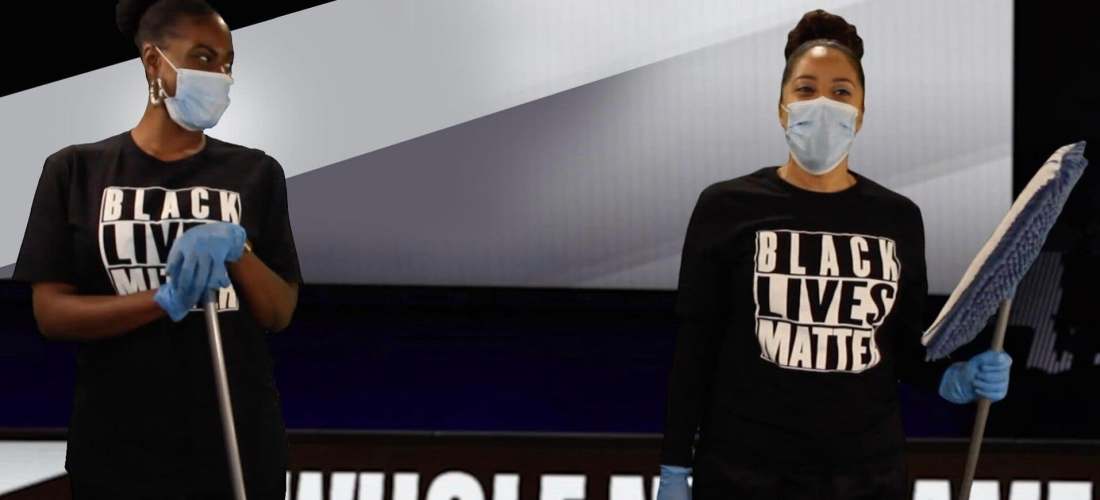
Taysha Marie Canales’ The Floor Wipers makes its debut as part of the Wilma’s HotHouse shorts series and illustrates friendship’s capacity for defusing even the most apocalyptic situations with humor.

The Wilma’s Hothouse company is made up of their resident artists who have the opportunity to develop and put on new works. They have put together a series of digital shorts that range in style, with some resembling music videos and others one-act plays. Floor Wipers is part of three digital shorts that are available to view for free.

The play is set in the NBA’s Covid Bubble during the 2020 playoffs with Jaylene Clark Owens and Marie Canales portraying floor wipers who are tasked with keeping the court’s floor clean from players’ sweat. Clark Owens’ character has “material girl” ambitions and is determined to find a new husband amongst the players. She even creates a “Player Compatibility Index” to rank which player is best suited to her taste. Marie Canales plays her counterpart, always ready to deliver the punch line that Clark Owens has set up for her.

The two floor wipers bond over the experience of finding refuge from the pandemic within their temporary bubble. If you’ve ever had a workplace bestie, you’ll likely appreciate the hi-jinks and antics they engage in on the courts. For example, Clark Owens’ instructions on wiping the floor with sex appeal brought to mind  the many ways that bored office workers―including myself―often enliven the monotony of their jobs. Other distractions include whining about receiving only one work T-shirt while joking that the “B” in NBA must stand for “budget.”

These moments brought to mind the ways that my own friends have elevated quibbles to epic scale as a tool for escaping the horror show of the ongoing pandemic. 

When Marie Canales and Clark Owens aren’t riffing off of each other, they are grappling with the dystopian world that they live in―the very same dystopia we inhabit. During the national anthem, they mention the players kneeling in protest. Clark Owens accidentally shows up to a game that is canceled because the Milwaukee Bucks are refusing to play in protest of the Jacob Blake shooting. At another game, both astutely note that “only the wealthy can survive this” pandemic.

However, because this is a bite-sized piece of theatre, their exploration of trauma feels hurried and unexplored. The floor wipers’ friendship is authentic and absolutely nourishing to watch, but I felt that they could have interrogated the trauma of their situation with more than passing remarks. Otherwise the dialogue seems more staged than poignant. I am left wondering what insightful dialogue they might have had outside of their work obligations or the show’s 15-minute time limit.

Near the end of Floor Wipers, Maria Canales reveals that she longs for an extra week or two in the bubble. That sudden acknowledgment of the calamities that are waiting for her in the outside world awakened me from the peace I’d found in her performance. It also brought to mind conversations I’ve had with good friends; moments that brought me to my own refuge. Perhaps that is The Floor Wipers’ point: cherished friendships are the real bubbles that protect us from the world. 


The Floor Wipers is available to watch through May 15th. Register for free here.

The Best Performances of 2021

Features

Kristina Wong of Sweatshop Overlord. Credit: Tom Fowler

When collecting a list of the “best” performances that have occurred in any given year, it’s important to remember that “The Great White Way” is nothing more than an expensive stretch of theatrical real estate and that theatre’s greatest performances occur far away from Manhattan’s midtown.

So even as “Broadway is back” was the constant clamor of the season, we mustn’t forget that business as usual demands that we look elsewhere when considering the highest quality. With that in mind, here are the 10 best NY performances that I was lucky enough to experience this year. The order is entirely random.

Romeo y Julieta

Co-produced by The Public Theatre and WNYC Studios

This was a continuation of director Saheem Ali’s experimentation with radio theatre as opposed to Zoom presentations in a time of COVID. Ali transformed the canceled live-version of Richard II in The Public’s first radio play last year. This Spring, working alongside Ricardo Pérez González, he adapted Alfredo Michel Modenessi’s text into a wonderful English and Spanish bilingual production of the oft-performed play that highlighted the sheer horniness of its characters.

Many productions of Romeo and Juliet strive to ennoble its characters. By contrast, Ali left me with the realization that most adults are foolish teenagers, driven more by our libidos than by any sense of logic. And just as relevantly, like never before, I was reminded that Romeo and Julieta are just kids who are trying to figure their stuff out in the midst of embryonic adults who are posturing as if they’ve got all of the answers.

The show is still available to experience on YouTube. Word of advice, use ear plugs, allow yourself to discern what the wonderfully performed Spanish text means through intuition, and close your eyes as the actors take you on a marvelous journey.


What to Send Up When It Goes Down

Presented at Brooklyn Academy of Arts, Fisher

“Black Lives Matter” is an easy slogan to say which may be why Alesha Harris used her play to confront audiences with the blunt truth behind the words: that Black lives would be prioritized and white fragility ignored. It’s rare to encounter a work of art that calls out systems of white supremacy for what they are while also centering Blackness for what it is: worthy and in need of no apologies. In What to Send Up When It Goes Down, there was nothing to apologize for, though there was much rejoicing in recognizing a world that stopped making excuses for state sanctioned brutality against Black bodies.

The show is a tribute to those who have been murdered by police violence as well as a testimony to Black people who have long been gaslit under the auspices of the idea that their discomfort is a natural part of living in these United States. Through song, dance, and vividly acted scenes which doubled back on themselves to deliver the salient point that nothing has really changed, Harris, director Whitney White, and their cast of multi-talented performers broke through that lie and asked audiences to hold onto the truth: we can be better, but only if we work to stop perpetuating the lie that default white superiority is the way things should be.

Read Maya Phillips’ review here.


Kristina Wong, Sweatshop Overlord.

Presented at New York Theatre Workshop

There’s a common saying that teaches one about community: “if you want to get somewhere fast, go alone. If you want to go the distance, take a team.” In her tribute to surviving the COVID-19 pandemic, Kristina Wong drew upon wisdom learned by activists from the AIDS epidemic of the 80s and 90s―to form a coalition of like-minded individuals to institute change―and recruited her own community of activist aunties from across the country who devoted themselves to sewing face masks for medical workers.

Sweatshop Overlord is a cheeky re-enactment of how her life ground to a standstill during the pandemic only to take on new meaning as her altruism transformed into an essential lifeline that brought her colleagues together. I could never imagine that I’d want to relive the crisis of 2020, but in Wong’s capable hands I was reminded that camaraderie is magnificent, particularly when it is pointed towards alleviating suffering rather than reveling in misery.

Read Joey Sims’ review here.


Nollywood Dreams

Presented at MCC Theatre

Jocelyn Bioh’s tribute to the burgeoning Nigerian Hollywood film industry (Nollywood) was brought to life under her frequent collaborator Saheem Ali’s piquant direction at MCC Theatre with a lively cast and star turn from the larger-than-life actress Abena, who plays an Oprah-esque talk show host.

Nollywood Dreams’ plot follows a young lady with dreams of stardom who meets cute with a handsome young star and chances upon the role of a lifetime after her older rival is suddenly incapacited. We’ve all seen this plot a million times before―indeed, it’s actually the plot of many a Nollywood dream. As always how we get there is all the fun, and in Bioh’s laugh every second script, it’s a riotously hilarious ride.

Read Vinson Cunningham’s astounding review at The New Yorker and if you’re able, order a copy of the script to read for yourself.


Twilight: Los Angeles, 1992.

Presented at Signature Theatre

Anna Deavere Smith interviewed scores of eyewitnesses to the Rodney King beating and riots that ensued to create a narrative that explored race and the unchecked power to brutalize anyone that police officers have been endowed with. In this revival of the searing work, she cast 6 actors to take on the roles that she once performed by herself.

Seeing the performers interact with each other imbued the work with a lustrous sense of community that eclipsed the wow factor of observing Smith morph from one characterization to another. As directed by Taibi Magar at The Signature Theatre, Twilight was messier and somehow less forgiving of the past that we all know has continued to repeat itself without even pretending to try to be better.

Read Helen Shaw’s review here.


Dana H.

Presented at Lyceum Theatre

Can lip syncing sustain an entire evening? It can if you’re Diedre O’Connell who embodies Dana Higginbotham’s harrowing tale of months long torture and rapes at the hands of her drug-addicted white-nationalist captor. This is a true story. O’Connell brings the story to life so flawlessly that even her jangling bracelets and opened envelopes are aligned with the audio interview of Higginbotham’s recollection that serves as the narrative of this piece.

The show follows Dana as she reveals the numerous ways that our system failed her, a white chaplain even as her tormentor openly abused her, which begs the questions: if this could happen to her, what hope do other marginalized people have? The likely answer to that frightening query is why Dana H. should be required viewing for anyone who aspires to join law enforcement; so that they can confront what occurs when they allow convenience to overtake saving lives.

Read my review here.


Lackawanna Blues

Presented at Friedman Theatre

Ruben Santiago-Hudson finally brings his one man show to Broadway, 20 years after it premiered at The Public Theatre. Lackawanna Blues offers the story of Santiago-Hudson’s upbringing in a boarding house that revolves around its dynamic proprietress, Nanny, who all but raised him and sacrificed herself to nurture her other tenants. Hudson plays all 20 characters with sui generis distinction to the point that the slightest lip protrusion or tilt of his hip becomes a clearly etched character.

As my colleague Bedati Choudhury brilliantly pointed out in her review, the play made “us yearn for a refuge that doesn’t quite exist. To, in turn, try and become that refuge because that is what our historical mothers have taught us.”

Read my review here.


Merry Wives of Windsor

Presented by Shakespeare in The Park at the Delacorte Theatre

Director Saheem Ali kicked off the return of major productions in New York with Jocelyn Bioh’s adaptation of Merry Wives by setting it among an African immigrant community in Harlem. The results? Pure comedic bliss. Most people know that the bard wrote the play to appease Queen Elizabeth and other fans of the lecherous character John Falstaff, whose untimely demise was mentioned in Henry V. What was an act of fan service for Shakespeare becomes a comedic blitz by proxy of African exultation in this production.

Last year, Ali told me that he and Bioh were dedicated to uplifting images of Africa so that they are seen as the highest standard rather than exoticized poverty. They continue to succeed perfectly with Merry Wives, all while making the play funnier than it has any right to be and without forcing prosperity politics down anyone’s throat. For a glimpse of how they pulled it off, watch the HBO documentary ‘Reopening Night’ which gives audiences a behind the scenes view of putting it together in a time of COVID.

Read Raven Snook’s review here.


Six

Presented by Brooks Atkinson Theatre

The six wives of Henry VIII gather for a reality television like competition in which they attempt to curry the audience’s favor with tales of whose life sucked the most. Except there’s a twist and a lesson to be won at the end of this fantastic women-helmed concert.

It’s rare to see as much feminine power on display as one is offered in SIX―particularly on Broadway.  Even the glorious onstage band is composed solely of women. The show is a reminder that the future is gloriously female and that the female of the species is deadlier than the male because she does not need his love. Best of all, rather than drown us in sorrow, these queens turn their travails into raucous tales of daffy delirium, all while astounding audiences with their rockstar vocals, killer dance moves, and ingenious costume changes.

Read Jose Solís’ review here.


Clyde’s

Presented at 2nd Stage Theatre

Lynne Nottage continues her study of the have-nots that she began in the Pulitzer prize-winning  Sweat with Clyde’s. Though in this instance, she tackles the carceral system as well by subverting formulaic tropes in a gut-busting comedy that gets to the root of how people who have already served their time remain all but enslaved even after their release.

It’s a bit of a hat trick on Nottage’s part in that she disguises the societal message within a sandwich shop that is run by the titular boss from hell, with an actual TV star (Uzo Aduba in glammed up hot bawdy mode) playing what should be a star part but is simply a featured catalyst here. It’s audacious and entirely successful because Nottage is that good at spinning entertaining yarms and delivering heart-felt goods.

Read my review here.


Bonus: NYC’s Top 10 Theatre Performers of 2021

  • Ruben Santiago-Hudson in Lackawanna Blues
  • Chuck Cooper in Trouble in Mind
  • Luke James in Thoughts of a Colored Man
  • Bonnie Milligan in Kimberly Akimbo
  • Abena in Nollywood Dreams
  • Pascale Armand in Merry Wives of Windsor
  • Susan Kelechi Watson in Merry Wives of Windsor
  • Francis Jue in Twilight: Los Angeles, 1992
  • Holden Hagelberger in Trevor: The Musical
  • Diedre O’Connell in Dana H.


The Visitor: A Case Study in White Savior Storytelling

Reviews, Uncategorized
Credit: The Public

In The Visitor, the new Tom Kitt scored musical that recently premiered at The Public Theatre, a white professor and Syrian refugee develop a friendship that feels more transactional than earnest. As framed by Brian Yorkey and Kwame Kwei-Armah’s book, the currency that drives their relationship is white savior antics that leave both characters poorer.

Walter (David Hyde Pierce), the show’s “hero”, begins the show in an emotional malaise due to the passing of his wife. Tarek (Ahmad Maksoud) strikes up a friendship with Walter and teaches him how to play the drums. As Walter begins to develop rhythm on the drums he also finds a new zest for life. Tarek is arrested for jumping a subway turnstile and faces certain deportation. Walter attempts to “save” Tarek from deportation and ultimately fails. Walter moves on with his life and decides to finish his book. In short, one family’s traumatic journey through the asylum-seeking process is framed as a set of checkpoints for a white man’s social and emotional awakening. 

Throughout the show, Walter is fed a steady supply of trauma porn to consume as a philosophical romp through his white privilege. At one point, Walter offers Zainab, Tarek’s partner, his apartment to stay the night. Zainab steadfastly refuses and provides an account of past sexual trauma that she has suffered. For the first time ever it seems, Walter is pensive over the sexual violence that women suffer at the hands of misogyny and white supremacy. This episode ends with Walter feeling pangs of white guilt before quickly moving on.

Even the driving force of the show, Tarek’s detention, is treated with this level of disregard. During a visit, Tarek drops all sense of agency despite being a long time survivor of American xenophobia and begs, “Walter get me out of here.” It is as if he has no other option for help but his new white friend. Indeed, Tarek’s actual support system is sidelined into an overzealously grateful ensemble to Walter’s magnanimity. 

Mouna, Tarek’s mother, who flies to New York after learning about Tarek’s arrest, is reduced to a damsel in distress who thanks Walter for just being there. A semi-flirtatious relationship arises between the two with Walter finding romance for the first time since his wife’s passing. This ignores Zainab’s earlier warning that  romantic propositions carry transactional weight when a white man holds all of the power. Though Walter is eager to revel in his white guilt, he does little to change himself or the system that he actually participates in.

As Alysha Deslorieux, in the show’s most believable performance, says through Zainab, “if the charity isn’t silent, then you are the charity.” If only the show had switched from its focus on Walter’s supposed charity to allow this message to actually resonate by giving equal time to other characters in The Visitor.

Instead, we are offered choreographed musical numbers with ICE agents that left one wondering if this was the best format to tell Tarek’s story. Far from entertaining, slant rhymes in a detention center coupled with the inhumane conditions that they are known for make light of the real trauma that refugees experience. Rather than address the power dynamics that accompany the asylum-seeking process, The Visitor sidelines its intricacies to elevate Walter’s finding a new sense of purpose by playing at being the hero. 

There is no place for white savior narratives in stories that purport to be about people of color. Previews for The Visitor were pushed back by a week in an effort to restructure the show’s representation of race. That was the right move, but it was clearly not enough. I hope that this musical is seen as a relic of pre-pandemic theatre and warns future theatre makers of the harm they can cause by investing theatre’s precious resources in the wrong stories.

Review: Pride and Prejudice (Civic Theatre)

Reviews
Credit: Civic Theatre

Bells are ringing on the snow-globe inspired stage of The Civic Theatre’s Pride and Prejudice, as young women assemble around a table filled with golden varieties of the instrument. Their fascination quickly turns into urgent, yet elegant, hoarding. A more composed young lady picks up a tiny, rather plain looking, bell almost left behind. She stares at it wishfully before she hides it in her pocket…

Hello, Lizzie. Long time, no see.

As this prologue, and its ringing, end the Bennets settle into their onstage home to a string quartet version of the 2019 electro-pop hit “Dance Monkey.” It’s the correct way to press all the right buttons for the 2021 Jane Austen lover.

Since the pandemic started, Austen has gained a particular kind of traction. The option to meet prospects face-to-face vanished, and dating seemed to regress to a more romantic (albeit physically distant) time. From funny to hopeful, memes, tweets and articles flourished on the subject. The phenomenon climaxed with the record-breaking Bridgerton, currently the most watched show in Netflix’s history. The series delves on the lives, and more-erotic-than-Austen, romantic hopes of young Britons in Regency London. It’s also set in the same year Pride and Prejudice takes place.

One of Bridgerton’s trademarks is the use of string versions of recognizable pop hits, like “Dance Monkey.” Their inclusion (alongside a dozen additional selections, including Ocean Away from the Bridgerton TikTok musical you didn’t know existed) makes the Civic a ten-thousand-pounds-a-year-worth winker to Austen contemporary audiences. It also shows how theatre can, and should, be part of multimedia storytelling universes, while still being just theatre.

The actors wear face masks that match their outfits and alternate in removing them for certain lines. The masks dangle as unobtrusively as grandma specs until they go on again. Anne Beck choreographed each movement following CDC procedures.

The stage is set up à la multi-camera sitcom, the play was recorded from the empty audience. Director Emily Rogge’s set-up makes it easy to stay invested in Kate Hamill’s adaptation, while occasionally focusing on specific details. The simplicity of the space and complementary pops of colors, from backdrop to wardrobe pieces, creates a captivating presentation.

The female actors easily dominate the stage. Megan Tiller does beautifully as Lizzie, with a precise Frankie Bolda as her best friend, Charlotte Lucas. The genuine warmth in their scenes feels the most Austen in the entire show. Bolda, also doubles as Mary Bennett. She’s one of six performers playing dual roles.

Jennifer Sims knows how to fully occupy the stage and Mrs. Bennet’s shoes. She does so in a boisterous manner that makes it quite easy to side with Darcy. Kelsey Vanvoorst fearlessly assumes the comedic relief as both Miss Bingley and Mr. Collins. Gender-bending a character like Mr. Collins is as fascinating as it is entertaining, but it doesn’t go beyond the blatant clashing of Austen’s usually inconspicuous brand of comedy.

Aside from Mr. Wickham, of course, the main enemy of this production is the use of a laugh track. For the Feb. 12th live stream, the track was “manned” by The Civic’s Executive Artistic Director, Michael Lasley, who introduced the tool to the audience and assured them that it would only be used in the parts he genuinely considered deserving of a laugh.

As a promoter of camaraderie, especially in socially distant environments, a laugh track is a great idea that needed a more democratic and, dare I say, female approach. There were worthy comedic moments that did not get the benefit of the track, while others, especially at the end of act two, were overindulged. But technicalities do little to overshadow the genuine charm of this Pride and Prejudice.

References:

  • Pride and Prejudice adapted by Kate Hamill from the Jane Austen novel. Streaming at the Civic Theatre.


‘American Dreams’ Asks: How Should We Fix Our Immigration System?

Features
Jens Rasmussen, Ali Andre Ali, Imran Sheikh, Andrew Aaron Valdez, and Leila Buck in “American Dreams.”

If you could describe Leila Buck’s play American Dreams in five words, it would be this: “C-SPAN as a game show!” said the show’s director Tamilla Woodard in a recent Zoom call.

This summation makes Buck laugh. “I grew up with Voice of America, which was mostly radio,” she explained. “It was what a lot of people all over the world heard. Some of it was great programming, and some of it was borderline propaganda. It was propagating an idea of what this country was. That for me was an inspiration [for American Dreams].” 

American Dreams is positioned as a game show created by the U.S. government. In it, three contestants compete for U.S. citizenship by answering questions about the government, and laying bare every single detail about their lives. The audience are active participants in the game show, helping interrogate each contestant and voting for which one they think most deserves that golden ticket.

In a time when political coverage and discourse has become a bloodsport, American Dreams forces audiences to think of the role they play in our democracy. And that even if certain issues, such as immigration, may not affect them personally, they still need to take an active role in being informed citizens.

“So many of us are immigrants,” said Buck. “We are children and descendants of immigrants, whether they were brought here by force or whether they came here willingly. The only people who get to not claim that identity are Native and Indigenous people.”

American Dreams was first performed live onstage in 2018 at Cleveland Public Theatre, after being developed by the Working Theatre in New York City, run by Woodard. It has now been retooled to be a live Zoom game show, and has been “touring” around the country since September. It started at Arizona State University, then has been hosted by a bevy of other venues—who all chipped in to produce the play. Its next date of performances is Nov. 10-15 at Marin Theatre Company in California (which really just means that the performance times will favor West Coast audiences).

One of the inspirations for the play was the legacy of immigration in Buck’s own family: her grandparents were refugees from Lebanon whose immigration journey wildly differed from Buck’s mother, who was able to get her green card through marrying Buck’s father. 

“My grandfather believed in our democracy, and then he came here and received the treatment of a man with an accent from an Arab country who was Muslim,” said Buck. “And it really broke his heart to not see what he believed about this country reflected back to him.”

Buck’s father was a foreign service officer who met Buck’s mother when he was stationed in Lebanon. Buck spent a large portion of her childhood abroad.

“All of those things really impacted my understanding of what it took and what people sacrificed and what people did to make new lives in this country,” she said. “And the very different impact that coming here could have on different people. And the very different ways that process could happen, depending who you were, and your circumstances, and the time in which you did it.”

American Dreams was developed over two years with Woodard, and a number of actors such as Jens Rasmussen, Imran Sheikh, and Osh Ghanimah—whose own immigration stories were incorporated into the final piece. It had its world premiere in 2018. Buck also performs in the show.

“American Dreams” when it was done onstage.

Then in early 2020, as theaters were shutting down, Woodard reached out to Buck about adapting American Dreams for Zoom. “There was a lot of work that was sort of like: stage shows that were being put up, ‘tune into the rehearsal that we taped,’ ‘watch this instead for theater,’” said Woodard. “I was just like, ahhh! This is so desperate.”

But the two of them realized that American Dreams, which depended on audience interaction, could replicate the feeling of watching a live show. For one, select audience members at every performance are invited to interact with the performers. Then the actors also ask the audience questions, and at certain moments, can see the audience. And, of course, everyone votes for who they want to become a citizen. It’s not the fact that the audience has to show up, which is the case for every Zoom theater experience, it’s that their presence is essential to the show itself, and that they need to be fully present for it. There’s no turning off your camera and switching over to another screen at American Dreams.

Also, the show has three different endings, depending on what the audience decides, so it encourages repeat viewings.

“What I miss is those things we used to do in person that forced us to be just where we are, to actually be fully just where we are,” said Buck. “Instead of all the things that we’re juggling because these screens and devices are our only mode of communication now. So that invitation to actually just be in the space fully for that 85 minutes, is something that people [audiences] have remarked on really needing.”

The Working Theater had made partnering with different organizations, and touring its shows across NYC, as part of its mission. But American Dreams is a bigger scale than its previous efforts—the play has been presented at six, going on seven, venues around the country. In total, 12 different theaters and organizations helped fund the tour.

According to Woodard, it started out as calls to her friends who ran theaters, and grew from there. “I know some people for whom this is exactly the kind of thing they want to do—those are the people I started with,” she said.

Even pre-COVID-19, this kind of tour for a non-commercial show was rare, mainly because of costs, and because the American theater ecosystem, according to Woodard, encourages competition and not collaboration. “That’s just taken over the American theater: competition and my subscribers and my patrons and my, my mys—rather than ours, ours, ours,” she said. 

With most theaters pivoting to creating online programming, as they see their bottom line dropping out, this kind of collaboration (and profit sharing) that American Dreams has pioneered shows that the only way the theater industry will survive is if everyone works together. 

Tamilla Woodard

“How do we take away the impulse to create systems of competition, so that we can actually, you know, live inside of environments of community building?” said Woodard. “This was one of those ways that we could do it, by saying, ‘Hey, you don’t have enough of any of this stuff? How about we all come together?’ And we just split the pie up? The more people here, the more beneficial it is, rather than the more people here, the less I get.”

Woodard said they’re working on adding one more week of performance, so that the actors in the show can qualify for health insurance under Actors’ Equity.

Over the past 5 years, as America has gone from the Obama Administration to the Trump Administration to now the Biden Administration, the immigration conversation (while it has become more xenophobic and destructive) has also remained something that not many Americans are aware of on a policy level. And it continues to be a conversation reduced to simple talking points, such as “build a wall” or “open all borders.” 

But to Buck, the truth lies somewhere in the middle, and she hopes the play gives people a more educated view of what it actually looks like to meet an immigrant and decide if they should be allowed to enter America. And if those parameters are flawed, how can they be changed.

“I have met people whose job it is to sit across from another human being and decide in three to five minutes, with a stack of papers, whether they believe this person to be a threat to others, and whether they might cause harm,” explained Buck. “And people have actually let people in and then been told that they actually did commit a crime. As open as they wanted to be, that impacted their decision-making process. And so what I wanted to do was to try to put the audience in a position where they couldn’t just say: ‘The system is bad. Or the system is good. Or we should let everyone in. Or we should build a wall.’ But actually reflect on: How am I participating? By paying my taxes, by who I vote for, what do I want this system to mean?”

Of course, there are some audience members who choose not to vote in the game show, such as in the performance I was at, because they didn’t think they should make a decision about someone else’s life. But to Woodard, inaction is also an action (just like when you vote in a real election). The play goes on regardless if you participate or not. And as the 2020 Election has shown all of us, democracy is fragile and can be broken if you don’t actively participate and fight for it.

“Our vote has consequences and in this play, it has consequences,” she said. “And if you don’t vote, the guy that you think that should win may not win, because you didn’t vote. Just like there are consequences to all of our actions, there are consequences to our decisions to be inactive. That’s what a democracy is.”

But American Dreams is not all doom and gloom. The show is funny, moving, tragic at times, and never loses sight of the humanity of everyone participating—actors and audiences alike. One of Buck and Woodard’s favorite parts of the show is when they ask this question to the audience: “What do you believe someone should have to PROMISE in order to be a citizen of this country?” 

The answers range from: “be loyal to the USA” to “don’t be a dick” to “bring their full selves and culture into this country” to “do your best every day to make the country a better place, however you define that.”

To Woodard and Buck, these promises are a testament to hope: the hope of the people who continue to want to come to America and start a new life, and the hope of the people living in it to create a more perfect union.

“It’s just a reminder of that dream that we hold in each of us,” said Buck.

Review: Cory, Smin, and a Broken Tropopause

Reviews
Credit: Suzi Sadler

Cory (Jordan Ho) and Smin (Jamie Lowenstein) are on the precipice of breaking up. The far away romance in Billy McEntee’s Cory and Smin’s Love Conquers the Earth, which had a brief run in director Charles Quittner’s Williamsburg backyard the weekend of October 16th, as ephemeral as it is intimate, is reaching the limit of its realistic sustainability. Not for lack of trying. New Jersey based Cory’s gestures towards solidifying their dynamic are met with reticence. A purchased plane ticket for Cali-bae Smin to spend the holidays with Cory hovers in the air; ready to drop to the pit of Cory’s stomach and weightless, maybe unimportant for Smin. Their online chats, pushing Cory past their curfew, are what they have to hold onto, this intangibility smarting of sharp irony, given their mutual dedication to environmental activism; the very importance of their exchanges with one another nonetheless burrowed into both of their hearts. 

Their desire for one another has become vine-like, wrapping itself around Cory’s sincere heart and, perhaps, Smin’s neck, maybe their sense of autonomy, too. I mean, these are high schoolers, still figuring out who they are, what they want to be, how they want to walk around in the world as themselves. Pretty precocious, too, their ambition for how to change the world and make it a better place, to ensure its continued existence, outsized from their adolescent access to resources. “I’ve been thinking about the ecological impact of our love,” begins Smin.

Environmental activism, once something that brought them together (as well as the musicals of Pasek and Paul), becomes shield and weapon; the plane ticket triggers doubts, and they bubble up in Smin’s mind, while Cory simmers across the country. Quittner has them never facing one another, staring out into a void, soundboards as keys to compensate. Smin, once fiery, in control, and curious (as seen in their scenes with Lime Rickey, played by Daphne Always with stunning humanity), stumbles, the prospect of confronting the reality of internet abetted affections destabilizing. Smin wields their environmental justice acumen waveringly. Excuses are made. The inequity of their affections is revealed. And then something breaks. 

“You just broke the tropopause,” Cory says, matter of factly. Cory’s optimism about their situation mutates, resigned not to what they once hope it was going to be like, draped in the anticipation and idealism of queer youth, seeped in the endless potential of whatever the internet and queerness in concert could hold, but in an immediacy of imagination that feels not like fiction but a kind of drag. 

You just broke the tropopause. A nice little nod to Harper, but without the solace. Cory’s once coquettish invitations become more forthright, a role-play of Smin on the plane en route to Jersey, but tinged with surreal eroticism. Cory authors a fantasy, presiding in an alluring and uncomfortable liminal space between potentially damaging the planet, to use their parlance, and possibly saving themselves, or maybe self-immolating. 

Credit: Derick Whitson

You just broke the tropopause. A broken-hearted brew of the world as it is, as it’s coming to be, and who Cory and Smin are, and who they could be. Cory narrates a could-be ending, Smin on the plane, Smin ordering water, Smin landing. Cory narrates the atmosphere around them, its fate paradoxically intertwined with and independent of the trajectory of their relationship. There’s a fragility to this fantasy: wrapped up in speculation of a future queer self, or a queer future period, but McEntee illustrates an unbecoming at the expense of becoming:

 “ozone gasping for air, no souls are flying no limbs akimbo no restoring of the cheesecloth it’s just dying molecules coughing and retching and it’s reverberating throughout the atmosphere and only you can see them and your plane is rattling”

It’s not the specificity of this scenario, wondrous and horrible, that arouses Smin necessarily. It’s the fact that Cory can see what Smin does. This dialogue hinges on disorientation and displacement, reorientation and replacement, that their connection to one another recontextualizes the very atmosphere’s topography. Even if it hasn’t happened, even if they’ve never been with one another in person, there is an undeniable insight into the way that Smin engages with the world around them that Cory understands intimately. However different the dynamic might be in person, Cory unearths the rawness and the core truth of both Smin’s longing and fear. And Cory, speaking feverishly, worries not about the projection or performance or artifice in this relationship, but loses themself in the telling, in the writing, in the fantasizing. 

When Smin climaxes, random articles of clothing fall from the air, recalling Xavier Dolan’s Laurence Anyways; gorgeous and soiled, luxury and detritus. Internet romances and perhaps queerness itself thrive in contradiction and ambiguity, in making artifice authentic again. If the world were to go down in flames from a flight for love, wouldn’t that be suiting? A death drive trying to make the intangible tactile, the performed material. Up in the air, together and apart, they’re far away, so close. 

How horrible that is. How lovely that is. They broke the tropopause.