Every week, the culture critics at Token Theatre Friends bring their fresh perspectives to the performing arts on their podcast and video series. You can find the podcast on Spotify, iTunes, and Stitcher (look for the all-red logo). The video series is available on YouTube. The TTF theme song is by Sean Mason (with vocals by Angela Ramos). The video animation is by Brad Ogden, with logos by Jason Simon.
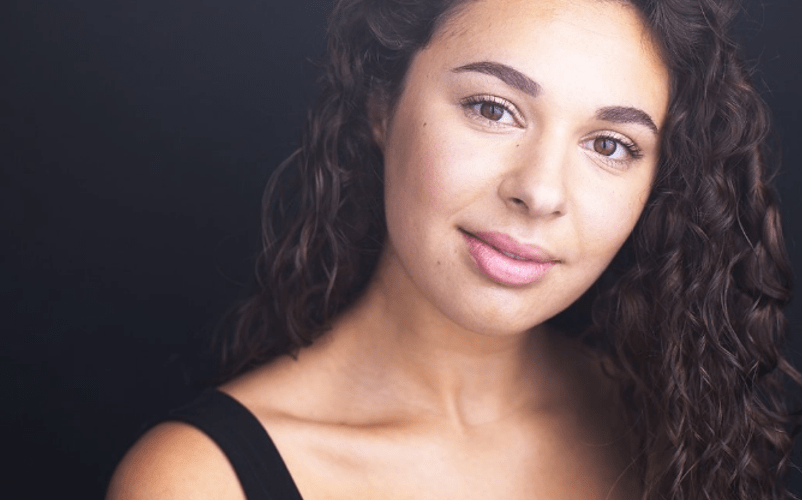
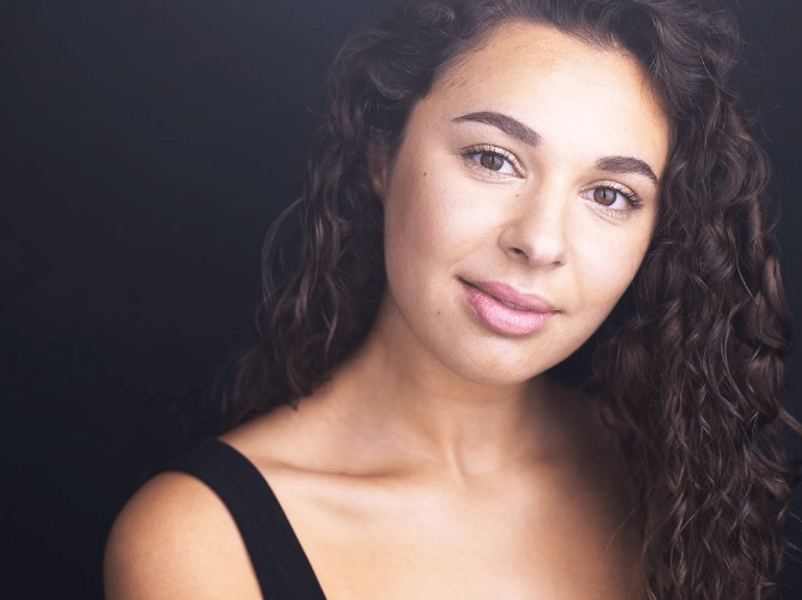
In this episode, Jose speaks with recording artist/actor Mia Pinero. Pinero is currently starring in Dipika Guha’s Yoga Play at PlayMakers Repertory in Chapel Hill, North Carolina. The actor speaks about what draws her to the characters she plays.
Mia Pinero in “Yoga Play.” Credit: Michael Sparks
Later this spring, Pinero will release her first solo album. Growing Up is a collection of songs that showcase Pinero’s eclectic tastes and interests. From Childish Gambino, to Sondheim, and John Mayer, Pinero’s melodious voice takes the listener on a journey from her childhood to today.
She explained how she came up with a setlist that fulfilled her needs while paying tribute to the people she loves the most. Pinero will celebrate the album’s release by doing a special performance at Feinstein’s/54 Below.
Every week, the culture critics at Token Theatre Friends bring their fresh perspectives to the performing arts on their podcast and video series. You can find the podcast on Spotify, iTunes, and Stitcher (look for the all-red logo). The video series is available on YouTube. The TTF theme song is by Sean Mason (with vocals by Angela Ramos). The video animation is by Brad Ogden, with logos by Jason Simon.
In this episode, Jose speaks with playwright Jonathan Payne and director Martin Boross about Addressless. In the digital experience, attendees play a game where they learn about the many causes/consequences of housing insecurity.
Boross first staged the show in his native Hungary, where he leads the revolutionary troupe STEREO AKT. Payne joined the project in its transfer to the United States, the two collaborated transatlantically via Zoom and share what that experience was like.
Every week, the culture critics at Token Theatre Friends bring their fresh perspectives to the performing arts on their podcast and video series. You can find the podcast on Spotify, iTunes, and Stitcher (look for the all-red logo). The video series is available on YouTube. The TTF theme song is by Sean Mason (with vocals by Angela Ramos). The video animation is by Brad Ogden, with logos by Jason Simon.
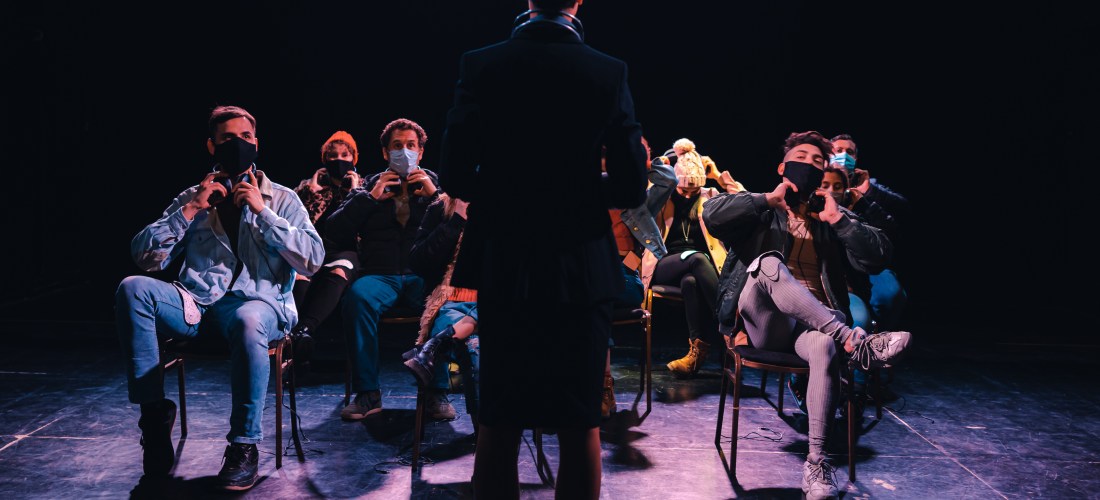
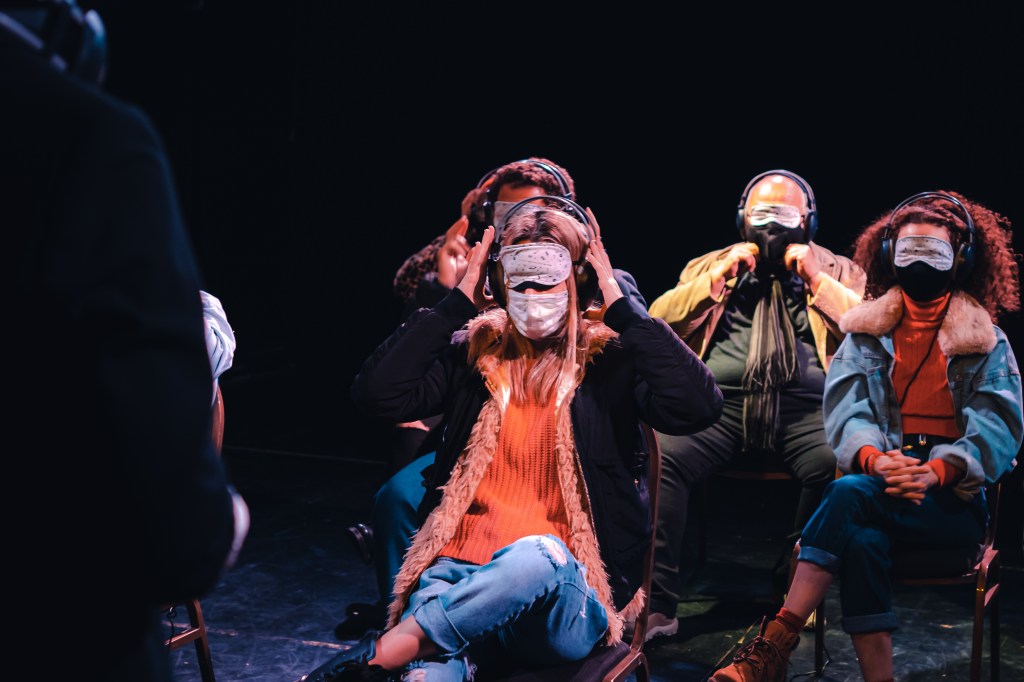
In this episode, Jose speaks with playwright Martín Bondone and dramaturg Carlos Armesto about Odd Man Out. The site-specific/international co-production takes place in complete darkness, audience members are blindfolded and experience the story of Alberto, a blind artist traveling to Argentina.
Armesto and Bondone talk about their backgrounds and how they found their way into making theater, as well as the importance of creating works that defy expectations of what a play should be like.
Taysha Marie Canales’ The Floor Wipers makes its debut as part of the Wilma’s HotHouse shorts series and illustrates friendship’s capacity for defusing even the most apocalyptic situations with humor.
The Wilma’s Hothouse company is made up of their resident artists who have the opportunity to develop and put on new works. They have put together a series of digital shorts that range in style, with some resembling music videos and others one-act plays. Floor Wipers is part of three digital shorts that are available to view for free.
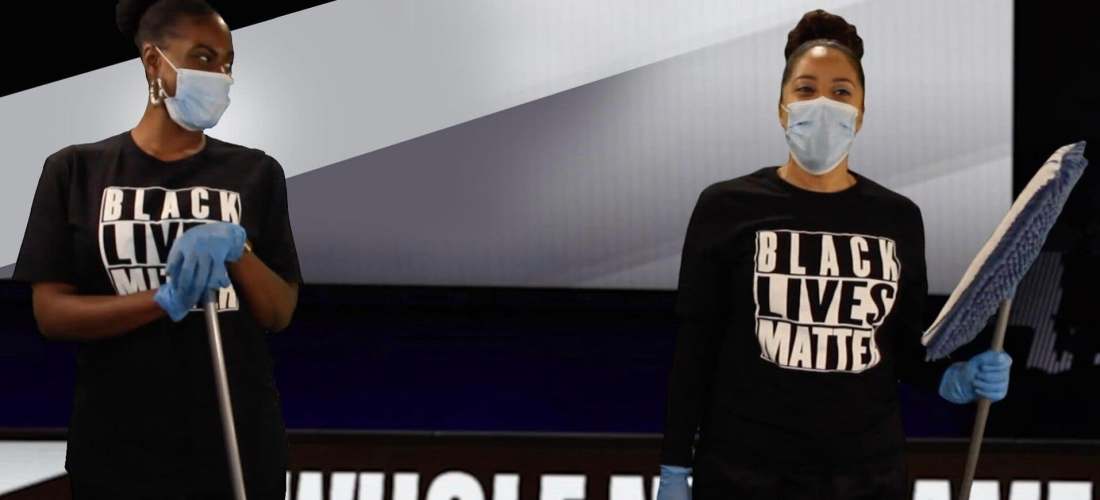
The play is set in the NBA’s Covid Bubble during the 2020 playoffs with Jaylene Clark Owens and Marie Canales portraying floor wipers who are tasked with keeping the court’s floor clean from players’ sweat. Clark Owens’ character has “material girl” ambitions and is determined to find a new husband amongst the players. She even creates a “Player Compatibility Index” to rank which player is best suited to her taste. Marie Canales plays her counterpart, always ready to deliver the punch line that Clark Owens has set up for her.
The two floor wipers bond over the experience of finding refuge from the pandemic within their temporary bubble. If you’ve ever had a workplace bestie, you’ll likely appreciate the hi-jinks and antics they engage in on the courts. For example, Clark Owens’ instructions on wiping the floor with sex appeal brought to mind the many ways that bored office workers―including myself―often enliven the monotony of their jobs. Other distractions include whining about receiving only one work T-shirt while joking that the “B” in NBA must stand for “budget.”
These moments brought to mind the ways that my own friends have elevated quibbles to epic scale as a tool for escaping the horror show of the ongoing pandemic.
When Marie Canales and Clark Owens aren’t riffing off of each other, they are grappling with the dystopian world that they live in―the very same dystopia we inhabit. During the national anthem, they mention the players kneeling in protest. Clark Owens accidentally shows up to a game that is canceled because the Milwaukee Bucks are refusing to play in protest of the Jacob Blake shooting. At another game, both astutely note that “only the wealthy can survive this” pandemic.
However, because this is a bite-sized piece of theatre, their exploration of trauma feels hurried and unexplored. The floor wipers’ friendship is authentic and absolutely nourishing to watch, but I felt that they could have interrogated the trauma of their situation with more than passing remarks. Otherwise the dialogue seems more staged than poignant. I am left wondering what insightful dialogue they might have had outside of their work obligations or the show’s 15-minute time limit.
Near the end of Floor Wipers, Maria Canales reveals that she longs for an extra week or two in the bubble. That sudden acknowledgment of the calamities that are waiting for her in the outside world awakened me from the peace I’d found in her performance. It also brought to mind conversations I’ve had with good friends; moments that brought me to my own refuge. Perhaps that is The Floor Wipers’ point: cherished friendships are the real bubbles that protect us from the world.
The Floor Wipers is available to watch through May 15th. Register for free here.
Every week, the culture critics at Token Theatre Friends bring their fresh perspectives to the performing arts on their podcast and video series. You can find the podcast on Spotify, iTunes, and Stitcher (look for the all-red logo). The video series is available on YouTube. The TTF theme song is by Sean Mason (with vocals by Angela Ramos). The video animation is by Brad Ogden, with logos by Jason Simon.
In this episode, Jose speaks to world renowned soprano Laquita Mitchell. This month she stars in On Site Opera’s Lesson Plan, an adaptation of Georg Philipp Telemann’s Der Schulmeister which takes place on Zoom.
During the pandemic, in addition to performing, Mitchell has hosted a series of conversations with artists and thinkers she admires, which in addition to being a delight, are often enlightening. Mitchell spoke about what she’s learned, seen, and heard during the last two years, and briefly touched on upcoming projects.
Every week, the culture critics at Token Theatre Friends bring their fresh perspectives to the performing arts on their podcast and video series. You can find the podcast on Spotify, iTunes, and Stitcher (look for the all-red logo). The video series is available on YouTube. The TTF theme song is by Sean Mason (with vocals by Angela Ramos). The video animation is by Brad Ogden, with logos by Jason Simon.
In this episode, Jose speaks to playwright Mike Lew and actor Gregg Mozgala about Teenage Dick. The high-school-set play is a hilarious adaptation of Richard III in which Mozgala plays the title Dick, a young man who exacts revenge on those who have bullied and mocked him for his cerebral palsy.
Lew and Mozgala talk about returning to the stage, how they found humor in one of the Bard’s darkest plays, and what it means to be a working parent in theater.
This production of Teenage Dick is a co-production between Woolly Mammoth Theatre Co., Huntington Theatre Co., and The Pasadena Playhouse (where it will be streaming from Feb. 1 – 17)
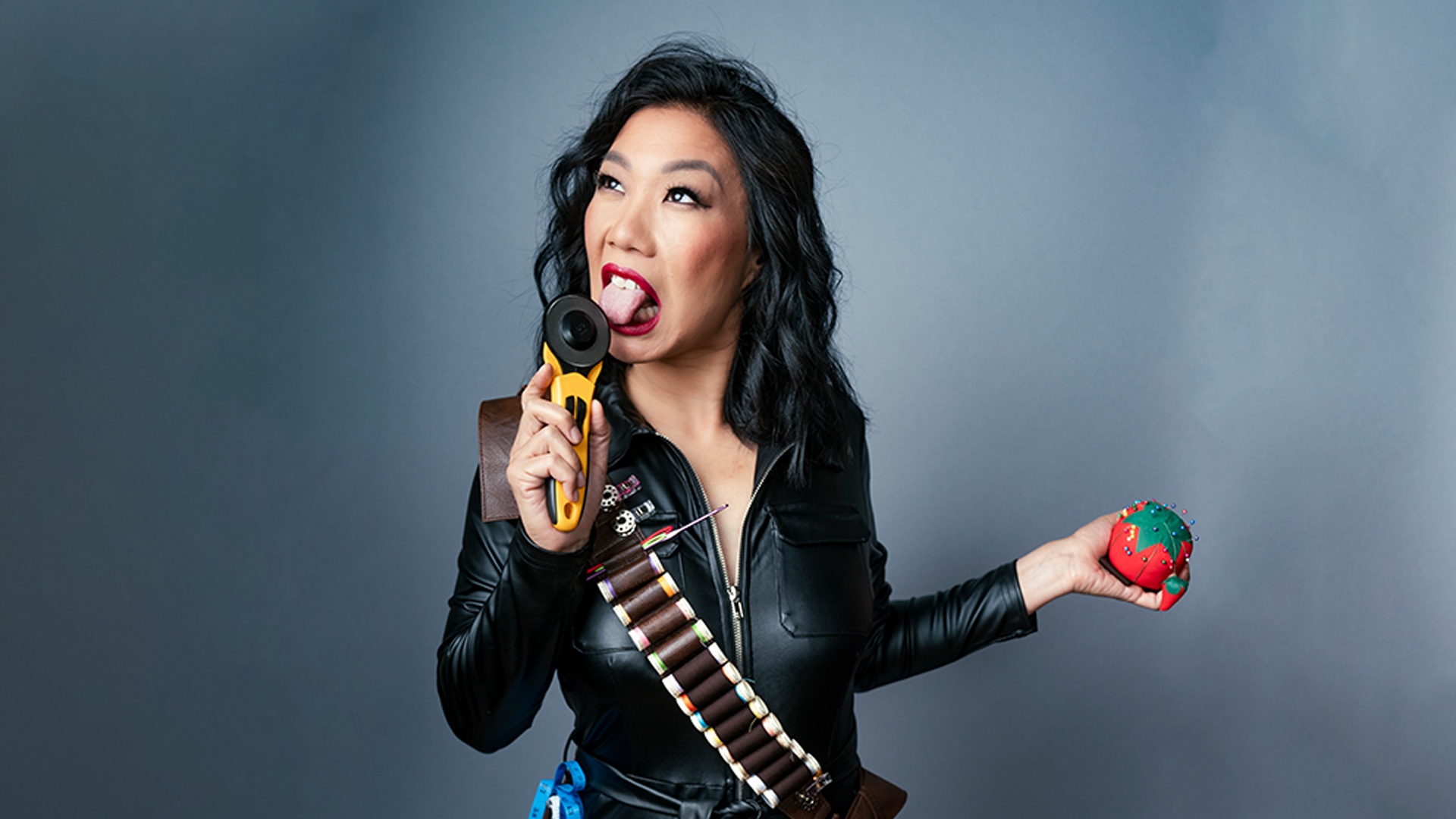
Kristina Wong of Sweatshop Overlord. Credit: Tom Fowler
When collecting a list of the “best” performances that have occurred in any given year, it’s important to remember that “The Great White Way” is nothing more than an expensive stretch of theatrical real estate and that theatre’s greatest performances occur far away from Manhattan’s midtown.
So even as “Broadway is back” was the constant clamor of the season, we mustn’t forget that business as usual demands that we look elsewhere when considering the highest quality. With that in mind, here are the 10 best NY performances that I was lucky enough to experience this year. The order is entirely random.
Romeo y Julieta
Co-produced by The Public Theatre and WNYC Studios
This was a continuation of director Saheem Ali’s experimentation with radio theatre as opposed to Zoom presentations in a time of COVID. Ali transformed the canceled live-version of Richard II in The Public’s first radio play last year. This Spring, working alongside Ricardo Pérez González, he adapted Alfredo Michel Modenessi’s text into a wonderful English and Spanish bilingual production of the oft-performed play that highlighted the sheer horniness of its characters.
Many productions of Romeo and Juliet strive to ennoble its characters. By contrast, Ali left me with the realization that most adults are foolish teenagers, driven more by our libidos than by any sense of logic. And just as relevantly, like never before, I was reminded that Romeo and Julieta are just kids who are trying to figure their stuff out in the midst of embryonic adults who are posturing as if they’ve got all of the answers.
The show is still available to experience on YouTube. Word of advice, use ear plugs, allow yourself to discern what the wonderfully performed Spanish text means through intuition, and close your eyes as the actors take you on a marvelous journey.
What to Send Up When It Goes Down
Presented at Brooklyn Academy of Arts, Fisher
“Black Lives Matter” is an easy slogan to say which may be why Alesha Harris used her play to confront audiences with the blunt truth behind the words: that Black lives would be prioritized and white fragility ignored. It’s rare to encounter a work of art that calls out systems of white supremacy for what they are while also centering Blackness for what it is: worthy and in need of no apologies. In What to Send Up When It Goes Down, there was nothing to apologize for, though there was much rejoicing in recognizing a world that stopped making excuses for state sanctioned brutality against Black bodies.
The show is a tribute to those who have been murdered by police violence as well as a testimony to Black people who have long been gaslit under the auspices of the idea that their discomfort is a natural part of living in these United States. Through song, dance, and vividly acted scenes which doubled back on themselves to deliver the salient point that nothing has really changed, Harris, director Whitney White, and their cast of multi-talented performers broke through that lie and asked audiences to hold onto the truth: we can be better, but only if we work to stop perpetuating the lie that default white superiority is the way things should be.
There’s a common saying that teaches one about community: “if you want to get somewhere fast, go alone. If you want to go the distance, take a team.” In her tribute to surviving the COVID-19 pandemic, Kristina Wong drew upon wisdom learned by activists from the AIDS epidemic of the 80s and 90s―to form a coalition of like-minded individuals to institute change―and recruited her own community of activist aunties from across the country who devoted themselves to sewing face masks for medical workers.
Sweatshop Overlord is a cheeky re-enactment of how her life ground to a standstill during the pandemic only to take on new meaning as her altruism transformed into an essential lifeline that brought her colleagues together. I could never imagine that I’d want to relive the crisis of 2020, but in Wong’s capable hands I was reminded that camaraderie is magnificent, particularly when it is pointed towards alleviating suffering rather than reveling in misery.
Jocelyn Bioh’s tribute to the burgeoning Nigerian Hollywood film industry (Nollywood) was brought to life under her frequent collaborator Saheem Ali’s piquant direction at MCC Theatre with a lively cast and star turn from the larger-than-life actress Abena, who plays an Oprah-esque talk show host.
Nollywood Dreams’ plot follows a young lady with dreams of stardom who meets cute with a handsome young star and chances upon the role of a lifetime after her older rival is suddenly incapacited. We’ve all seen this plot a million times before―indeed, it’s actually the plot of many a Nollywood dream. As always how we get there is all the fun, and in Bioh’s laugh every second script, it’s a riotously hilarious ride.
Anna Deavere Smith interviewed scores of eyewitnesses to the Rodney King beating and riots that ensued to create a narrative that explored race and the unchecked power to brutalize anyone that police officers have been endowed with. In this revival of the searing work, she cast 6 actors to take on the roles that she once performed by herself.
Seeing the performers interact with each other imbued the work with a lustrous sense of community that eclipsed the wow factor of observing Smith morph from one characterization to another. As directed by Taibi Magar at The Signature Theatre, Twilight was messier and somehow less forgiving of the past that we all know has continued to repeat itself without even pretending to try to be better.
Can lip syncing sustain an entire evening? It can if you’re Diedre O’Connell who embodies Dana Higginbotham’s harrowing tale of months long torture and rapes at the hands of her drug-addicted white-nationalist captor. This is a true story. O’Connell brings the story to life so flawlessly that even her jangling bracelets and opened envelopes are aligned with the audio interview of Higginbotham’s recollection that serves as the narrative of this piece.
The show follows Dana as she reveals the numerous ways that our system failed her, a white chaplain even as her tormentor openly abused her, which begs the questions: if this could happen to her, what hope do other marginalized people have? The likely answer to that frightening query is why Dana H. should be required viewing for anyone who aspires to join law enforcement; so that they can confront what occurs when they allow convenience to overtake saving lives.
Ruben Santiago-Hudson finally brings his one man show to Broadway, 20 years after it premiered at The Public Theatre. Lackawanna Blues offers the story of Santiago-Hudson’s upbringing in a boarding house that revolves around its dynamic proprietress, Nanny, who all but raised him and sacrificed herself to nurture her other tenants. Hudson plays all 20 characters with sui generis distinction to the point that the slightest lip protrusion or tilt of his hip becomes a clearly etched character.
As my colleague Bedati Choudhury brilliantly pointed out in her review, the play made “us yearn for a refuge that doesn’t quite exist. To, in turn, try and become that refuge because that is what our historical mothers have taught us.”
Presented by Shakespeare in The Park at the Delacorte Theatre
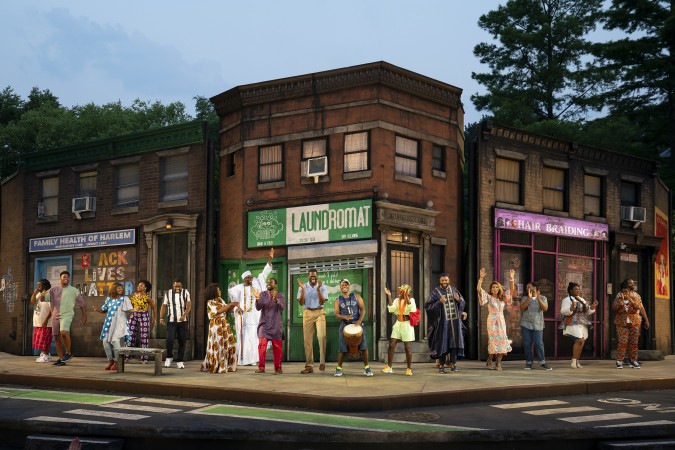
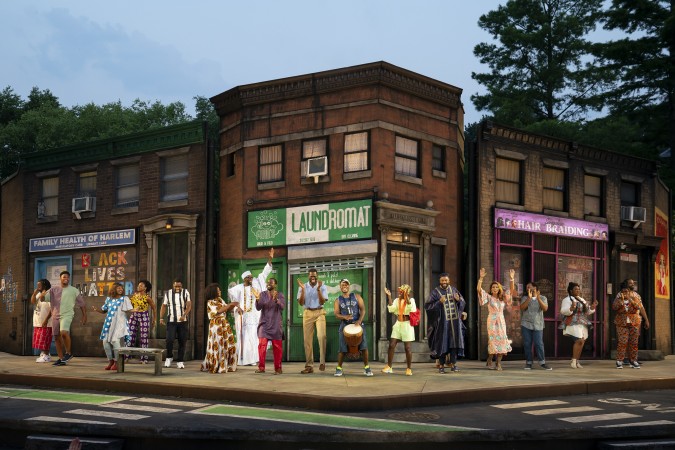
Director Saheem Ali kicked off the return of major productions in New York with Jocelyn Bioh’s adaptation of Merry Wives by setting it among an African immigrant community in Harlem. The results? Pure comedic bliss. Most people know that the bard wrote the play to appease Queen Elizabeth and other fans of the lecherous character John Falstaff, whose untimely demise was mentioned in Henry V. What was an act of fan service for Shakespeare becomes a comedic blitz by proxy of African exultation in this production.
Last year, Ali told me that he and Bioh were dedicated to uplifting images of Africa so that they are seen as the highest standard rather than exoticized poverty. They continue to succeed perfectly with Merry Wives, all while making the play funnier than it has any right to be and without forcing prosperity politics down anyone’s throat. For a glimpse of how they pulled it off, watch the HBO documentary ‘Reopening Night’ which gives audiences a behind the scenes view of putting it together in a time of COVID.
The six wives of Henry VIII gather for a reality television like competition in which they attempt to curry the audience’s favor with tales of whose life sucked the most. Except there’s a twist and a lesson to be won at the end of this fantastic women-helmed concert.
It’s rare to see as much feminine power on display as one is offered in SIX―particularly on Broadway. Even the glorious onstage band is composed solely of women. The show is a reminder that the future is gloriously female and that the female of the species is deadlier than the male because she does not need his love. Best of all, rather than drown us in sorrow, these queens turn their travails into raucous tales of daffy delirium, all while astounding audiences with their rockstar vocals, killer dance moves, and ingenious costume changes.
Lynne Nottage continues her study of the have-nots that she began in the Pulitzer prize-winning Sweat with Clyde’s. Though in this instance, she tackles the carceral system as well by subverting formulaic tropes in a gut-busting comedy that gets to the root of how people who have already served their time remain all but enslaved even after their release.
It’s a bit of a hat trick on Nottage’s part in that she disguises the societal message within a sandwich shop that is run by the titular boss from hell, with an actual TV star (Uzo Aduba in glammed up hot bawdy mode) playing what should be a star part but is simply a featured catalyst here. It’s audacious and entirely successful because Nottage is that good at spinning entertaining yarms and delivering heart-felt goods.
Every week, the culture critics at Token Theatre Friends bring their fresh perspectives to the performing arts on their podcast and video series. You can find the podcast on Spotify, iTunes, and Stitcher (look for the all-red logo). The video series is available on YouTube. The TTF theme song is by Sean Mason (with vocals by Angela Ramos). The video animation is by Brad Ogden, with logos by Jason Simon.
In this episode Jose speaks to playwright Jocelyn Bioh and director Saheem Ali, who star in the documentary Reopening Night (available on HBOMax from Dec. 20). The film by Rudy Valdez follows the talented troupe led by Bioh and Ali who brought back Shakespeare in the Park following the Covid-19 theater shutdown.
Bioh and Ali look back at their thrilling summer and reflect on how their artistry has been informed by the pandemic and share their wishes for theater in 2022.
Every week, the culture critics at Token Theatre Friends bring their fresh perspectives to the performing arts on their podcast and video series. You can find the podcast on Spotify, iTunes, and Stitcher (look for the all-red logo). The video series is available on YouTube. The TTF theme song is by Sean Mason (with vocals by Angela Ramos). The video animation is by Brad Ogden, with logos by Jason Simon.
In this episode, Jose speaks to actor Ilda Mason, who is making her big screen debut in Steven Spielberg’s sumptuous retelling of West Side Story. Mason talks about how she ended up starring in four different versions of the beloved musical, as well as her upbringing in Panamá.
Mason is also an artist in residence at Abingdon Theatre Company and spoke about the joy she feels when she is collaborating with other artists.
In The Visitor, the new Tom Kitt scored musical that recently premiered at The Public Theatre, a white professor and Syrian refugee develop a friendship that feels more transactional than earnest. As framed by Brian Yorkey and Kwame Kwei-Armah’s book, the currency that drives their relationship is white savior antics that leave both characters poorer.
Walter (David Hyde Pierce), the show’s “hero”, begins the show in an emotional malaise due to the passing of his wife. Tarek (Ahmad Maksoud) strikes up a friendship with Walter and teaches him how to play the drums. As Walter begins to develop rhythm on the drums he also finds a new zest for life. Tarek is arrested for jumping a subway turnstile and faces certain deportation. Walter attempts to “save” Tarek from deportation and ultimately fails. Walter moves on with his life and decides to finish his book. In short, one family’s traumatic journey through the asylum-seeking process is framed as a set of checkpoints for a white man’s social and emotional awakening.
Throughout the show, Walter is fed a steady supply of trauma porn to consume as a philosophical romp through his white privilege. At one point, Walter offers Zainab, Tarek’s partner, his apartment to stay the night. Zainab steadfastly refuses and provides an account of past sexual trauma that she has suffered. For the first time ever it seems, Walter is pensive over the sexual violence that women suffer at the hands of misogyny and white supremacy. This episode ends with Walter feeling pangs of white guilt before quickly moving on.
Even the driving force of the show, Tarek’s detention, is treated with this level of disregard. During a visit, Tarek drops all sense of agency despite being a long time survivor of American xenophobia and begs, “Walter get me out of here.” It is as if he has no other option for help but his new white friend. Indeed, Tarek’s actual support system is sidelined into an overzealously grateful ensemble to Walter’s magnanimity.
Mouna, Tarek’s mother, who flies to New York after learning about Tarek’s arrest, is reduced to a damsel in distress who thanks Walter for just being there. A semi-flirtatious relationship arises between the two with Walter finding romance for the first time since his wife’s passing. This ignores Zainab’s earlier warning that romantic propositions carry transactional weight when a white man holds all of the power. Though Walter is eager to revel in his white guilt, he does little to change himself or the system that he actually participates in.
As Alysha Deslorieux, in the show’s most believable performance, says through Zainab, “if the charity isn’t silent, then you are the charity.” If only the show had switched from its focus on Walter’s supposed charity to allow this message to actually resonate by giving equal time to other characters in The Visitor.
Instead, we are offered choreographed musical numbers with ICE agents that left one wondering if this was the best format to tell Tarek’s story. Far from entertaining, slant rhymes in a detention center coupled with the inhumane conditions that they are known for make light of the real trauma that refugees experience. Rather than address the power dynamics that accompany the asylum-seeking process, The Visitor sidelines its intricacies to elevate Walter’s finding a new sense of purpose by playing at being the hero.
There is no place for white savior narratives in stories that purport to be about people of color. Previews for The Visitor were pushed back by a week in an effort to restructure the show’s representation of race. That was the right move, but it was clearly not enough. I hope that this musical is seen as a relic of pre-pandemic theatre and warns future theatre makers of the harm they can cause by investing theatre’s precious resources in the wrong stories.







 Token Theatre Friends