‘American Dreams’ Asks: How Should We Fix Our Immigration System?

Features
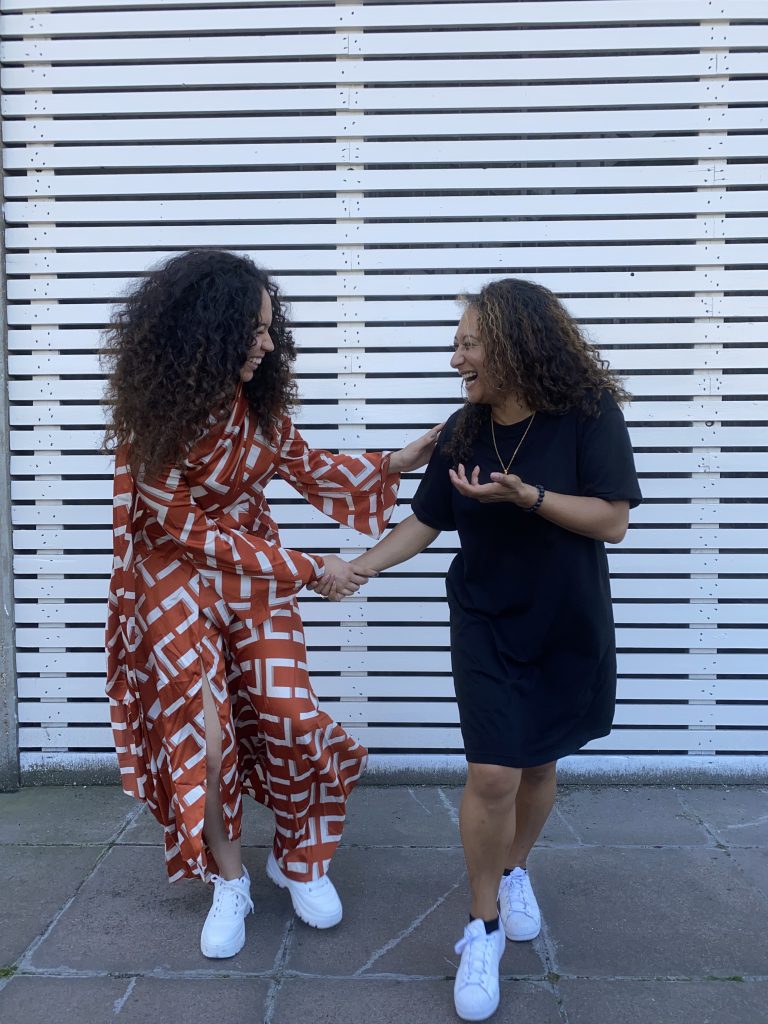
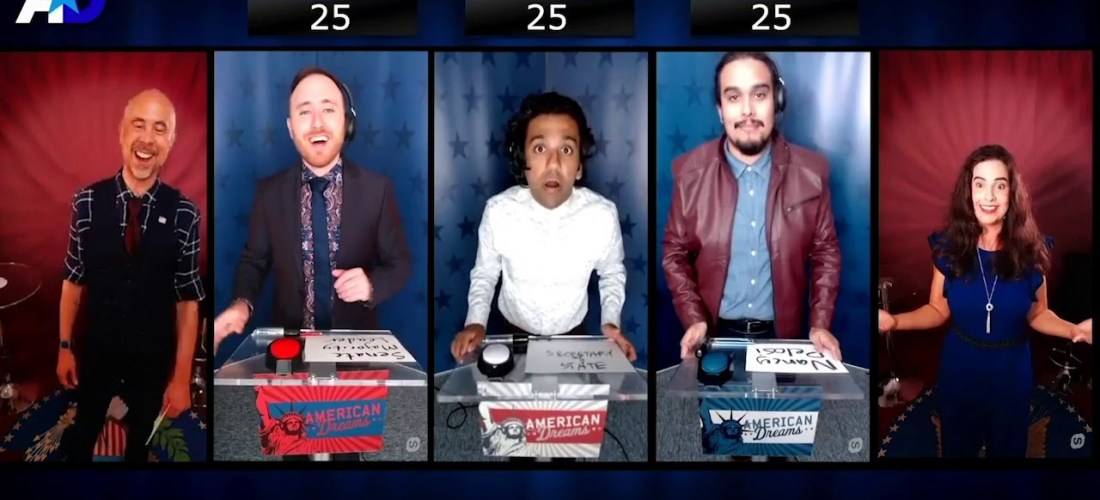
Jens Rasmussen, Ali Andre Ali, Imran Sheikh, Andrew Aaron Valdez, and Leila Buck in “American Dreams.”

If you could describe Leila Buck’s play American Dreams in five words, it would be this: “C-SPAN as a game show!” said the show’s director Tamilla Woodard in a recent Zoom call.

This summation makes Buck laugh. “I grew up with Voice of America, which was mostly radio,” she explained. “It was what a lot of people all over the world heard. Some of it was great programming, and some of it was borderline propaganda. It was propagating an idea of what this country was. That for me was an inspiration [for American Dreams].” 

American Dreams is positioned as a game show created by the U.S. government. In it, three contestants compete for U.S. citizenship by answering questions about the government, and laying bare every single detail about their lives. The audience are active participants in the game show, helping interrogate each contestant and voting for which one they think most deserves that golden ticket.

In a time when political coverage and discourse has become a bloodsport, American Dreams forces audiences to think of the role they play in our democracy. And that even if certain issues, such as immigration, may not affect them personally, they still need to take an active role in being informed citizens.

“So many of us are immigrants,” said Buck. “We are children and descendants of immigrants, whether they were brought here by force or whether they came here willingly. The only people who get to not claim that identity are Native and Indigenous people.”

American Dreams was first performed live onstage in 2018 at Cleveland Public Theatre, after being developed by the Working Theatre in New York City, run by Woodard. It has now been retooled to be a live Zoom game show, and has been “touring” around the country since September. It started at Arizona State University, then has been hosted by a bevy of other venues—who all chipped in to produce the play. Its next date of performances is Nov. 10-15 at Marin Theatre Company in California (which really just means that the performance times will favor West Coast audiences).

One of the inspirations for the play was the legacy of immigration in Buck’s own family: her grandparents were refugees from Lebanon whose immigration journey wildly differed from Buck’s mother, who was able to get her green card through marrying Buck’s father. 

“My grandfather believed in our democracy, and then he came here and received the treatment of a man with an accent from an Arab country who was Muslim,” said Buck. “And it really broke his heart to not see what he believed about this country reflected back to him.”

Buck’s father was a foreign service officer who met Buck’s mother when he was stationed in Lebanon. Buck spent a large portion of her childhood abroad.

“All of those things really impacted my understanding of what it took and what people sacrificed and what people did to make new lives in this country,” she said. “And the very different impact that coming here could have on different people. And the very different ways that process could happen, depending who you were, and your circumstances, and the time in which you did it.”

American Dreams was developed over two years with Woodard, and a number of actors such as Jens Rasmussen, Imran Sheikh, and Osh Ghanimah—whose own immigration stories were incorporated into the final piece. It had its world premiere in 2018. Buck also performs in the show.
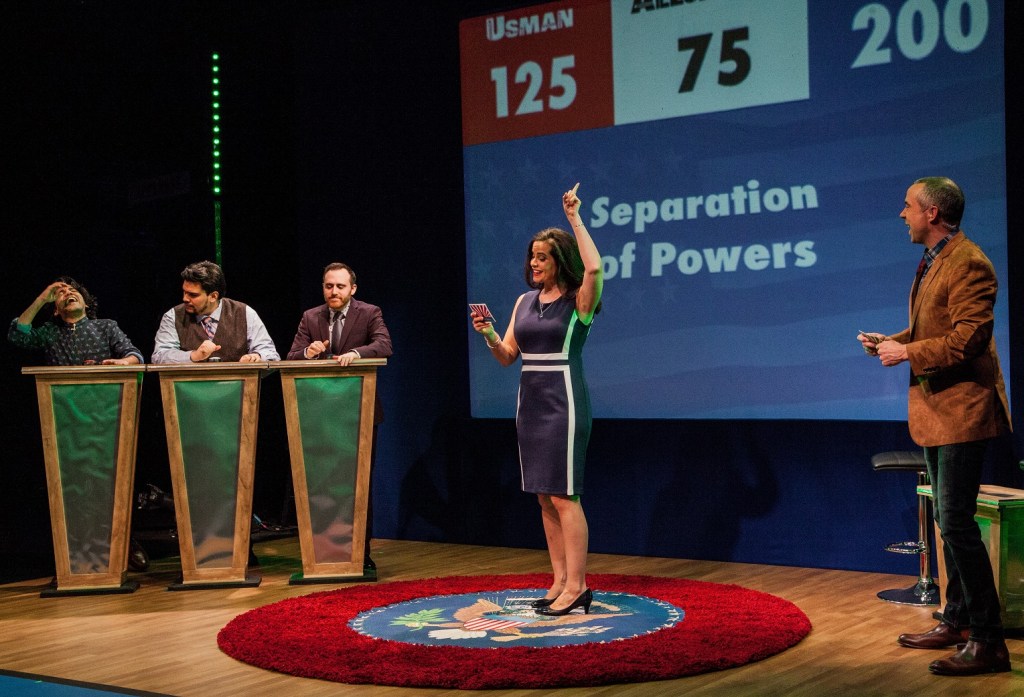
“American Dreams” when it was done onstage.

Then in early 2020, as theaters were shutting down, Woodard reached out to Buck about adapting American Dreams for Zoom. “There was a lot of work that was sort of like: stage shows that were being put up, ‘tune into the rehearsal that we taped,’ ‘watch this instead for theater,’” said Woodard. “I was just like, ahhh! This is so desperate.”

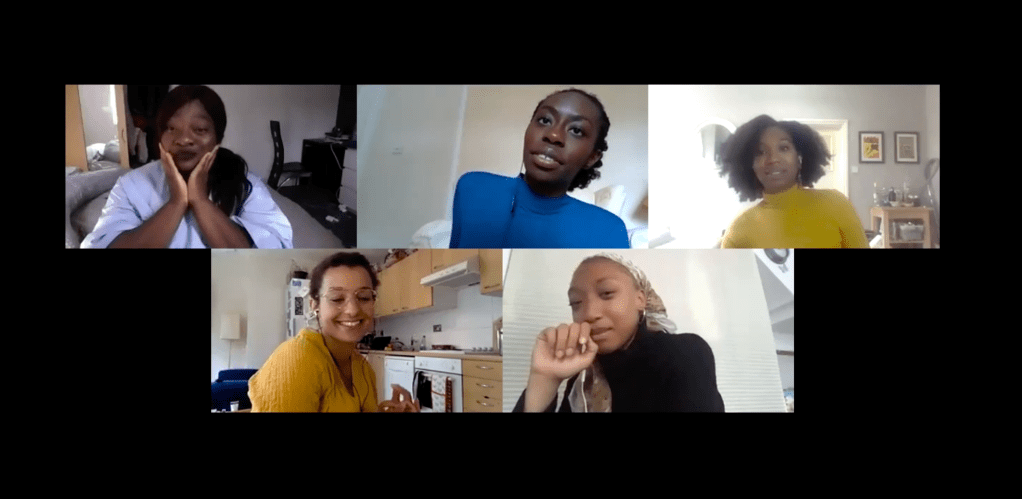
But the two of them realized that American Dreams, which depended on audience interaction, could replicate the feeling of watching a live show. For one, select audience members at every performance are invited to interact with the performers. Then the actors also ask the audience questions, and at certain moments, can see the audience. And, of course, everyone votes for who they want to become a citizen. It’s not the fact that the audience has to show up, which is the case for every Zoom theater experience, it’s that their presence is essential to the show itself, and that they need to be fully present for it. There’s no turning off your camera and switching over to another screen at American Dreams.

Also, the show has three different endings, depending on what the audience decides, so it encourages repeat viewings.

“What I miss is those things we used to do in person that forced us to be just where we are, to actually be fully just where we are,” said Buck. “Instead of all the things that we’re juggling because these screens and devices are our only mode of communication now. So that invitation to actually just be in the space fully for that 85 minutes, is something that people [audiences] have remarked on really needing.”

The Working Theater had made partnering with different organizations, and touring its shows across NYC, as part of its mission. But American Dreams is a bigger scale than its previous efforts—the play has been presented at six, going on seven, venues around the country. In total, 12 different theaters and organizations helped fund the tour.

According to Woodard, it started out as calls to her friends who ran theaters, and grew from there. “I know some people for whom this is exactly the kind of thing they want to do—those are the people I started with,” she said.

Even pre-COVID-19, this kind of tour for a non-commercial show was rare, mainly because of costs, and because the American theater ecosystem, according to Woodard, encourages competition and not collaboration. “That’s just taken over the American theater: competition and my subscribers and my patrons and my, my mys—rather than ours, ours, ours,” she said. 

With most theaters pivoting to creating online programming, as they see their bottom line dropping out, this kind of collaboration (and profit sharing) that American Dreams has pioneered shows that the only way the theater industry will survive is if everyone works together. 
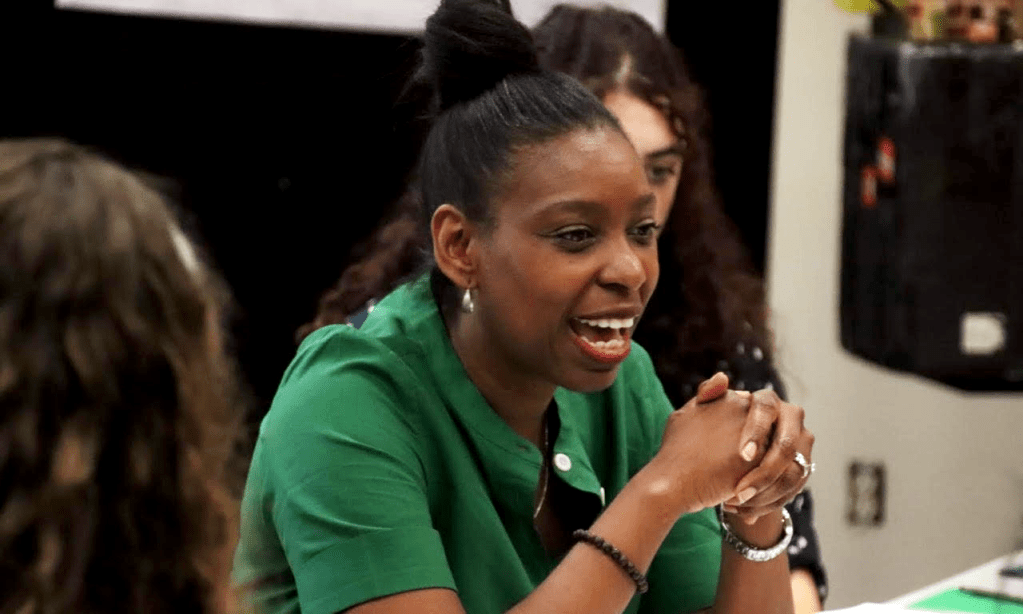
Tamilla Woodard

“How do we take away the impulse to create systems of competition, so that we can actually, you know, live inside of environments of community building?” said Woodard. “This was one of those ways that we could do it, by saying, ‘Hey, you don’t have enough of any of this stuff? How about we all come together?’ And we just split the pie up? The more people here, the more beneficial it is, rather than the more people here, the less I get.”

Woodard said they’re working on adding one more week of performance, so that the actors in the show can qualify for health insurance under Actors’ Equity.

Over the past 5 years, as America has gone from the Obama Administration to the Trump Administration to now the Biden Administration, the immigration conversation (while it has become more xenophobic and destructive) has also remained something that not many Americans are aware of on a policy level. And it continues to be a conversation reduced to simple talking points, such as “build a wall” or “open all borders.” 

But to Buck, the truth lies somewhere in the middle, and she hopes the play gives people a more educated view of what it actually looks like to meet an immigrant and decide if they should be allowed to enter America. And if those parameters are flawed, how can they be changed.

“I have met people whose job it is to sit across from another human being and decide in three to five minutes, with a stack of papers, whether they believe this person to be a threat to others, and whether they might cause harm,” explained Buck. “And people have actually let people in and then been told that they actually did commit a crime. As open as they wanted to be, that impacted their decision-making process. And so what I wanted to do was to try to put the audience in a position where they couldn’t just say: ‘The system is bad. Or the system is good. Or we should let everyone in. Or we should build a wall.’ But actually reflect on: How am I participating? By paying my taxes, by who I vote for, what do I want this system to mean?”

Of course, there are some audience members who choose not to vote in the game show, such as in the performance I was at, because they didn’t think they should make a decision about someone else’s life. But to Woodard, inaction is also an action (just like when you vote in a real election). The play goes on regardless if you participate or not. And as the 2020 Election has shown all of us, democracy is fragile and can be broken if you don’t actively participate and fight for it.

“Our vote has consequences and in this play, it has consequences,” she said. “And if you don’t vote, the guy that you think that should win may not win, because you didn’t vote. Just like there are consequences to all of our actions, there are consequences to our decisions to be inactive. That’s what a democracy is.”

But American Dreams is not all doom and gloom. The show is funny, moving, tragic at times, and never loses sight of the humanity of everyone participating—actors and audiences alike. One of Buck and Woodard’s favorite parts of the show is when they ask this question to the audience: “What do you believe someone should have to PROMISE in order to be a citizen of this country?” 

The answers range from: “be loyal to the USA” to “don’t be a dick” to “bring their full selves and culture into this country” to “do your best every day to make the country a better place, however you define that.”

To Woodard and Buck, these promises are a testament to hope: the hope of the people who continue to want to come to America and start a new life, and the hope of the people living in it to create a more perfect union.

“It’s just a reminder of that dream that we hold in each of us,” said Buck.

How Can We Get the Arts Some Bailout Money?

Features
Photo by Kevin Bidwell on Pexels.com

Recently, the advocacy group Be An Arts Hero was trying to get a meeting with Alaska Senator Lisa Murkowski about why there needs to be a federal bailout for the arts. Suffice it to say, it was not going well. “Her person got back in touch with us and was like, ‘Oh, you know, it’s not a big deal up here.’” said Carson Elrod, one of the cofounders of Be An Arts Hero, an independent non-profit advocacy group.

But the group was undeterred. Said Elrod: “We wrote back and we said, ‘Well, it’s this many tens of thousands of jobs. It’s this many billions of dollars contributed to Alaska’s GSP. And these are organizations that are positioned to fail that are vulnerable. And this is what’s at stake.’ And her economic policy person got back in touch with us and said, ‘I’d like to talk to you guys right away.’”

The group was able to have an hour-long conversation with Murkowski’s senior policy counsel Anne McInerny who told them, as Elrod recalled: “Well, your argument is unimpeachable. What you’re saying is that 4.5% of the GDP has been left out of the relief conversation, and you want to be put into it.” 

The fact that Murkowski was willing to listen to them proved a point that the group was making: “There is no state where arts and culture doesn’t employ tens of thousands people and provide billions of dollars of economic value,” said Elrod. And a way to get politicians to care about the arts is to lobby for it in those terms. Simple, right? Not really.

Be An Arts Hero was founded this past July, by three out-of-work theater actors (Brooke Ishibashi, Jenny Makholm, and Elrod) who were seeing their industry shut down before their eyes with no plan of re-opening. It was originally a social media campaign, to publicly advocate for an arts bailout in America. 

According to the U.S. Bureau of Economic Analysis, the creative sector (this includes live performance, Hollywood, musicians, visual arts, artisans, etc.) is responsible for employing 5.1 million people, provides $877 billion value added to the economy, and makes up 4.5% of GDP. According to Be An Arts Hero, the arts “adds more value than transportation, agriculture, or tourism.”

The COVID-19 pandemic has led to a loss of 2.7 million arts jobs (and counting). And theater and live performance in particular was the first industry to shut down and will be the last industry to reopen. 

Speaking as someone who lost her arts job because of this pandemic, I have been frustrated, along with other arts people, about the lack of attention this has been given by Congress and the public at large. Granted, that frustration is just the cherry on top of the multitude of debilitating feelings of anger and grief the Trump Administration has caused.

Meanwhile, countries like Germany and the United Kingdom have provided $50 billion and $1.5 billion, respectively, to their arts industries during the pandemic. Granted, these are countries that are also giving their residents monthly stipends during the pandemic because unlike the U.S., they don’t have a Republican party who would rather take away people’s healthcare during a pandemic than pass more federal relief.

This lack of attention to the arts sector can be seen as a lack of care overall from Congress. After all, restaurants are also in a similar dire state as the arts, and there’s no bailout coming for them anytime soon. 

Recently, a number of lobbying groups from the Broadway League, and the recently created National Independent Venue Association, successfully lobbied the House of Representations to fold the Save Our Stages Act into its HEROES Act.

Save Our Stages would provide “grants to eligible live venue operators, producers, promoters, or talent representatives to address the economic effects of the COVID-19.” The grants can go up to $12 million and can be used for payroll costs, rent, utilities, and personal protective equipment.

Granted, SOS and HEROES is basically in stasis unless the Democrats successfully take back the Senate on Nov. 3.

Other lobbying groups, such as Theatre Communications Group (where I used to work) and Actors’ Equity Association, helped lobby for freelancers to be eligible for unemployment benefits as part of the CARES Act—a majority of arts workers are freelance. And a number of groups have been lobbying Congress for the HEROES Act, which would provide another stimulus check to Americans, and additional unemployment money. 

It seems like in the Senate, these pleas are falling on deaf ears. 

At the same time, given the dire state of the arts currently, there is a remarkable lack of urgency from artistic producers. 

The head of the Broadway League, which contains around 800 members, Charlotte St. Martin told Broadway News that while the League was campaigning for SOS, the bill “certainly doesn’t save us, because we’re not going to die.” As Broadway News put it, “[Martin] said, it would help support the industry as it works to rebuild audiences.”

Those words seem very out-of-touch with the present moment when 2.7 million arts workers are unemployed, and tens of thousands are losing their health insurance. Even during a pandemic, the arts ecosystem is still divided between the haves and the have nots. 

“There were portions of this business that are still operating under the same gatekeeper paradigm, as though it were business as usual,” said Makholm of Be An Arts Hero. “As though the house wasn’t literally on fire, and we’re just trying to pass buckets to each other of water.”

And it is because the people who control the industry are those with money, who do not feel this recession as deeply as the independent contractors, technicians, artisans, assistants, and other people whose earnings from the arts afford them a middle-class lifestyle. 

Which means when producers go to Congress to lobby, they are only only lobbying for their sector. SOS mainly benefits producers and venue owners. They do not benefit the independent contractors who make up a majority of the industry. No wonder, as Washington Post critic Peter Marks puts it in one tweet, “The [Broadway] League has been told by its DC lobbyists—one Democratic, one Republican—not to mention Broadway in their efforts to secure help. Lawmakers hear it and think, rich people.” 

Because the people lobbying for that relief are rich people looking to primarily bail out their relatively privileged friends. 

“Everybody’s kind of only looking out for themselves,” said Makholm. “And I don’t blame them, because that’s born of decades of disenfranchisement and defunding. So it’s not as though they’re coming at it from a selfish impulse. It’s just that when you have been systemically defunded, over the course of multiple decades, you have to get into survival mode in order to survive.”

That’s why I’ve found the Be An Arts Hero team so inspiring, because they’re actively strategizing outside of the box. For one, they are rank-and-file arts workers who are independent contractors, who don’t belong to a theater or a Broadway show. 

They are also super visible. Their Instagram has over 18,000 followers. They got a bunch of Broadway actors to perform a song from RENT in Times Square and the video got over 80,000 views.

And since their founding, they’ve met with around 60 Congressional senators. They are now a 501(c)(4) called Arts Workers United and can take donations. Not bad for a movement that’s not even six months old. 

But more importantly, they’re trying to bring together the fragmented parts of the arts industry, different groups who are all lobbying for their own small piece of the pie, to come together and lobby for a large pie that will benefit everyone. It’s not just about getting a celebrity involved. It’s about everyone (especially those who work in the arts) shouting that the arts are not made by elites, that the arts are valuable, that the work is actually labor, and those that make it need help. 

Or to use another corollary. When the airline industry was asking for a bailout, it wasn’t asking on behalf of its CEOs or executives. The airlines, along with the unions that represent workers, centered pilots, flight attendants, and other workers. It said that if Congress did not give them those funds, they would be forced to lay people off. And the industry got $25 billion bailout, and a majority of that money had to go to payroll. 

While SOS is asking for $10 billion, Be An Arts Hero thinks the ask should be higher, in proportion to the need of the industry and the people in it, but also the economic value it has. Said Ishibashi: 

“We’re asking for $43.85 billion dollars because we’re advocating for the entire arts and culture sector. I think it becomes a tricky conversation of divisiveness. I think everyone kind of silos off into different compartments and departments. And it seems to us that we may be the first ones who’ve come along to say: Hi, why don’t we rally the troops and provide a collective or a unified front, so that we’re mobilizing everyone under the arts and culture sector together? And wouldn’t that be so much more effective if we all go to Congress as a unit and say, give us a blanket amount that will cover everyone? Instead of these 16 different frickin’ bills that are just lying in a heap collecting dust in Congress right now, because they don’t know what to do with it.”

That model has some precedence. Over the summer, the Oregon Shakespeare Festival successfully lobbied to a $50 million arts relief package from the state of Oregon. And they didn’t do it alone. “This is not something that could have been accomplished without the coming together [of a] coalition of arts organizations around the state,” said OSF marketing manager CJ Martinez. “The responsibility and the relevance and the inherent connection between the Ashland community and OSF, and the responsibility for not just that community but the economics of the whole southern region of Oregon, I think, also played a role in the consideration that OSF was given.”

If the arts want to show that they are not for the elites and that arts workers are not part of the elites, then those workers need to be placed at the forefront of any campaign for support. And how much money arts workers make, what their lives are actually like, and how hard they are struggling right now, need to be part of the bailout narrative. 

At the very least, all of these lobbying efforts need to be a lot more visible publicly. Those who do arts lobbying tend to work behind the scenes, and the process is invisible unless you’re in the literal rooms where they happen. But what it those conversations were also happening publicly?

If the arts sector can focus on getting out the vote in advance of the election, and fundraising for Joe Biden and Kamala Harris, and publicly announce all those events with clever PSAs and music videos, they can also do the same to get relief for their sector. 

Where is the large marketing campaign showing how an average stage manager lives? Or the PSA about the playwright who is leaving the country because they cannot afford NYC and do not feel safe? Or the YouTube video about the working actor who brought joy to so many people, but got COVID and now cannot effectively do their job? Where are the Broadway celebrities and producers advocating for Medicare for All and a monthly basic stipend for all out-of-work Americans? 

When the arts and culture sector wants to, they can market the hell out of their products. But why can’t they market for their livelihoods and for their industries? 

In my estimation, as someone viewing it from the outside, it seems the leaders of the theater industry are taking the same approach to COVID as the federal government: don’t acknowledge how bad things are and hope it will one day just “disappear.” 

Meanwhile those on the ground are getting sick, getting evicted, moving out of the country, leaving the industry, because they can’t afford to wait for a summer 2021 Broadway reopening. The longer the pandemic rages on, and there is no relief to arts workers, it means that when theaters reopen, the industry will be more elite, more white than before. As lower-income artists, artists of color, immigrant artists leave the industry because of economic uncertainty, only the wealthy will be able to afford to do theater or buy a theater ticket. Before the pandemic, white actors made $1.70 for every $1 an actor of color made, because works featuring people of color are seen as riskier and are given less funding. How bad will this inequality be after the pandemic, as producers tighten their purses even more?

The arts have touched the lives of every single person in America. And now is the time for those who make it to come out and publicly make a case for why their work is important, why they’re regular people who deserve relief—like every person in America who’s not rich. Just because the popular perception is that the arts, and the people in them, are for elites doesn’t mean that the industry shouldn’t try to change that perception.

If people don’t care, make them care.

“For us, infrastructure is the people,” said Ishibashi. “When Broadway picks up the phone and they’re like, ‘We’re back, everybody, let’s go.’ And the Costume Industry Coalition and all of their warehouses and all of their suppliers, and all of the audio companies, lighting companies, and sound companies—when all of those surrounding businesses have imploded because they haven’t gotten the support they needed to survive the crisis, then Broadway can’t come back.” 

She then continued. “What we are trying to do is provide a more comprehensive, holistic, long-term solution. And spray a giant firehose of sunshine and money across the entire arts and culture sector—not just theater, not just Broadway, not just New York City.”

Why is the Theater Canon Filled with Men? These Women Want to Change That

Features

“Why have we only been producing dead white men?” That was the question that Mary Candler asked herself one day. Candler runs Hedgepig Ensemble Theatre, a Brooklyn-based company that specializes in classic plays and hiring women and non-binary individuals to star in and direct them. But there was a slight snag in their mission statement: the classical canon is white, male dominated.

According to a 2018 study by American Theatre, while men and women are almost evenly produced when it comes to plays written in the last 10 years, when it comes to classics (anything written before 1968), men are produced a whopping 88% of the time. That’s a whole lot of Shakespeare.

Hedgepig wants to change that.

“If we as a feminist theater company aren’t producing plays by women, how are other people across the country and around the world going to do that?” said Candler. “So we thought, let’s make this as easy as possible for the industry to get these amazing plays on stage.”

On Sept. 21, Hedgepig is unveiling their Expand the Canon initiatives. At the center of the initiative will be a list of notable plays by women, written before 1960. They include the Restoration comedy Bold Stroke for a Wife (1718) by Susanna Centilivre, who is the most successful English playwright after William Shakespeare by number of performances before the twentieth century, though she has rarely been produced in modern times. 

There’s also 20th-century works. Another play, Rachel by Angelina Welde Grimké (1916), was about a Black family in the early 20th century. The list also includes more well-known writers like Zora Neale Hurston, Mae West, and Alice Childress (who will be getting her much-belated Broadway playwriting debut in 2021). 

“We were really intentional that we wanted this list to be diverse,” said Candler. “Going from just dead white men to dead white women is not the kind of step that we’re trying to take. In English, it’s much easier to find dead white ladies. And those also tend to be more of the names that got submitted that people knew.” 

That’s why some of the plays on the list are English translations of international works: such as the 1693 play House of Desires by Sor Juana Inés de la Cruz, translated by Catherine Boyle, which is a comedy about two sisters. 

Hedgepig was inspired by the Kilroys List of contemporary plays by women and non-binary individuals. The plays are gathered from industry recommendations and suggestions from academics. The initial list contained nearly 600 plays. A team of dramaturgs, professors, and artists then read nearly 200 plays. Then a team of four—Candler, Hedgepig associate artistic director Emily Lyon, actor/director Skye Pagon, and actor/director Shannon Corenthin—whittled it down to nine plays for the inaugural list.

Hedgepig artistic director Mary Candler and Hedgepig associate artistic director Emily Lyon.

In addition to the list, Hedgepig will also produce a series of readings from Sept 22 to Oct. 1. They’ve partnered with Ma-Yi Theater Company and The Classical Theatre of Harlem to produce the readings.

Florida State University professor Chari Arespacochaga will be directing two one-acts: Restless Night in Late Spring and A Hell of Her Own by Fumiko Enchi, dating to 1928. One play is about two students who debate whether to give up their art to pursue political activism. The other play is about a woman who wants to rebel against the gender confines placed on her. Ayako Kano translated both plays and the reading will be the first time the plays will be presented in the English-speaking world. 

“[Enchi] really navigates women’s place in Japanese society at that point, especially during the political upheaval that they were dealing with—the influx of Marxism, young student activism, and all of that changing the political landscape of Japan,” said Arespacochaga.

The director hadn’t been aware of Enchi’s work, or most of the works on the canon list, and it’s been a revelation. “Why have we never been told about this? Why are these plays not in the anthologies?” she exclaimed. “It’s also really humbling, like, oh my god, we silo so many things as sources of knowledge. And we just overlook so many places and so many things that we can learn from. I think that’s why work like this is important.”

Hedgepig plans to release a list every single year and part of their dream is to one day be able to commission original translations; many of the plays by women of color on the list were already translated. So there could literally be a whole world of work out there that has been overlooked.

“In our dreams, upon which people understand why this is so cool and important and then people give us tons of money and want to work with us, we get people translating plays from all over,” said Lyon. “It was very challenging to find plays from, like, India.”

Hedgepig is also making PDFs of some of the plays available to download, or they’ve linked to places where the plays can be purchased. They want other classic theater companies to look beyond Shakespeare, Chekhov, and other men when planning their seasons. Lorraine Hansberry wasn’t the only woman writing plays before 1960.

“I think that a lot of classical companies rest on what’s tried and true,” said Candler. She hopes the list will be a resource for these companies. “I think you take a risk anytime you produce a play that doesn’t have a writer attached or name attached that people know and recognize. We’ve got to get over that if we’re gonna change anything.”

Adds Lyon, “I feel like when it comes to these classic theater companies, in the diversity conversation, it always comes down to casting. And so I feel like this is an opportunity to really make it more holistic.”

Chari Arespacochaga

Arespacochaga also sees the list as an opportunity to educate not just professionals, but students. She wants to take the Expanding the Canon list and turn it into a course for her students at FSU, so that they know that there is more to the canon than dead white men, and that what is considered canonical has historically been based on the whims of other white men.

She believes one way to make change and to create more diversity is to educate the next generation.

“That part of building the theater landscape, which is educating the young people who are about to go into the industry, is failing us,” she said. “It’ll be harder to have change at the professional level, if at the training level, we have not changed the basic things. We have to recognize that the canon has been prescribed by white men. So I think this [list] is a great way to disrupt it.”

According to Lyon, “I didn’t know,” is no longer a viable excuse for exclusion. “Women have always been here, women have always been writing, women have always been amazing,” she said. “It’s just honoring what already exists.”

The full list of plays, with casting notices, and links to purchase, is available here.

What Happens to “West Side Story” When You Remove Race?

Reviews
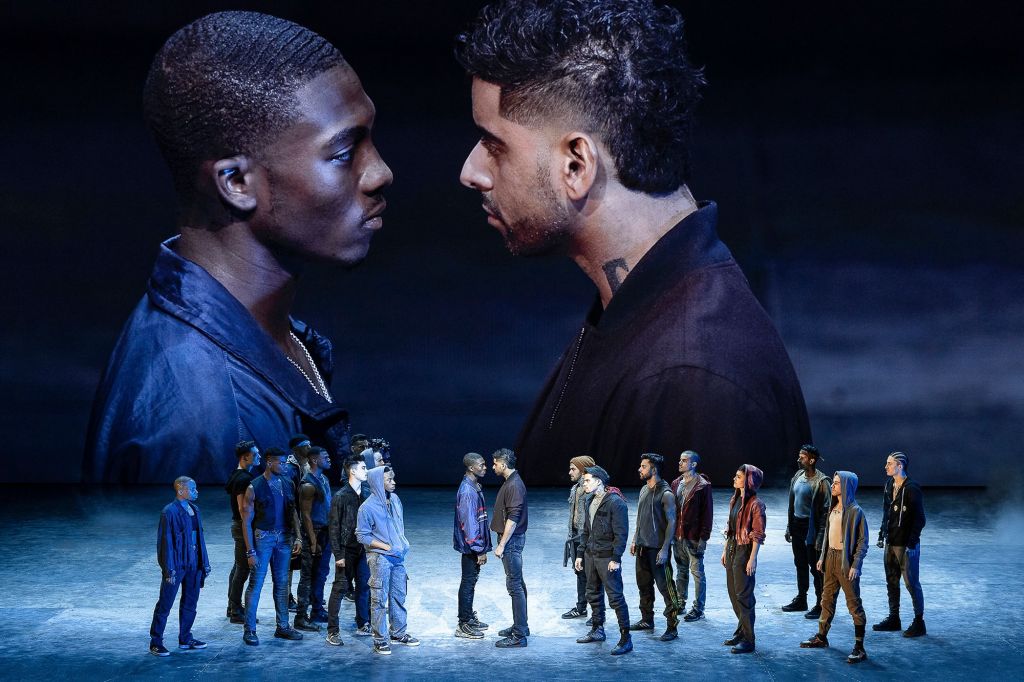
Dharon E. Jones, Amar Ramasar, and the cast of “West Side Story.” (Photo: Jan Versweyveld)

West Side Story is a musical that wears its liberal heart on its sleeve. Created by Jerome Robbins, Arthur Laurents, Leonard Bernstein, and Stephen Sondheim, West Side Story took a play that was relatively apolitical, Romeo & Juliet, and turned it into a look at racism, gang warfare, assimilation, and poverty. The musical ends with its heroine Maria, a Puerto Rican woman who had tried to be a peacemaker, pointing a gun at a group of Latinx and white teens shouting, “You all killed him! And my brother, and Riff. Not with bullets, or guns, with hate. Well now I can kill, too, because now I have hate!”

When the musical first premiered, in 1957, it was inspired by both Romeo & Juliet but also by news headlines at the time about turf wars among teenage gang members. The Montagues and Capulets of R&J then became the Jets and the Sharks of West Side Story—a white gang versus a Puerto Rican gang, who hate each other not because of some “ancient grudge break to new mutiny,” but a very contemporary grudge: racism. In creating West Side Story, Robbins and co. were reviving Romeo & Juliet and making it relevant to a mid-20th-century audience.

Or at least, as white men, they tried. West Side Story has always had a fraught relationship with Latinx people. Said Hamilton creator Lin-Manuel Miranda in 2009, as he was working on that year’s West Side Story Broadway revival: “I think West Side Story for the Latino community has been our greatest blessing and our greatest curse…As a piece of art, I think it’s just about as good as it gets. It also represented our foot in the door as an artistic community on Broadway. At the same time, because it’s just about the only representation of Latinos on Broadway and it’s about gangs, that’s where it gets tricky.” 

Which brings us to 2020, where two different versions of West Side Story are being released. One is the new film by Stephen Spielberg, scheduled for a December 18 release. Like the original musical, the film is set in the 1950s. Meanwhile on Broadway, Belgian director Ivo van Hove helmed a revival of the musical that began performances in December 2019. This version was set in the modern era, with the Sharks and Jets filming the action on their phones which is then projected onto a giant screen behind them. West Side Story on stage was shut down on March 12 when Broadway shuttered because of COVID-19. But once again, a musical about racism and the lives of people of color in America are directed by white men. 

Despite its sometimes questionable qualities, I have always had a soft spot for West Side Story. I own a box set of the 1961 film that came with a bound script. The mambo scene, in all of the iterations I’ve seen of the show (I’ve seen three), never fails to make me breathless. It’s because even though West Side Story is a tragedy, it uses music and dance to remind all of us that there is still hope and beauty in the world, if we can only move past our racial differences to see it.

Which brings me to the 2020 Broadway revival of West Side Story, which I saw twice earlier this year (both times for work). I had come into this revival with misgivings (which I will discuss later), but I wanted to like it. And I left feeling like I’d been hollowed out. 

“But What About Black-on-Black Crime?”

I’m not the kind of person who believes you should preserve theater in amber. I think if you’re going to revive a classic play or musical, you should have a reason for doing the show now. And creators shouldn’t be beholden to tradition when reviving a show; they should be allowed to re-imagine it. If Shakespeare can be recontextualized in seemingly unlimited ways, why can’t West Side Story?

This version of West Side Story wanted to be modern; van Hove said he wanted to set it after the 2016 election, when America is “a much rougher world…where people don’t listen to each other’s arguments, but just react to each other, and blame each other for what they are missing in life.” And he also made it multiracial: the Jets are now a Black and white gang, led by a Black teenager named Riff (Dharon E. Jones). If their hatred isn’t along racial lines, then what is it? Said choreographer Anne Teresa De Keersmaeker, “But I do think that both Jets and Sharks are young and are looking for identity. And it’s also about violence, poverty and exclusion.”

On the one hand, the violence should not make sense because hatred and violence is senseless. On the other hand…we’ll get to that momentarily.

The revival also cut out some elements of the original which, on the surface, seem innocuous. It cuts Maria’s only solo song “I Feel Pretty,” and the all-women scene preceding it. It also cuts the ballet that usually accompanies the song “Somewhere.” And it cuts this line from Maria (Shereen Pimentel) in the show: “You all killed him! And my brother, and Riff. Not with bullets, or guns, with hate. Well now I can kill, too, because now I have hate!”

These cuts may seem innocuous but what it does is remove any sense of lightness, joy, and hope from the musical. Maria is the sole voice in the musical who calls for the end of violence and for peace. What her song “I Feel Pretty” shows is a girl who looks at the world with optimism. In a world where Latinas are made to feel invisible and ugly, she chooses to feel pretty. Maria is hope personified. Cutting that song cuts a crucial character moment for her. 

When at the end, Maria holds a gun and says “now I have hate,” that hope is seemingly broken and that is the true tragedy. But when Maria chooses not to use that gun, it’s supposed to be the triumph of love over hatred. In the movie, the final line is “Te adoro, Anton,” and the final shot is of Maria, resolute and moving forward. You get the sense that there will be a better world somewhere, and Maria will help build it.

The 2020 West Side Story revival sidelines Maria and the other women, in order to center the violence of the men. The men are also centered in the marketing campaign for the show as well as the images on the marquee. The women do not push back against the hate, or give a hopeful alternative to it. At the end, Maria doesn’t break away from the violence, she just stands on the stage, next to the Jets and Sharks, looking exhausted and depleted. Another Black woman whose lover was killed by gun violence (Pimentel is Afro-Latina). The revival took away what made Maria special. 

And who is responsible for the violence? In the scene where Anita (Yesenia Ayala) is almost raped, we see a close-up camera shot of her jeans being unbuttoned, and then a Black man on top of her. During the song “Gee, Officer Krupke,” usually sung by white Jet members, it’s instead sung by mostly Black actors, who are then shown in a jail cell.

During the rumble, Bernardo (Amar Ramasar) kills Riff, who is Black in this production. Tony—played by Isaac Powell who is part Native American, Black and white—then kills Bernardo.

Van Hove may have made the Jets multiracial, but he also took out white supremacy and institutional racism as a source of violence in West Side Story. As theater director Schele Williams put it:

“It’s a very specific story about white people making Puerto Ricans other. The story changes considerably when you make it brown on brown…You put all brown people on stage to show danger and you took the whiteness out of a story that is about a group of people saying, ‘This is America and you don’t belong here.’ In a moment when America is having a whole conversation about putting children in cages on the border and saying, ‘you don’t belong here,’ but you’ve taken whiteness out of that story.”

Schele Williams


“In addition, you have cut, ‘I Feel Pretty’ away from a community that so desperately needs to say out loud, ‘I feel pretty and witty and bright.’ How often does that group of people, those women, those Latinx, Puerto Rican women, get to say something affirming about themselves on the American stage? And that song was cut. Who was behind the table for that conversation? And who thought that only brownness can be dangerous? Because I fear the white boy who comes into my kids’ school and shoots it up. I don’t fear the brown one.”

Schele Williams

Even before summer 2020, America was experiencing a reckoning around race. Black people were getting murdered with impunity by white police officers, the president called a group of white supremacists “very fine people,” Latinx children were being put in cages by white immigration officials. In the original West Side Story, the police officers treat the Puerto Rican Sharks much more harshly than they do the white Jets. That nuance is gone from the revival. Van Hove wanted to make his West Side Story relevant to American audiences today. But by taking away the race element in the musical, he made his version irrelevant, the theatrical version of “all lives matter.”

But this is how white supremacy wraps itself up as allyship. Because you can hire a group of Black and Latinx actors and have them act in a beloved Broadway musical about how hate and violence is destructive. But how you position them onstage matters. In this new West Side Story, young people of color are senselessly violent, and police intervention is justified, because otherwise, these mostly Black and brown youths would keep killing each other. It’s no different than the fear mongering on Fox News.

Said Williams: “That’s why cops shoot first and ask questions later, because brown is scary and white is fine. In this platform with all of these thoughtful, kind, liberal humans, we are reaffirming the prejudices of our nation on the American stage.”

And I’m not saying Van Hove and his predominantly white creative team meant for West Side Story to say those things. But they didn’t even assemble a team that could even ask the right questions.

The cast of ‘West Side Story.” (Photo: Jan Versweyveld)

The Ethics of Consumption

West Side Story is the first Broadway show in a long time to be met with protests on its opening night. That’s because it had cast Amar Ramasar, who was fired (along with a number of other male ballet dancers) from the New York City Ballet for sharing nude photos of female ballerinas. In all of the ensuing media coverage, Ramasar did not apologize. The West Side Story protests were organized by Paige Levy, a senior at LaGuardia High School in Manhattan. Ballet dancer Alexandra Waterbury, whose photos were also circulated, also joined the protests. 

A member of the West Side Story cast also wrote anonymously to OnStage Blog, saying: 

“I hate that I have to share the stage with him. I hate seeing him smile or laugh backstage. I hate seeing him reap rewards of adoration from audiences who don’t know or who haven’t bothered to look up what happened.

“But most of all, I hate that I can’t say the things I want to say freely. I’m young. I’m at the beginning of what I hope is a long career and as passionate as I am about wanting to scream from a soapbox about this, I’m just as passionate about wanting to continue to work on Broadway and I know people have been blacklisted for saying less.” 

Those weren’t the only issues the West Side Story revival faced. Backstage, a number of actors were injured. Isaac Powell was out of commission for more than a month because of a knee injury he got while performing. Another principal cast member, Ben Cook, left the production due to an injury. Multiple actors getting injured within two months of a show’s life is not normal. So besides the sexual harassment issue, there also seemed to be a workplace safety issue.

Maybe that’s why the show rang hollow to me. It’s the equivalent of a corporation saying it supports diversity, but won’t take any actionable steps to make itself more diverse. For a show that seemed to condemn violence in the text, it had little consideration for the humanity and safety of its performers. There’s a difference between saying the words and actually putting those words into practice. A show can have pretty and progressive words, but when there are harmful practices backstage, what value do those words have?

There’s a meme that’s been around a few years now with the phrase, “there is no ethical consumption under capitalism.” If you’re a person living in a developed nation today, everything you consume was probably produced under the auspices of oppression: the people who make our iPhone or pick our vegetables are likely underpaid and overworked, the air conditioning we use or the planes we travel on is contributing to the harming of the planet, Jeff Bezos is the richest man in the world because he underpays his factory workers and doesn’t give them bathroom breaks. Oppression and harm is woven into the fabric of a capitalistic society.

For me, it’s become steadily harder to separate the artistic merits of the work with how the work was made. I haven’t been able to enjoy anything Harry Potter related after I found out that J.K. Rowling is a transphobe. That is because living in the now is a constant negotiation of how to put the things that I value—humane and safe working conditions, diversity in storytelling, anti-racism and justice—into active practice in an imperfect world.

That is why I didn’t want this essay to just be about, “I hated the new West Side Story and here’s why.” Because the artistic merits of a show is one thing, we can talk all day about that. But should the conditions in which a piece of art is made impact your enjoyment of that art? That’s the tougher question. 

This is not to shame anyone who enjoyed the Broadway revival of West Side Story. Let me know what you liked about it. But when Broadway reopens again and if West Side Story comes back, I hope we will all be able to have a more open conversation about the way the art is made, in conjunction with talking about the work itself. And how inequitable artistic practices can damage the art itself.

There is a reason why the We See You, White American Theatre demand letter devotes just as much space to artistic practice as it does to the product. Because if we are serious about a better, more equitable environment for artists from marginalized backgrounds, then we need to have a frank discussion about how we treat those artists. And we need to have those discussions in conjunction with whether or not the work is “good.” What happens offstage is just as important as what’s onstage.

And if in the next decade you have to revive West Side Story again, give it to a Latinx person to direct.

How 3 Designers Are Making Sure Immigrant Theater Artists Are Not Being Forgotten

Features
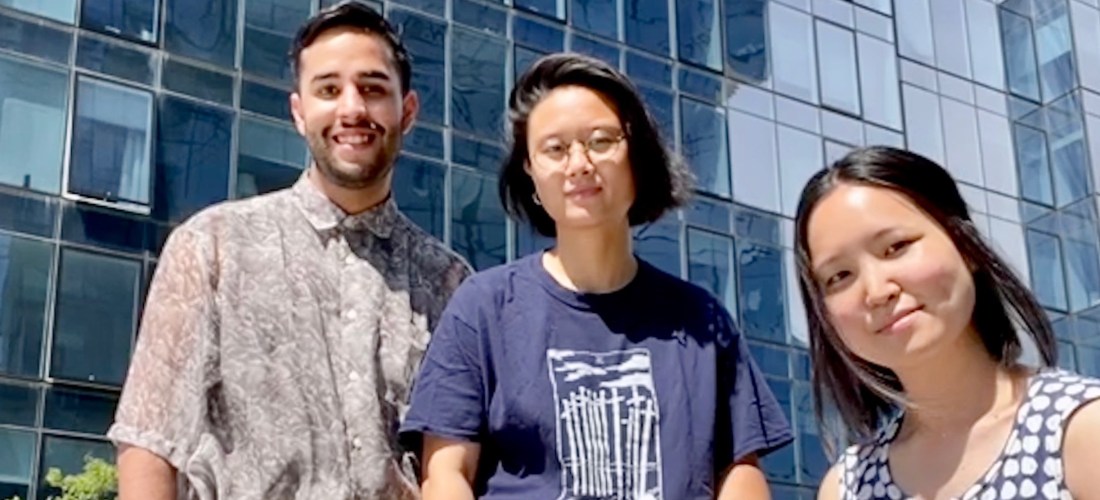
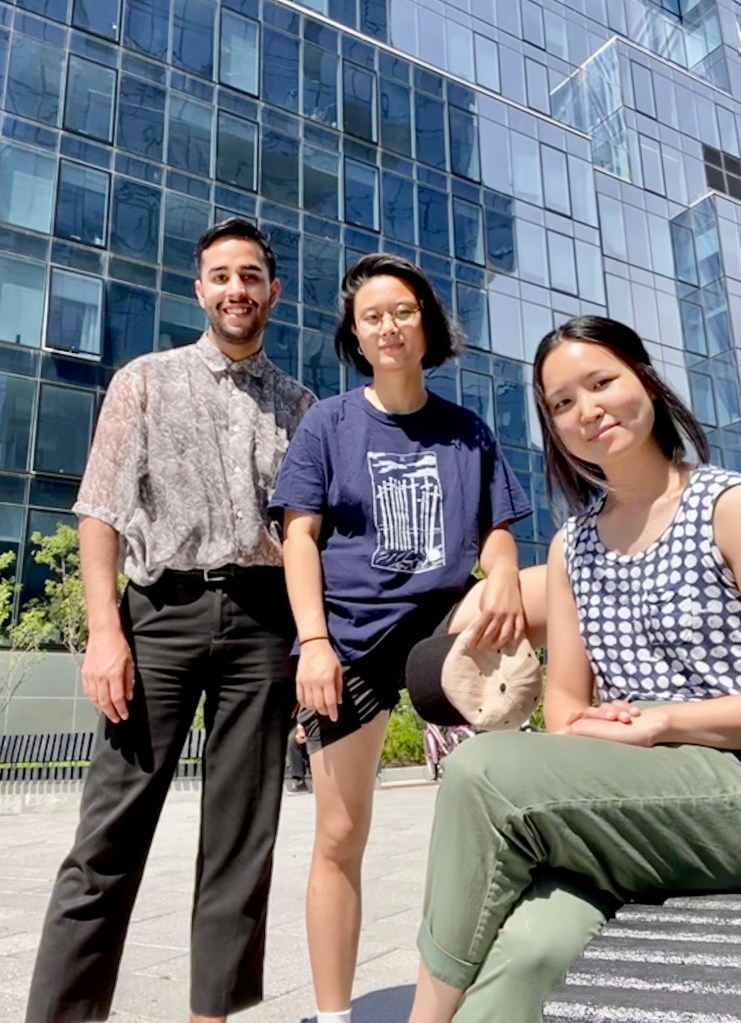
Rodrigo Muñoz, Cha See and Kimie Nishikawa.

Back in May, as COVID-19 shut down theaters around the country, Cha See, a lighting designer, was in a bind. Like many, she was also out-of-work. But unlike most theater artists, she could not apply for unemployment. As an immigrant designer from the Philippines, in America on an O1 visa, applying for government aid could put her visa in jeopardy.

And See was not alone, she noticed other immigrant designers who, like her, were wondering how they were going to make ends meet. Especially because unlike actors or playwrights, their work did not translate as well to Zoom. So See created a GoFundMe. 

“It all started when I was having troubles financially,” she said. “So I started this GoFundMe. At that time, I was just talking to my friends who were also having the same problems because we couldn’t apply for unemployment, all of our shows have been postponed. It was the uncertainty with finances and with theater.”

The GoFundMe originally raised $32,969. But See soon realized that the need was greater than her immediate circle of immigrant designers. “Many people were contacting us from different disciplines and what we wanted to do was help as many people as we can,” said Kimie Nishikawa, a set designer from Tokyo; she helped See administer that original GoFundMe.

The two, along with costume designer Rodrigo Muñoz from Mexico City, then created the See Lighting Foundation, which has been raising funds and distributing them to immigrant theater artists in need.

“There’s no vetting process, there’s no application process, the only requirement is that you’re on an O1 or an OPT, and you work in theater,” said Nishikawa. OPT stands for Optional Practical Training, which allows students on an F1 visa to temporarily work in their area of study.

Originally, the idea of the See Lighting Foundation was to do a one-time-only payment to anyone who applied for it. But the group soon realized that theater was going to be shut down for at least the rest of 2020, which meant many artists were going to be without income for months. And artists on an O1 visa cannot find work outside of the jobs specified on their visa.

So the See Lighting Foundation is currently supporting 64 artists, giving them $500 a month. “We have a waiting list, which is about 15 people,” said Nishikawa. “Hopefully some people who have registered with the foundation, their financial situation might improve, and they will drop off. A few have already dropped off and then people on the waiting list come up.” Artists also usually drop off when they go back to their country of origin.

Adds See, “I wish we can help them all. But it’s also based on the number of donations and the amount of donations. We’re working hard.” The three administrators make sure the artists on their list have gotten their funds before they pay themselves.

Before they started the See Lighting Foundation, See, Nishikawa and Muñoz had never fundraised before. As Nisikawa puts it bluntly: “We’re fucking designers. We don’t know how to fundraise.” 

It’s been a learning experience for the team, from finding a fiscal sponsor so that the donations can be tax-deductible (Ars Nova is their fiscal sponsor), to directly asking big potential donors for money. The funds are distributed to artists as personal gifts, so it doesn’t violate their visas. On the day of the interview, the team disclosed they had received a donation of $30,000, their biggest single donation yet (their average is usually $74). 

“We just realized how really, really, really, really important it is to keep our voices out there,” said Muñoz. “We need to make ourselves present. And it’s been like an interesting and funny ride because we decided, for example, we should open a Twitter. And then it’s like, wait, how does Twitter works? None of us use those platforms!” 

But they’ve been learning how to fundraise as they go. The most valuable thing they’ve learned about asking for money during this time is similar to getting theater work in the before times: persistence.

“Even if you don’t get a response, just keep emailing them back,” said Nishiwaka. “Always be polite. Just keep poking, keep poking.”

They’ve also learned that they can use social media to educate people. They realized that many people who worked in the industry assumed immigrants can apply for government assistance. So they’ve been doing a series of Instagram posts to dispel some myths about visa holders.

As for the future, the three artists at the head of See Lighting plan to stay in America, which they consider their home.

“We’ve already sacrificed a lot,” said Muñoz. “Giving up or going back is not an option for us. From my personal opinion, I just hope things change and the future has great opportunities for everyone, for the three of us, so we can just continue making theater in the United States.”

Nishikawa hopes that when theaters come back, they pay artists better so that artists are no longer living paycheck-to-paycheck with no savings, so that they’re better equipped to withstand hard times. 

“I hope that people or institutions invest more in the people and not the product,” she said. “There are so many shows that I have done, where my fee is $2,000 for a whole set design, and my [production] budget is $30,000. And just the gap between how much the institution pays for their people and how much they care about advertising and the product itself is too big. We were all hanging on by a thread. When this pandemic hit, most of us were like, ‘Wow, I don’t even have enough money to pay rent for next month.’ And we’re all working on big Off-Broadway shows. We are supposedly the ones who made it but the industry cannot support their artists. And I think that really has to change.”

For her part, See hopes America as a whole learns to be less individualistic and less obsessed with one person bootstrapping themselves out of hardship.

“The idea of individualism, I hope it’s lessened,” she said. “ I hope that we all realize that we all need each other—whatever my neighbor does, whatever my coworker does, whatever my collaborator does, it’s all gonna affect me. Whatever I do, it’s all gonna affect you. We all need to help each other at the end of the day in times of crisis. It doesn’t matter where you’re from. It doesn’t matter what your background is. If you’re in need right now, we’re all here to support you and help you. That’s what I want to see more of when we go back to the new normal.”

In the Play “Black Women Dating White Men,” Love Is a Revolutionary Act

Features
Somebody Jones and Khadifa Wong. (Photo: Etian Almeida)

Playwright Somebody Jones grew up in Los Angeles but in her mid 20s, she moved to London to get her MFA in playwriting and dramaturgy. There she found herself doing something she never thought she would do: she started dating a white man. As a Black woman, she felt conflicted about it. She then wondered if any other Black women had the same experience.

“I had been dating my boyfriend at the time for four months, and I didn’t know any other Black or mixed woman who was dating a white man,” she said. “So I was like, it’s the perfect time for me to find community.” As part of a grad school assignment last year to create a documentary play, Jones found five Black women who were willing to speak frankly and honestly about their experiences in interracial relationships. The text of those interviews became Black Women Dating White Men, a frank and funny look at modern love. 

Black Women Dating White Men was originally supposed to tour the UK this summer, but COVID changed those plans. The play will tour in 2021, assuming theaters reopen in the UK. In the meantime, Jones and her director Khadifa Wong wanted to keep the play alive. So they filmed it, recontextualizing it as a Zoom call between five girlfriends, wine glasses in hand. According to Wong, the script didn’t have to be changed at all.

“That was what was so brilliant about it, and why I love the script,” said Wong. “I think the beauty of the writing, it lends itself to whatever context you want to put it in.” 

The team originally submitted Black Women Dating White Men to the Hollywood Fringe in Los Angeles, where it played earlier this summer as part of the festival’s all-virtual program. Then they submitted to the Fringe of Colour Festival in the UK. The play will stream online August 8-14 and again Aug 22-28. 

When the show was at the Hollywood Fringe, the audiences were from America and the UK, as well as Europe and Trinidad. “We did better than we expected,” said Jones. “People saw it who would not have had the chance to see it, which I think was great.”

Alternatively probing, tender and funny, Black Women Dating White Men fits perfectly within today’s entertainment ecosystem, where television shows like Insecure or I May Destroy You are presenting a hyper-realistic look at contemporary, and cosmopolitan, Black life. In Black Women Dating White Men, the women are honest about the struggles of dating outside their race, such as one who says: “He’s never gonna know what it feels like to have this sense of otherness. It can also be very straining to continuously explain why I feel this way about this kind of thing.” 

But they’re also honest about why they said yes to going on a date with a white man in the first place, such as one character who says, “I haven’t run into Black men who were ready to be in a relationship.” While they were creating the show, both Jones and Wong were dating white men (Wong’s relationship status now: “It’s complicated”). But what the artists both learned from the play was that it takes patience to make those relationships work, and a willingness to truly be open and communicative.

“I would say you have to obviously like the person, and then it’s all about patience,” said Jones, who is still dating the same man from last year. “Even in the play, one character talks about how tiring it is, and you really don’t understand how tiring it is until you’re in it. I just feel like it depends on the person. If you find somebody that you really like, and you want to invest time in, then yes, it’s worth it.”

What Wong loves about the play is that it features five different women, showing their different approaches to relationships, their differing opinions, and their individuality. In entertainment, it’s still rare to see multiple Black women given space to talk frankly about their lives.

“With any ethnic group that isn’t white, how we’re dealt with in the media is very monolithic,” said Wong. “And they never see that within our groups, there are layers and light and shade in the conversations that we’re having within ourselves. But we’re always expected to be one way and that’s just not true.” She then added, “The moment I realized I wasn’t alone in feeling guilty for dating a white man, it made me feel more comfortable in my choices of a partner because I was like, I’m not the only person that struggles and feels this way.”

A still from ‘Black Women Dating White Men’

When creating the video version of Black Women Dating White Men, Wong approached it like a film. The actors were asked to do two takes of every scene, and then Wong spent a week editing it together. “I really enjoyed dictating certain moments, and playing up certain moments,” said Wong. “I treated it like a film. I didn’t treat it like a play.”

The two friends are still in London, and still see each other regularly. Jones is currently working a day job, while Wong is currently furloughed from her job as a dresser on The Lion King on the West End. Though Wong was an active and healthy dancer before, she is still recovering from a bout of COVID-19. 

“I will yell it from the rooftops anyone that thinks that this is just flew and a little bit of an inconvenience is completely wrong,” said Wong. “I was exhausted. I’m still exhausted. I still struggle going on, like, a 40-minute walk. My goal for this year was to be able to do the same gymnastics I could do as a 12 year old. And I was almost there before lockdown here. So that’s a sign of how my fitness and my health plummeted through COVID.”

Meanwhile Jones is at work on two other documentary theater plays: Present Black Fathers, where her dad is one of the subjects, and Black and Bi, about bisexuality in the Black community. She says that presenting Black Women Dating White Men while the Blacks Live Matter protests were happening in London made the play feel that much more essential for her, in how funny and hopeful it ends up being about how Black and white people can learn from each other, and in that, learn how to truly love each other. 

“The quotes that sort of bookend the piece is from Tonya Ingram, about how love is a revolutionary act,” said Jones. “I actually found [the play] funnier. Because we are dealing with such heavy things, because it’s so much about love, I feel like you can feel that love from these performers. It’s added a level of lightness with that deepness.”

As for how we can all live in the world together, Jones believes change comes in two ways, on a societal level but also on an interpersonal level. “You might do your part in voting and trying to change legislation but also, it is important to change the people around you,” she said. “If you care about someone, influence them, and if it’s too much work then obviously, let that person go and hope that they find the light.”

We Need to Talk About Money

Features
Photo by cottonbro on Pexels.com

For the past few years, one of my favorite pastimes has been to read the Money Diaries from Refinery29. In it, a millennial woman tracks her spending for one week. I’ve used it when I was making $40,000 a year in NYC as inspiration for how to make my dollar stretch in one of the most expensive cities in the world (hint: food prep ALL your meals). And I’ve also used it to judge people for the dumb things they spend money on (like being furloughed and using that stimulus money to buy… lingerie from Nordstrom).

But most of all, I love how frankly it talks about money. I tried to get something similar started when I was at American Theatre, when I found six different theater workers willing to give me their annual budgets: how much they made from their theater jobs and side hustles, and strategies they used to make that low income stretch. Through these budget breakdowns, I was hoping to make talking about money in the arts a little less taboo, and for people to talk more frankly, publicly, about how little theater jobs pay and how that leads to greater inequality along racial, gender and class lines. 

That didn’t happen as much as I wanted it to. Because here we are during a pandemic, one that has put millions of arts workers out of work, and yet artists are still seen as un-essential, elitist members of society who don’t need federal help. 

A recent New York Times article about the state of federal pandemic relief said this: “Hands are out as Congress is set to begin negotiating  a new round of pandemic stimulus. Airlines, hotels and restaurants. Military contractors and banks. Even Broadway actors. These are just a few of the special interests already maneuvering to get a piece of the next coronavirus relief package about to be taken up by Congress, which is back in session this week.”

In response, Howard Sherman, an arts administrator and American theater thought leader, tweeted this:

“‘Hands out’? ‘Even Broadway actors’? These are people and families in distress. Live performing arts comprise a major industry brought to its knees. Do not dismiss what we do or our importance to the economy. This is shameful, @nytimes. Treating the performing arts, whether commercial or not-for-profit, as if they are a frivolity looking for a handout diminishes accomplished professionals around the country. Using the arts as a flip coda to a political lede is insulting, @nytimes.” 

Sherman then tweeted out an update, saying, “@nytimes has removed the word ‘Even.’ But the sting lingers. People who work job to job, in a field that will be the last to come back from the pandemic, are hardly the same as banks.”

Yes those Broadway actors, who, if they’re lucky, will make $98,000 a year—a modest salary in a city like NYC (the true take-home pay is far lower considering fees to union and agents). And they’re at the top tier of the theater profession. Most actors in theater are lucky if they’re making a living wage. 

Leslie Odom Jr spoke frankly to The Los Angeles Times about how in 2015, while working on Hamilton Off-Broadway and playing a leading role, he only took home $400 a week (for a show in a 299-seat house where the tickets cost $120 each). The cast got paid eventually, but it was only after years of little to no pay to help develop Hamilton—development time is an investment expected of any artist who wants to work regularly in the business. 

Many Off-Broadway actors have told me they can make more on unemployment than acting (the maximum weekly amount for New York unemployment is $504 a week). 

This past spring, backstage at her hit one-woman Off-Broadway show Dana H., I asked long-time, award-winning stage actor Deirdre O’Connell how she makes a life in the theater work. Here is what she told me:

“I have a rent-stabilized apartment and I live on my Screen Actors Guild pension. I had gone away for 6 years to do some TV series and TV movies and stuff like that. I didn’t want to do it, I was kicking and screaming, but I had no money. And I feel like every Off-Broadway actor, that you ask how they’re doing it, has some sort of secret sauce. If you have a great year where you work all year, that means you’re completely broke. Basically actors are giving a non-tax-deductible contribution to the theaters they’re working at.”

And that’s only the numbers for actors; those who work behind-the-scenes, either on Broadway or in Hollywood are not exactly living the champagne life. A mid-career TV writer will make $5,000 to $10,000 an episode but they still need to pay union fees and agent fees, and they don’t necessarily work all year. A life in entertainment will net you, if you’re lucky, a comfortable middle-class lifestyle.

When I was first hired as an editorial assistant at American Theatre magazine in 2011, I was paid $30,000 a year (and when I left 8 years later, my salary was $46,000). When I wanted to write a piece about income inequality in the arts, the part about my own meager salary, was cut from the final article.

I believe that one of the reasons that the arts are considered frivolous and elitist is because the industry itself promotes that image.

It’s hard to walk into a theater building that costs $400 million, and not think that those working in it must be paid extremely well. It’s also hard, when tickets to an Off-Broadway show can cost close to $100, not to assume that the actors must be rich if the tickets are that high. 

Like in many other industries, theater workers are not encouraged to disclose their salaries, and in many cases are reprimanded for it. Salary transparency is so toxic that the only time theater workers want to disclose how much they make, they only feel safe doing so in a public, anonymous Google spreadsheet

When talking about theater, the industry places its shiniest faces forward: the glittering buildings, the lead actors, the star-studded award shows. That’s normal, after all, fewer people click on articles about stagehands and front-of-house crew—all of the other people who help make the work happen and whose incomes aren’t as high. Kids who love theater usually want to be actors first, before they realize there’s a wider theater world than on stage.

At the same time, it helps maintain the illusion that the arts, and the people who work in it, are elite. Theater has leaned into the glamour, to the detriment of its workers being seen as human beings. That is why funders and rich people would rather pay for new buildings than better wages for the people working in those buildings. And why because of that low-pay and long hours and passion required for the job, many people burn out and leave the industry. 

Or as one arts administrator told me:

“One BIG problem in non-profits is that funders very rarely want to fund overhead. They want to fund specific projects, not staff salaries. And websites like Charity Navigator make a percentage of money to salaries/overhead a part of their rating, which means even individual donors keep an eye on that and are turned off by companies that a) actually pay staff reasonable salaries, and b) prioritize staff health.”

The theater industry is a microcosm of the entire country at large: a country that for too long has divested resources away from people and into things—buildings, larger budget shows, bigger galas. And it has created an ecosystem where a majority of workers are on contract, going from job-to-job with little financial security.

And like many corporations, during a pandemic, many theaters have laid off their lower-level staff members while maintaining the employment and salary of those at the top. The Kennedy Center, despite receiving a $25-million bailout from the federal government, has laid of 30% of its staff, aka 64 employees, while its president Deborah Rutter is taking a 75% pay cut from $1.2 million, so she now earns $300,000.

That is why in the face of a global pandemic where the arts are shut down and artists are jobless, disaster is looming. Because these workers had been living paycheck-to-paycheck. Said set designer Kimie Nishikawa, who helped launch the See Lighting Foundation to help immigrant theater artists during this time (I’m writing an article about them that will come out soon):

“I hope that people or institutions invest more in the people and not the product. There are so many shows that I have done, where my fee is $2,000 for a whole set design, and my [production] budget is 30,000. And just the gap between how much the institution pays for their people and how much they care about advertising and the product itself is too big. We were all hanging on by a thread. When this pandemic hit, most of us were like, ‘Wow, I don’t even have enough money to pay rent for next month.’ And we’re all working on big Off-Broadway shows. We are supposedly the ones who made it but the industry cannot support their artists and I think that really has to change.”

Many are rightly concerned with the well-being of institutions. After all, if these large theaters fold, where will these artists work after COVID is through? For me, I am more concerned about immigrant artists who may have to go back to their home country, about individual artists who have no job security—people at risk of leaving the field and finding new employment, whose creativity and vision cannot be easily replaced. The death of institutions may be tragic but an exodus of artists and workers will be catastrophic. 

I was recently asked by two different people about what I think will happen to the theater industry in the future, post-COVID. I answered that I’m not in the prediction business. But I can tell you all what my hopes are. What I hope for are more frank and honest conversations about how difficult it is to make a living in the arts. I hope more people follow the strategy of the #FairWageOnStage campaign and openly talk about how much a life in the arts pays, or doesn’t pay. I hope those who give money to the arts understand that funding personnel, payroll and overhead is just as important as funding a production or a building. I hope in the future, our society as a whole will value people more than products.

I hope there is a conversation around class, alongside the conversation around race and equity, and more strategies for eliminating the class barrier in the arts (aka pay your interns). If theater is truly for everyone, then everyone must be able to make a life in it, and everyone must be able to afford to go see it.  

Let radical honesty be a regular artistic practice. 

The arts are nothing without the people making it happen. So I hope for a humanity-driven artistic practice, even a slower artistic practice, that prioritizes the well-being of the people making the art happen. I hope for care and love that starts from the bottom up.

Already I see some change happening. Baltimore Center Stage in Maryland recently announced they were eliminating 10 out of 12s (which is 14-hour days for technicians and 12-hour days for actors, during tech rehearsals), and instituting a five-day rehearsal week instead of the typical six. Producers shouldn’t be announcing productions for the future, they should be figuring out how they can help artists survive right now.

And if in the near future, universal basic income and healthcare become a reality, then perhaps a life in the arts will seem less elitist and more normal. If we’re all more frank about how much money we make, then those who work in creative fields will be seen as part of society, instead of above it.

I hope when this is over, people will realize that while it was doctors and essential workers who saved our lives during COVID-19, it was the people in film, TV, theater who created work that nourished our souls.

And in the words of two-time Obie Award-winning actor April Matthis: “When the dust starts to settle—and I’m not talking about just theater, I’m talking about TV and film—let’s support small businesses. I’m a small business as an independent contractor.”

P.S. Click here to tell your Congresspeople to fund relief for the arts and its workers. #ArtsHero

How the Homebound Project Brought Stage and Screen Artists Together to Help Fight Child Hunger

Features

For the past few months, director Jenna Worsham has been making theater for people all over the world. “People in Singapore, Brazil, Germany are tuning into the show,” she said. “It’s crazy to think that if I did a show in New York, I would never have this audience.” 

That’s because Worsham’s been producing digital theater. Worsham is the co-founder of the Homebound Project, which since May has been commissioning original short plays, and performers to act in them and film it for the web. Homebound just finished its fourth installment, the final one will be streamed on August 5–9. 

When all is said and done, Homebound will have created more than 50 new short plays, all created and performed by volunteers to benefit No Kid Hungry, a campaign of Share Our Strength, an organization committed to ending hunger and poverty.

“We found out this morning that we hit over $100,000 in donations, which is just, I can’t even wrap my head around it,” said Worsham. And for the final installment of Homebound, an anonymous donor will be matching all donations, up to $20,000.

Worsham co-founded the Homebound Project with playwright Catya McMullen (whose credits include the play Georgia Mertching is Dead and she is also a writer on “The Auteur,” a new comedy by Taika Waititi  on Showtime). When asked about why they started the Homebound Project, Worsham described it as “sustenance.” 

A play she was directing Off-Broadway, The Siblings Play by Ren Dara Santiago, was cancelled at the beginning of its run at Rattlestick Playwrights Theater. Another play she was directing in the summer at Lincoln Center was also postponed. Worsham and her wife are also immunocompromised so they both were literally homebound. 

“I feel like I was going crazy for a couple of reasons,” said Worsham. “New York City was falling apart and a lot of people were getting sick. And Catya and I both felt like we wanted to make something. And we also felt really useless. Because, you know, we weren’t first responders. As artists, I feel like your job is to feel relevant. I am not a firefighter, so we were kind of like, alright, what can we do?”

This was also during the early days of shutdown in New York State and of digital theater, where the focus was mostly on streaming pre-existing shows that had already been staged. McMullen and Worsham wanted to create original works that responded to the current moment. 

“I want to hear from the writers who are actually going to speak to this moment,” Worsham said. “Different voices in the theater that we want to actually hear from right now, while we’re stuck in our homes, who can make us feel human. And also give people and ourselves an opportunity to work, even if it’s through Zoom, the sustenance of that creativity is so essential, and just something I think we were dying for.” 

Playwright and actor Ngozi Anyanwu (who wrote the play Good Grief and is a writer on the upcoming HBO miniseries Americanah) has both acted in and written a piece for Homebound. In quarantine, she admits that she’s been too overwhelmed with the news to work. So short projects like Homebound have been useful in giving her a creative outlet that isn’t too draining.

“With COVID and the racial uprising, most of the time, I literally want to stay in bed and not do anything,” Anyanwu admitted. “When Jenna called me about doing Homebound, I was like, OK, yeah, feed hungry people, I can do that. It’s low energy, it’s low impact and it’s for a very good cause.” She then added, “It’s really helpful to me to know that I’m being helpful with my work and it does relieve some of the, just like, staying at home all day.”

Anyanwu wrote a monologue for model/actor Hari Nef called Here is Good, directed by Caitriona McLaughlin, which takes place in bed under a blanket. For the playwright, it was freeing to just write what she was feeling, and not go through the years of development a typical play goes through before it’s produced.

“I’ve been using these mini-commissions to take the pressure off of having to toil over the words and every single conjunction, every single preposition,” she said. “For the most part, it’s like, what if I treat everything that I make as worthy?”

Unlike other Zoom theater experiences, Homebound is not performed live. The playwrights are commissioned to create original monologues on a certain theme (the most recent Homebound theme was “promises”). Then the actor they’ve been paired with are taught how to shoot the work on their smartphone. If they want a director to help guide them, they can ask for one, who can help them with props and set dressing. It’s similar to The 24 Hour Plays—solo work where everything is pre-taped and put together with the resources on hand. 

Anyanwu performed a monologue by Anne Washburn called Comfort Food, which called for her to sit in complete darkness with her face illuminated by a candle. Trying to find the right candle that didn’t “look shitty on camera” was a process, as well as the right room in her house acoustically (she settled on the bathroom). “This is why tech people are important,” she said. “Just becoming your own producer, it was fun and it was a lot of learning. I literally filmed it by my toilet.” It’s not just Homebound, it’s also homemade. 

Ngozi Anyanwu in “Comfort Food”

Then Homebound’s Jon Burklund edits all the videos together, and the Homebound installment is then available for four nights for ticket-buyers to stream. The creators also teamed up with Broadway producer Mary Solomon to help them with logistics (she was the one who put them in contact with Billy Shore, who runs No Kid Hungry).

So far, the artists involved in No Kid Hungry have been a who’s who of theater and Hollywood names: William Jackson Harper, Martyna Majok, Betty Gilpin, Zachary Quinto, Diane Lane, Leigh Silverman, Philippa Soo, Blair Underwood, Michael R. Jackson, Lena Dunham…the list goes on.

“The first two series was just us asking our friends, famous friends that we’ve made through theater to get involved,” said Worsham. But as word got out about Homebound, artists started inviting other people they knew to get on-board. “It’s such a community, like I did a show with Phillipa Soo few years ago, and she’s a friend with Daveed Diggs [of Hamilton]. I feel like once people know who you are, and they have a good time, then they vouch for you.”

It’s an all-volunteer effort, no one (not even the producers) are getting paid. But it’s a way to feel useful during this time. And though the plan is to close Homebound in August, Worsham isn’t saying anything definitive. The team have been talking about doing a live show whenever theaters reopen in 2021, as a reunion special and a final fundraiser for No Kid Hungry.

“I don’t know what the future holds,” said Worsham. “If there’s a need down the line, whether it’s with No Kid Hungry or another frontline organization, I wouldn’t put it past us. We’ll see what happens and if the call is there, I think it’ll probably be answered.”

National Black Theatre’s Sade Lythcott: Optimism is a Superpower

Interviews
Sade Lythcott

In 1991, Dr. Barbara Ann Teer, the founder of the National Black Theatre in New York City, wrote a letter that she called, The Letter to the Future. In it, she wrote about what she hoped for Black people in the year 2000. “Although we came to the new world in slave ships, by now I’m sure we are leading the world in a righteous direction. We are the power source, the energy machines need[ed] to keep souls alive in the world,” she wrote. 

These words, written almost 30 years ago, are gaining so much more urgent meaning now, in light of the renewed conversation around racial justice and increased support for the Black Lives Matter movement. So when Teer’s daughter Sade Lythcott, who has been the CEO of National Black Theatre since 2008, was trying to figure out how NBT can still fulfill its mission during the COVID-19 shutdown, she turned back to her mother’s words.

“When we look at the history of the National Black Theatre, and what my mother was building, you know, 50 years ago, there’s so many similarities,” Lythcott said. “So how do we use the blueprint of Dr. Teer, teachings and the blueprint of Dr. Teer’s activism, to create a modern, 21st-century manifesto for what the future can be for Black liberation through theater arts.”

NBT was in the middle of its production of Skinfolk: An American Show by Jillian Walker when New York City shut down on March 12. Then in June, the outside of the theater was the site for one of the many Black Lives Matter protests in NYC (it’s situated in Harlem on East 125th Street). Then in the past few weeks, in honor of Founder’s Month celebrating its 51st anniversary, NBT has been hosting virtual conversations with Black artists such as musician Toshi Reagon and playwright/actor Ngozi Anyanwu. And on July 14, NBT was the recipient of an Obie Award for its work in developing Black artists and advocating for the Black community (full disclosure: I was an Obie judge this year and a longtime fan of NBT’s programming).

Below, Lythcott talks about NBT’s current fundraising campaign, how optimism can be a powerful force and how she’s keeping hope alive right now.

Can you tell me about the digital programming you have coming up?

In NBT’s radical commitment to human transformation, and bettering our communities, we’re really looking at this November as probably the most important election of our generation. And so we’re doing a micro commission of seven black, self-identified women artists in a series of micro conditions in the fall called Unbossed and Unbought. It’s kind of building on the legacy of Shirley Chisholm and her famous quote, and that series Unbossed and Unbought: Reclaiming Our Vote will be seven micro-commissions that deal with, and interrogate, our rights, our voting rights. 

We will couple that with a civic organization. Right now we’re looking at When We All Vote, Michelle Obama’s organization which we’ve partnered with before, to couple the artistic output with civic engagement and really putting in people’s hands, not only amazing new work, but a call to action of how we can empower ourselves as we reclaim our vote in November. So those are some of the micro-commissions coming up. 

NBT has launched the Vision Forward Fund, what will that money be used for?

That’s really looking at fortifying our organization from a capacity standpoint, building capacity, investing in the infrastructure of NBT. As we look towards launching a capital campaign [Ed note: NBT was in the middle of constructing a new home when COVID hit], it is to amplify the voices that we do currently support. One of the things that became acutely clear for us is that so much of the artists community, our gig workers, our artists are the ones who are being forgotten to some extent—they don’t have a voice at the table. And so NBT really is looking to double down on the investment in Black artists during this period of time. So commissioning, engaging more, creating deeper impact in the our residency programs. So the fund will support that. 

And then we are looking to also raise money for an archival project. NBT is more than a half century old. And we sit in this very unique space in history, where we presented some of the most defining voices of the Black Arts Movement. Through that we have evolved two generations of work that really captured the American experience of black theater. And so what we want to do is raise money to properly archive the work and our history. As the old African proverb goes, and what my mother used to always say to me, “If you know the beginning well, the end will not trouble you”. And for us, there’s a real service that NBT’s archive can have not just for our organization, but for the public to really learn about Black theater in such an intimate and powerful, impactful way. So those are like the three buckets that the vision forward fund is supporting.

What do you think about the conversations going on right now around institutional racism in predominantly white organizations? Do you think Black and POC-run institutions are being left out of the conversation in terms of, these are the places where we should direct our resources, instead of trying to fix white spaces? After all, BIPOC-led organizations are still underfunded in comparison to white organizations.

We’re all using the same words, but we’re defining them all very differently. For almost a decade there have been initiatives for diversity, equity and inclusion and we’re all using these words. And yet what we can see is systemically and structurally, they mean different things to different people. And one of the things that I think NBT really works hard at is coming to the table with a value proposition that isn’t based on deficit. I think a part of the reason why marginal communities stay marginalizes is that the dominant culture perceives anything as charity. Or, you know, you should be so lucky to have this because you’ve been underprivileged, under-invested, all the unders. 

And as a Black community, I say immediately, we need to get over being under. And so how do we communicate that equity is important, not in service to whiteness, but in service to humanity? When we say equity, we don’t mean a few new programs here and there. What we mean is a fundamental dismantling of structural racism, in order to build a new table. We don’t want more seats at your table, we want to imagine collectively create a table, by which each and every one of us can come to the table as our full selves. And so this is going to be a hard period of time. 

I’m not a Pollyanna about what this moment is, because I think that the discomfort of this moment really scares folks away from systemic change. And I think systemic change is possible, but we have to be talking from that perspective, and not just aesthetic, in which one extra person gets invited into the room. I don’t know if that answered your question.

But I think that it’s an exciting time because people are listening differently. And I think if you can tell your story—not the story they’re familiar with, or the story they feel comfortable with, or the story they want to hear—but really tell your story, in the fullness of your value proposition, there’s more of a chance today that it will be heard, and that change can happen. I think that you have to keep banging on the door. 

I think the other thing is: we as artists of colors, institutions of color, we have to be very strategic. We have to think smarter, not harder. And I think that there is a banal beat to the drum of oppression. Everyone’s responding to it, but it isn’t necessarily a different beat than the drum that was beating in 1968, when my mother founded the National Black Theatre. The difference was in 1968, she built the theater, right? And so it’s inviting our funders to build, not just to say, “You haven’t been doing that.” So we should get these reactionary dollars, but really paint the picture of what one deep investment looks like and why it’s essential. And through that lens point out we’ve been under-invested in or divested in—NBT has been divested in, from a space of real philanthropic support.

And how do we use our digital platforms, like what we’re doing with Founders Month, to create conversations because in one way, we will not gather for quite some time. In another way, we’ve seen with all of our conversation series with our artists is where people would gather in our theater. We are now getting 1000 people per conversation. So really looking at, wow, there’s a real opportunity to speak to a broader audience about the work that we do. And that can be very powerful. So really like figuring the digital space out, figuring out really, instead of calling people out.

I think that some of the challenge with what we’re seeing in this day and age with cancel culture, and calling folks out—NBT is really leaning into calling people in. So this is how we’re going to call the funding community. This is how we’re calling our audience. And we’re not going to call you out because there’s so much shame attached to that. And there’s some reactionary behavior attached to that. But if you feel invited in, we’re calling you in, we’re pointing out where  we fell short in the past, or where they fell short in the past. This is new for us to like, right-side our relationships with each other. 

I was raised thinking that there was no limit or no possibility, no limit to possibilities in terms of what we could accomplish.

Sade Lythcott

What I’ve always noticed when I’ve heard you or artistic director Jonathan McCrory speak is how both of you kind of glow with this positive energy. Would you say that was a positivity you inherited from your mother, and also from not having to work in white-dominated spaces?

So I never actually worked at NBT while my mother was alive. I mean, maybe I costume designed a couple shows. My mom and I were best friends. I’ve lived in other places, but I always kept the majority of my stuff here in the house. I was acutely aware that I was a support system for my mother that she didn’t have anywhere else. So I absolutely grew up in a household and had a best friend that did not see any lack in our culture or our people or our communities. I mean, I grew up in Harlem in the ’70s, ’80s and ’90s. I saw crack, I saw AIDS, I saw gang violence. And yet, Harlem was and is, continues to be, a mecca for me. 

I mean, it really takes fortification just to preach the love supreme of your people, to be able to always see the rose instead of just the concrete. And so I would just say I was raised in a way that I always saw that. And I also was raised on the front lines of understanding that being able to see our culture through those rose-colored glasses was a privilege. And that if we could just find as many rose-colored glasses to give our own people, in order for us to believe in ourselves and invest in our communities ourselves, that we can all experience this net gain. 

NBT obviously is not the most resourced organization and 100% of what’s poured into the organization goes directly to the work which we’re working on. It’s like at some point, you have to put your oxygen mask on yourself, and hopefully that’s what this capital project will be—us putting the oxygen mask on ourselves in a different kind of way. Because, you know, everyone at the theater is a liberating force. 

And so I would just say, yes, I was raised thinking that there was no limit or no possibility, no limit to possibilities in terms of what we could accomplish. And that the importance of a free Black space outside of the lens, or the judgment, of white American dominant culture was the only way to truly survive. And not everyone feels that way. So we just needed to protect this kind of oasis, for folks to find us when they are at that place in their journey. To be able to say, this is what I’ve been missing my whole life. I always say when people like, “Oh my god, I didn’t know you even existed.” I never take that personally. I’m like, you found us when you were supposed to find us and I hope you never leave. Welcome to your home away from home. So it’s kind of the way we approach everything: this is your home. Sometimes you have to kind of traverse the world in order to find it. But when you do, like we will be there to embrace you. And that for us is really across the board. 

We look at LGBTQ+ community, we look at our deaf and disabled community, we look at our artists from every vantage point. We are slow, we are different and we are just as Black as anything else that’s qualified on the main stages of American theater or on film or television. We want to be that place for all of Black culture. And simultaneously, our audience members are from all walks of life, because I think they identify with the courage and the bravery of the stories that we tell. And that helps them be a little bit more courageous and brave in their own lives. And so yeah, sorry, that was a soapbox. I apologize.

No, this is so empowering. I love hearing you and Jonathan speak. So my final question for you is, considering what you said about the ’60s when your mother founded the theater is not so different from today, and we’re still having the same conversations around race and justice, what is making you hopeful right now? How do you keep on believing that change will happen?

Wow. This is not having to do with work but I’m a mother of a three-year-old Black boy. And so I can’t afford not to be radically hopeful about the future because his life and his survival depends on it. So one, being a mother makes me hopeful that I will continue to play a role in the frontlines, trying to make our community and our world a better place, for his well-being.

I would also say that with COVID in particular, there’s this very interesting thing that’s happening with the uncertainty. The uncertainty coupled with this revolution really is forcing folks to reimagine everything right, like the uncertainty of reopening, you know? Whether you’re Lincoln Center, Roundabout Theatre or NBT—this idea that we are all startups, all of a sudden. None of us know what we’re gonna do. All of the resources that we thought we had, or the principles in which by which we gathered, are all out the window. 

You look at startups that happen during times of crisis, some of the most innovative systems get built, and get put in place. And when you couple that with the revolution that’s happening, people are also needing to rethink their mission, their programs, how they see the world and relate to their leadership and to their staff. So there’s this idea of being a startup and really leaning into the innovation of our times, the creative innovation of artists to build a more sustainable world—both physically when we will reopen, but also morally and how we identify, who and what our family is, and who and what are our brothers and our sisters. Really question those spaces in which we haven’t seen each other as brother and sister in the past.

We get to write that now because we’re all startups. We get to remap it, reimagine it. And so that makes me very hopeful for the future—that work that we all get to do.

Support the National Black Theatre’s Vision Forward Fund here.

Putting the POC in the Period Drama: From ‘Hamilton’ to ‘Six’

Features
Daveed Diggs, Okieriete Onaodowan, Lin-Manuel Miranda, Leslie Odom Jr and Anthony Ramos in “Hamilton.” (Photo: Disney+)

Here’s something you might not know about me: I’m crazy about period dramas. Next to musical theater, it’s a favorite form of escapism to me: people in gorgeous gowns having problems with a sweeping string quartet score (and probably starring Keira Knightley)…hand me my wine and snuggie, I’m about to treat myself.  

But here’s the thing about being a person of color who loves historical dramas: you rarely ever see yourself represented. I mean, you rarely see yourself represented in ANY form of American entertainment, but the period drama has the biggest gap. That’s because they’re usually about white people who are friends with other white people. If there’s a Black body, they’re probably playing a slave. If there’s an Asian body, it’s probably set in China or Japan (though the last period drama set in Asia, before Disney’s live-action Mulan was Memoirs of a Geisha in 2005, which was based on a book by a white man, which…we’ll get to the authorship question later). 

So to put an actor of color in a ballgown? Other than the 2013 film Belle starring a luminous Gugu Mbatha-Raw, that’s an incredibly rare occurrence, you might as well wait for a solar eclipse. Even post-2010, you still can’t cast an actor of color in a period role without someone crying out, “historical inaccuracy!” 

When I first saw Hamilton in 2015 during its Off-Broadway run at the Public Theater, it was a revelation. By having actors of color portray the Founding Fathers, it seemed like the world of period dresses and waistcoats had finally opened up to include BIPOC folks. As Lin-Manuel Miranda told the New York Times around then, “Our goal was: This is a story about America then, told by America now, and we want to eliminate any distance — our story should look the way our country looks.” The two-song sequence of “Helpless” and “Satisfied” remains one of my favorite sequences in musical theater.

Hamilton used casting to make the point that the Founders were forward-thinkers and revolutionaries of their time, and that their legacy is one that encompasses all Americans, not just white people. It also used a rap and hip-hop score to make the connection between then and now even clearer. When Hamilton and Thomas Jefferson argue, they do so via a rap battle. 

Said Miranda: “We have deified them so much; they’re on rocks in South Dakota. But they were people, and the flaws they had creep into everything we have now. The fights Jefferson and Hamilton have in the show are the fights we are still having.”

A Very Short, And Not Comprehensive, History of Colorblind Casting

Hamilton was not the first popular period piece that used anachronism to make the case for modern relevance. The 2001 film A Knight’s Tale starring Heath Ledger used rock music to show how knights were the rockstar of their days. Modern music as the soundscape for period films were also present in Sofia Coppola’s 2006 Marie Antoinette and Baz Luhrmann’s 2001 Moulin Rouge! and 2013 The Great Gatsby (where the music was produced by Jay-Z). Not that critics took well to anachronism; Marie Antoinette was booed at Cannes and criticized for not being historically accurate. “I wanted to make a personal story and not a big epic historical biopic,” said Coppola to The New York Times. “I didn’t want to get bogged down with history.”

Anachronism in style is one thing. Casting has been another battle. Hamilton was not the first piece of theater to have actors of color in period wear. Colorblind casting, aka casting with no thought about race, was first revolutionized in the 1950s by Joseph Papp, the founder of the Public Theater, where Hamilton debuted. For instance, he cast James Earl Jones as the lead in Shakespeare’s King Lear.

“His vision was initially that you should not notice race at all, and that, you know, this was going to be the transformative event for people then to not notice race in the rest of their lives,” said Ayanna Thompson, a Shakespeare scholar and the editor of the book Colorblind Shakespeare, in an interview with NPR. That production of Lear was an example of colorblind casting, where “[Jones’] race wasn’t supposed to impact the production.” 

For most ’90s kids, the most vivid example of colorblind casting is probably the television movie adaptation of Rodgers and Hammerstein’s Cinderella, starring Brandy, and her fairy godmother was played by Whitney Houston (making both of them the first to play those roles in any medium). Though the 2013 Broadway revival of the same musical went back to having all-white leads, showing you that progress is not linear.

Not all artists were a fan of colorblind casting. In 1996, August Wilson delivered a speech where he talked about how colorblind casting is a tool of white supremacy: “To mount an all-black production of a Death of a Salesman or any other play conceived for white actors as an investigation of the human condition through the specifics of white culture is to deny us our own humanity, our own history, and the need to make our own investigations from the cultural ground on which we stand as black Americans.”

Indeed, colorblind casting was not without its flaws, most noticeably when it’s been used as an excuse to cast white actors as characters of color (which I’ve written about extensively because there’s been so much of it). More recently, a bunch of white actors have committed to no longer voicing characters of colors in cartoons, though colorblindness was an excuse when they were first cast years ago

But as racial discourse in America has evolved from an “I don’t see race” approach to one that now acknowledges how proximity to whiteness (or lack thereof) affects every racial group differently, colorblind casting has evolved into color-conscious casting. It’s a way of saying that bodies are not interchangeable, that every person brings an ethnic specificity to their role that can affect how that role is played and how audiences read it. And it’s a way of acknowledging that not all bodies have equal access to opportunities.

Said director Lavina Jadhwani in a 2014 HowlRound article: “I’ve got a big fat opinion on the term ‘color-blind casting,’ which is that it doesn’t exist. I can’t think of an environment, in real life, where race doesn’t factor into relationship dynamics. And if it doesn’t exist offstage—why do we think we can (or should) create that scenario? I prefer the term ‘color-conscious casting,’ by which I mean that race is acknowledged in, and ideally deepens, theatrical conversations.”

Hamilton was not the first work I saw that took the color-conscious casting approach. The first was actually the Dave Malloy musical Natasha, Pierre & the Great Comet of 1812, which I first saw in 2013 (it would later have a Broadway run in 2016). The musical, based on War & Peace, was not historically accurate, at all. It had an Asian-American actor named Phillipa Soo playing the 19th-century Russian aristocrat, Natasha (Soo would later originate the role of Eliza in Hamilton). The music was a mix of electronica, house and pop. Like Hamilton, the music and casting was used to make a point: these characters are not stodgy and removed, they’re vivid and modern, and their emotions are the same as yours, the audience. If you want to make a case for color-conscious casting, just look up a video of Amber Gray singing “Charming.” 

But it was Hamilton’s success at the box office and critically, that helped popularize casting as anachronism—using bodies of color to make historical dramas more relevant to modern audiences. After all, it’s no accident that even though it was produced first, Natasha, Pierre & the Great Comet of 1812 went to Broadway a year after Hamilton and was compared to the latter musical for its entire too-short run. Miranda’s musical made historical anachronism cool. 

As actor Heath Saunders (who was in The Great Comet) said on the Token Theatre Friends podcast: “The importance of the shift that Hamilton did…was about divorcing character from body, which was a defense of white American theater. That for decades, as long as white American theater has been around, they’ve been defending the fact that these characters would never look like XYZ. So Hamilton did an amazing scalpel-like attack on that particular institution of white supremacy.” 

Recently, the Hulu television show The Great also used anachronism in style and casting to make a point about how revolutionary Catherine the Great and her followers were. Uber historically accurate dramas have gone out the window, it seems. 

How Six Succeeds Where Hamilton Falls Short

With its release on Disney+, there has been a criticism of Hamilton that has come up periodically in the five years since its Broadway premiere, but is even louder now: Hamilton uses bodies of color to put white, slave-owning men and their accomplishments at the center of the narrative. Though Hamilton ends with the phrase “who tells your story,” history is more about who gets to tell the story, something the musical doesn’t interrogate.

“By telling a curated version of events, Hamilton acts as an ad for racial diversity in history and on Broadway while masking the more violent aspects of the past, a dangerous message for a largely white audience, already used to hearing white narratives,” writes Larry Dang on Medium.

Miranda has called such criticisms “valid.” And invites other creators to take over from the space Hamilton helped open. Which is where Six comes in. I saw Six back in March, right before COVID-19 shut down New York. It was created by two young white people: Toby Marlow and Lucy Moss. Like Hamilton, Six uses modern music idioms (in this case pop songs) to tell the story of the six wives of Henry VIII. 

Anna Uzele, center, surrounded by Adrianna Hicks, Andrea Macasaet, Abby Mueller, Brittney Mack and Samantha Pauly in “Six.” (Photo: Joan Marcus)

Six builds on what Hamilton was trying to do through casting. In Hamilton, bodies of color was used to make the Founders seem like outcasts and rebels who were going up against a patriarchal and regressive system. But what Six does with its casting is arguably more powerful. Six uses mostly women of color to portray historical white women who were marginalized, victimized, villainized and erased—thus tying in that historical pain to the pain that women of color feel today. And at the same time, it finally gives these women agency over their own story, letting them choose how they want to tell it. 

Said Moss to the Telegraph: “We’re at a time when we’re culturally thinking and talking a lot more about who’s been neglected from spaces, and what equality really means. It’s absolutely no coincidence that our two musicals and lots and lots of other things people are writing are about addressing stories that haven’t been told from the perspective of people who haven’t had their voices heard.” 

Granted, if you say one of your music inspirations for the show is Beyoncé, it would be inappropriate to not cast a Black woman.

Unlike Hamilton, Six gives us a side of history that we did not know about, from voices that were kept out of the room. It challenges us to look for the voices that are not in the history books, and to take what was in those books with a grain of salt. Was Katherine Howard a slutty temptress who deserved to get her head chopped off? Or was she a 17-year-old girl, a child, who was continually assaulted and victimized throughout her painfully short life? Six argues the latter. 

History is written by white men, thus making it biased and incomplete. Six asks us to imagine what history would be like if women told the tale, while commentating on modern feminism, which should be about collaboration, not competition. 

But at the end of the day, it all still comes back to white people, Six including. Next year, 1776 is coming back to Broadway, with a mostly BIPOC (and predominantly female, trans, gender-nonconforming cast), and directed by Diane Paulus. Also written by white people, 1776’s treatment of the Founding Fathers is rosy-eyed, to say the least. It idolizes and celebrates them, which seems tone-deaf considering the current moment. What does casting it with people who are not white men say about American history right now? Will it defy what we know of history? Or will it do what Hamilton has been criticized for doing: using bodies of color to make the story of white male accomplishments palatable to today’s audience; to make America cool again. 

I don’t think that’s what’s going to be needed in 2021. Despite the success of Hamilton, creators of color, as well as actors, are still underrepresented on Broadway. The season after Hamilton won 11 Tony Awards was another season dominated by white voices. Until that changes, no amount of diverse casting attempts will make up for the gap in agency. It’s not enough for bodies of color to be on the stage, we need to be in positions of power, in the room where it happens. 

What’s going to be needed are original stories, that celebrate the accomplishments of people of color, that look at us independent of whiteness—that positions us not as victims, but as heroes. For Hamilton to truly be revolutionary, it needs to lead to BIPOC folks being able to tell our own story, our way. 

Or to quote August Wilson’s timeless words: “We do not need colorblind casting; we need theaters. We need theaters to develop our playwrights. We need those misguided financial resources to be put to better use. Without theaters we cannot develop our talents.”