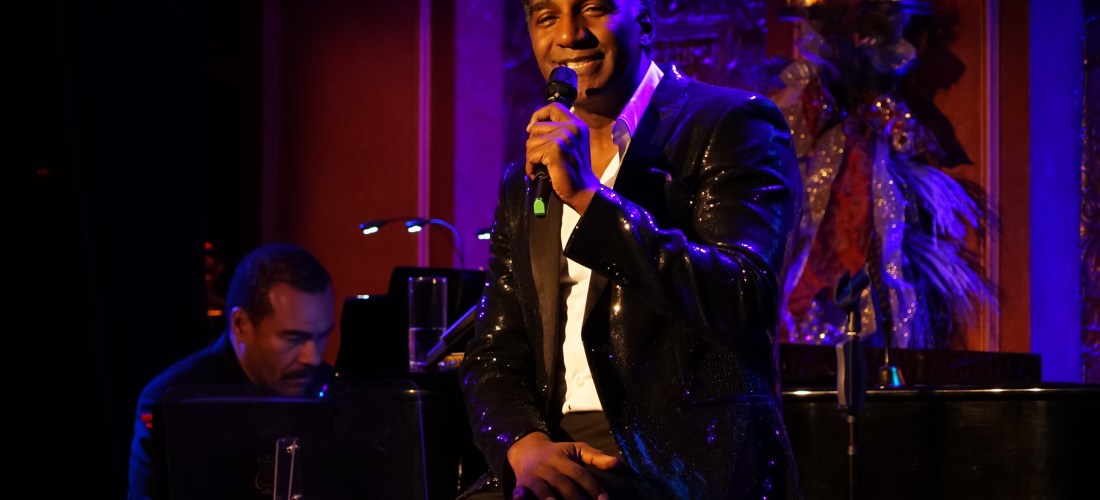
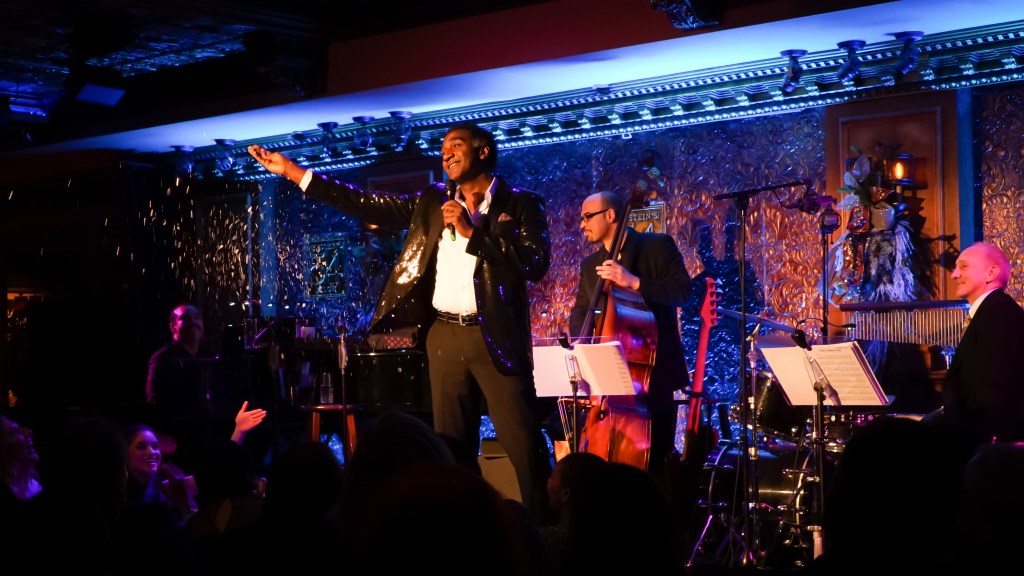
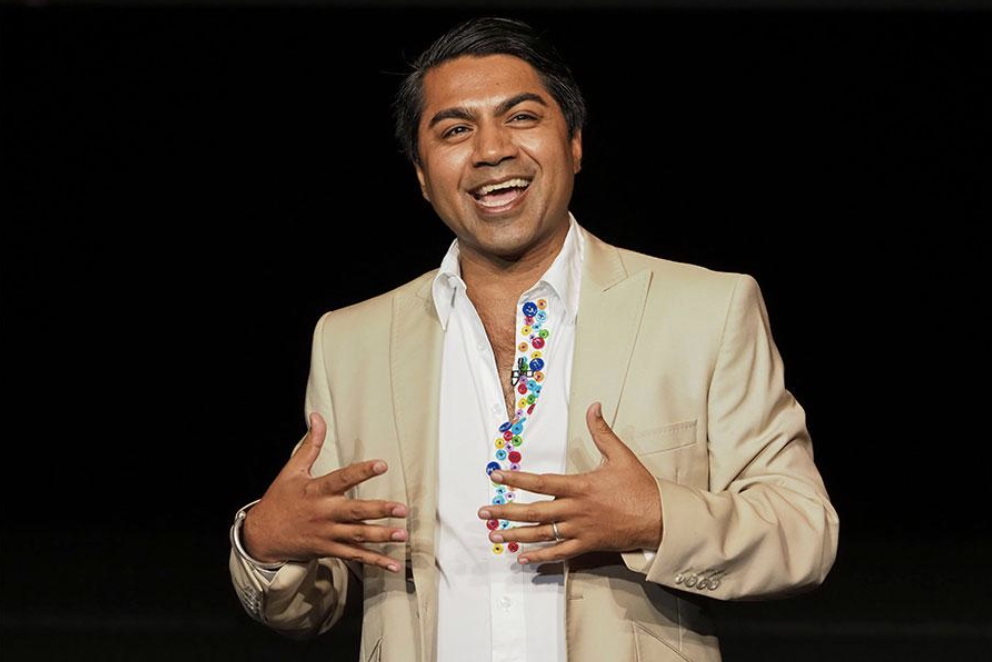
Norm Lewis performing at Feinstein’s/54 Below. Credit: Nellie Beavers
Every week, the culture critics at Token Theatre Friends bring their fresh perspectives to the performing arts on their podcast and video series. The podcast can be found on Spotify, iTunes, and Stitcher (look for the all-red logo) The video series is available on YouTube. The TTF theme song is by Sean Mason (with vocals by Angela Ramos). The video animation is by Brad Ogden, with logos by Jason Simon.
In this episode, Jose talks to Broadway icon Norm Lewis about his new Christmas show at Feinstein’s/54 Below. Unlike years past, audience members can’t gather at the famed nightclub to be serenaded by Lewis. So he’s doing the next best thing by crafting an intimate evening filled with beloved holiday classics. As well as Lewis’ own takes on what makes “a Christmas song.” The show premieres on Dec. 17 and will be streamable from Dec. 18 – 31.
The star of Dessa Rose and Porgy and Bess, goes deep into his song selection process and explains his love for his band. He also reveals what’s in his letter to Santa this year, and shares his heartfelt wishes for our world.
The characters of “She KIlls Monsters.” Courtesy of Kelly Lin Hayes.
In Show Your Work, BIPOC theater-makers provide insight into their favorite creations. Think of it as a guided tour inside the artists’ minds, with the artists themselves as your tour guides. In this series you will see artists deconstructing scenes, elaborating on their designs, sharing acting techniques, and allowing us to see them at their creative best. We get out of their way and they show their work.
What captivated me about Kelly Lin Hayes work was its sincerity. Her characters’ expressive eyes simply disarm you. They wear their hearts on their sleeves; a refreshing trait, and a return to innocence in a world drenched in cynicism. Hayes’ characters convey their creator’s unabashed passion for theater, and to my delight, and the luck of theater-makers working digitally, she happens to be a polymath.
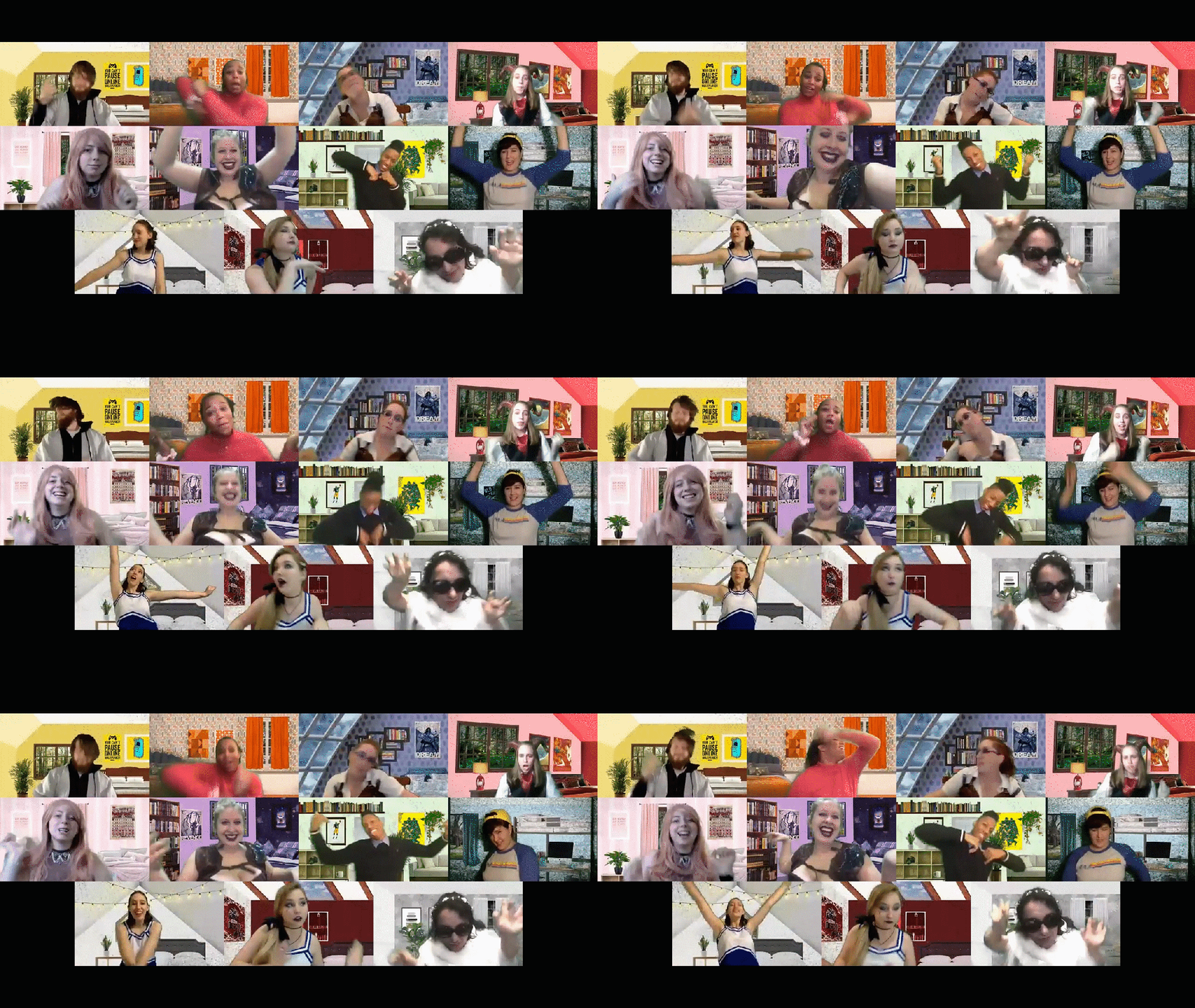
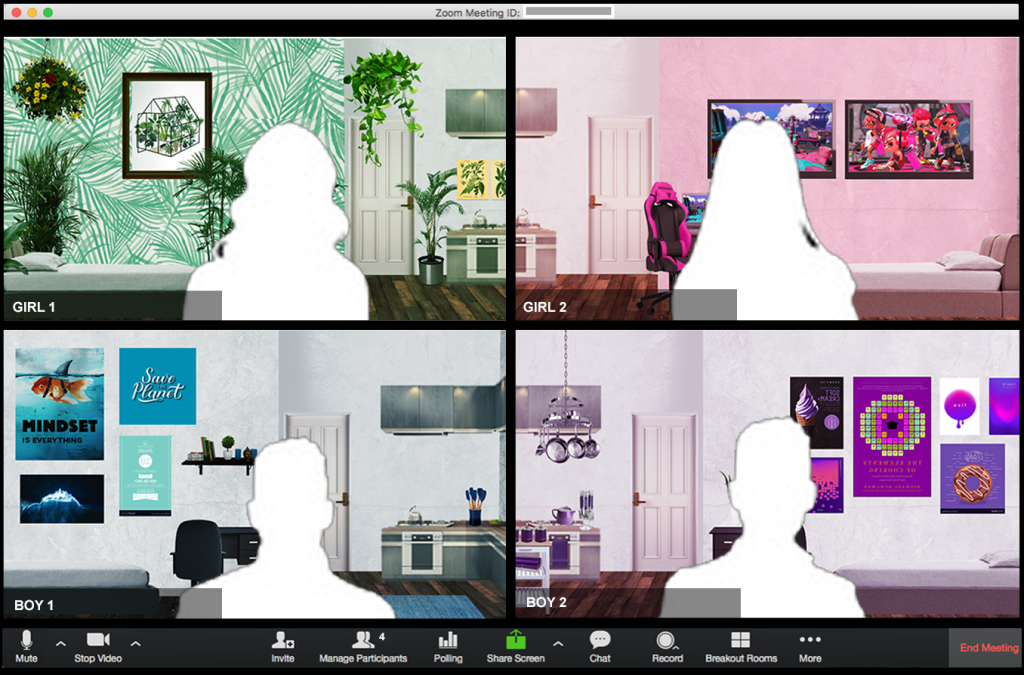
When Zoom plays and readings became ubiquitous, Hayes imagined a world beyond actors’ bookcases and living rooms. She brought back illusion through her custom set designs, which she meticulously creates using her keen eye for detail and knowledge that how the characters move in a space matters regardless of the nature of the stage. Here she talks about her life in the arts and shares some of her favorite designs, and the ideas behind them.
Courtesy of Kelly Lin Hayes.
What were you surprised to learn about your field?
I have two answers to this. Because technically I’m in two different fields. For virtual theater I would say it is so different then set design. It taught me a lot about design, and storytelling, technology and the creativity of multimedia production, which is its strength.
For physical set design, I was surprised to learn the details I have to go into as a designer. We are responsible for all of the design, going down to furniture, tile, all these smaller details. I was surprised how much we have to know about everything. This job is just constant learning.
How does being a BIPOC theatre maker influence the opportunities you have?
It’s hard to know how it influences the opportunities I get personally because I’ve only done virtual set design professionally. And all of the productions have been with friends. But it’s definitely been very hard to get people to give me the opportunity to talk and to take up space. I have all these ideas but it’s so hard to find professionals to listen to them seriously and consider, especially when all those ideas center BIPOC stories.
What is one thing you wish people knew more about your craft?
I wish people knew how much of a collaborative art it is. I don’t pretend to know everything but I do love learning about anything. So many people have helped me with set design, and my virtual set design journey and I just have a rolling list of people to thank for every show.
What was the show that made you want to do theatre?
I have three because my love of musical theatre was segmented.
The first show that brought me into theatre was Rent and I was obsessed with the show, I still am. But after some bad theatre experiences in high school I realized that while I was in love with theatre, theatre maybe didn’t like me back and I tried to stop liking theatre. But then Hamilton came about in my junior year of college, and I fell in love again. I’ve been here ever since.
A few years later Natasha, Pierre and the Great Comet of 1812 showed me a design that was both seemingly impossible and so interesting. So that show specifically is responsible for me changing careers from Architecture to Set Design.
Four Set Designs By Kelly Lin Hayes
She Kills Monsters by Qui Nyuyen
In process. Courtesy of Kelly Lin Hayes.
She Kills Monsters is a vast project. Making use of pixel art, collage, animations, backgrounds, and comics the show pushes beyond the bounds of traditional theatre, and approaches it with a new multimedia experience of theatre. This show won honorable mention in La Mama “Designfest” Competition.
(See it on November 6th 8PM EST/ Nov. 7th 8PM EST/ Nov.8th 3PM EST tickets are available here)
Marry Me a Little by Stephen Sondheim
In process. Courtesy of Kelly Lin Hayes.
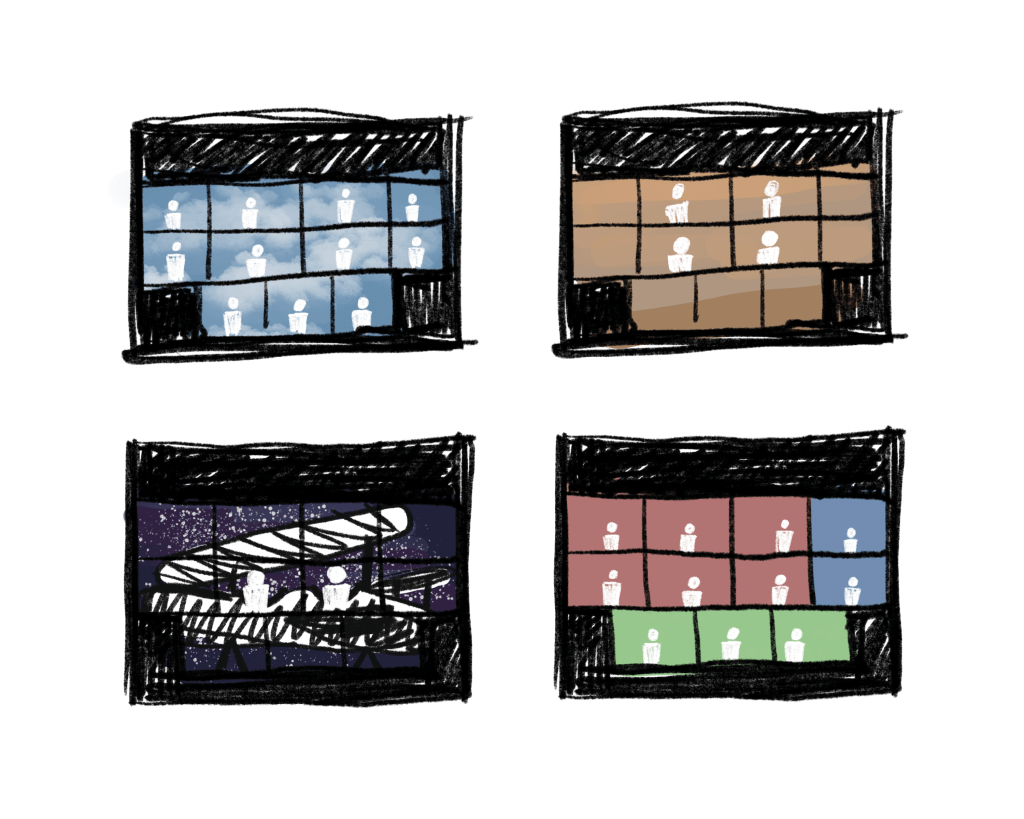
Marry Me a Little is an example of a design that I came up with just for myself. The loose song cycle format, and the story of being lonely with other people was especially relevant to the current time. This was the first example of what I call “tiling” zoom panels that helps put people in scale, and diversifies the set.
Final version. Courtesy of Kelly Lin Hayes.
The Dumb Waiter by Harold Pinter
In process. Courtesy of Kelly Lin Hayes.
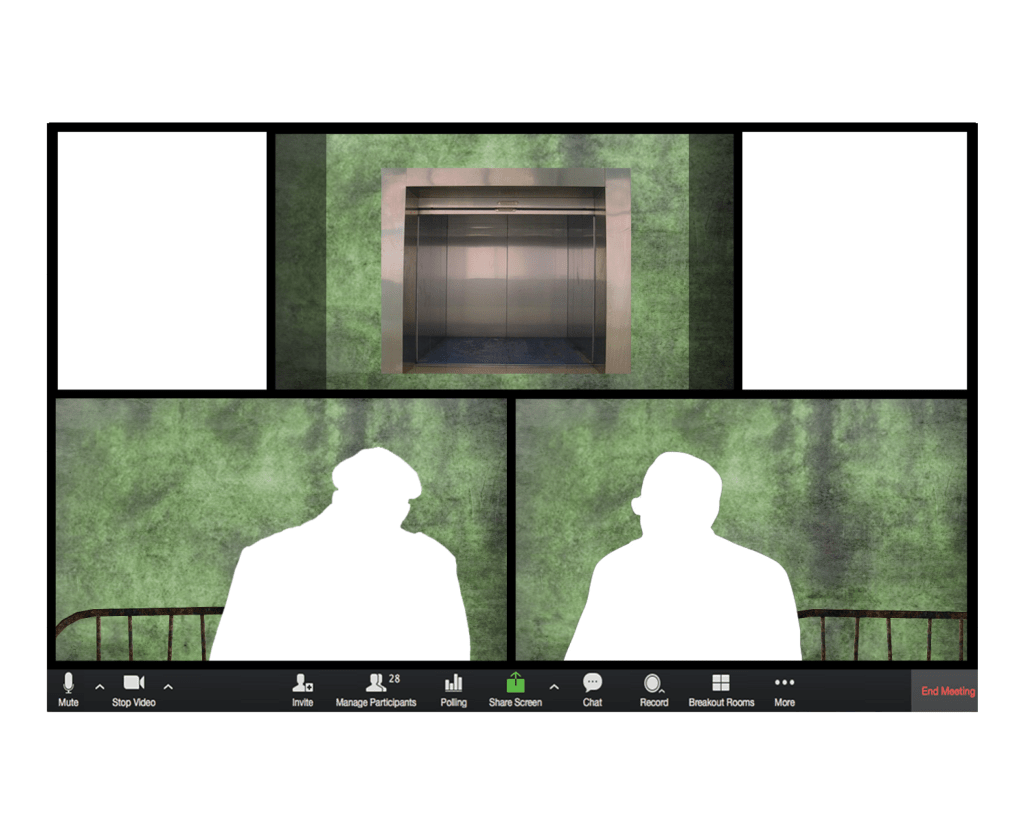
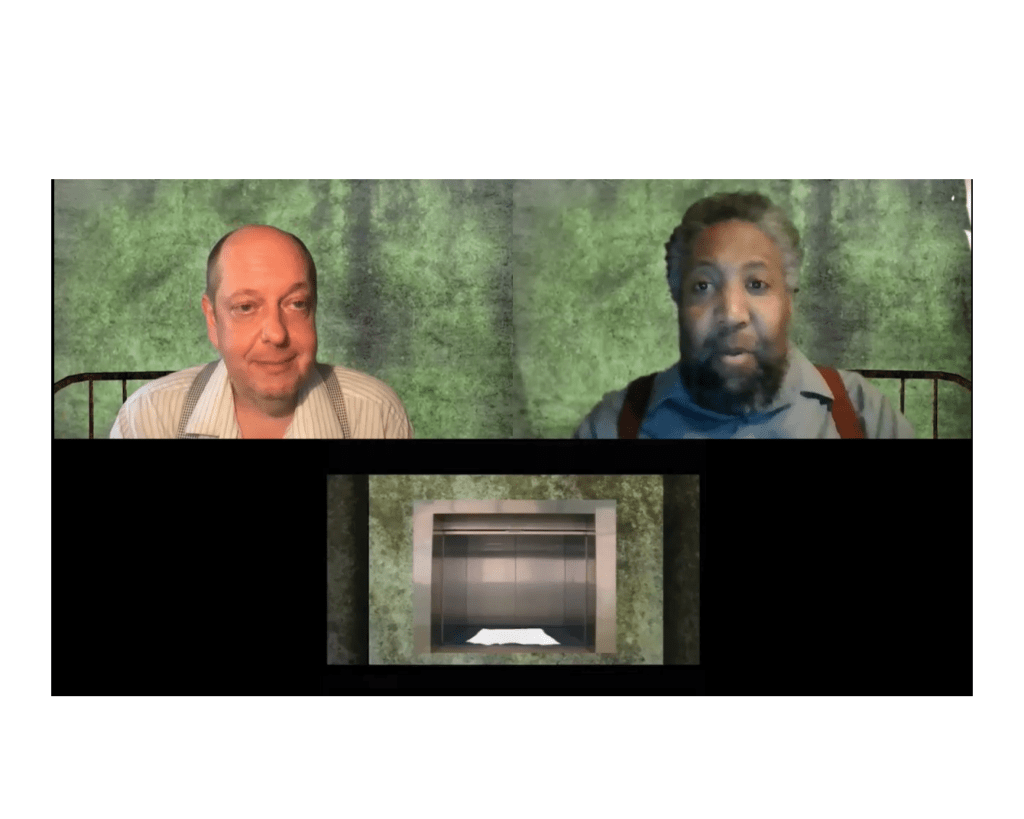
The Dumb Waiter was my first professional show. I worked with my friends Merle, Ona, Rolls and Tony. It was originally meant for a theatre, but when COVID happened we deferred to a virtual show. The “dumb waiter” itself was turned into its own character and I created animations of it being raised and lowered to add an element of surprise into the show.
Final version. Courtesy of Kelly Lin Hayes.
Night Witches by Rachel Bublitz
In process. Courtesy of Kelly Lin Hayes.
The Night Witches is the latest show I’ve taken on. A lot of the scenes take place in the sky so the “tiling” method mentioned earlier is helpful in portraying the vast skies. The careful ordering and positioning of entrances and exits help to line up the actors in the correct order to tile the scene.
Every week, culture critics Diep Tran and Jose Solís bring a POC perspective to the performing arts with their Token Theatre Friends podcast and video series. The show can be found on Spotify, iTunes, Stitcher, and YouTube. You can listen to episodes from the previous version of the podcast here but to get new episodes, you will need to resubscribe to our new podcast feed (look for the all-red logo). The TTF theme song is composed by Sean Mason (with vocals by Angela Ramos). The video animation is created by Brad Ogden, with logos by Jason Simon.
On this episode Jose talks to Grace McLean, the composer and star of In the Green, a musical about medieval saint Hildegarde Von Bingen, a composer, exorcist, and doctor of the church who spent most of her childhood in a tower. The cast recording is out now, you can stream it wherever you get your music, or you can buy a CD version as well (those will be released later this year).
Grace spoke about the new subject she’s been fascinated in during quarantine, shared insight on her writing, and what it was like to give voice to a woman who challenged societal and religious norms on what women were supposed to do.
Here are the links to the things discussed in this episode:
A screencap from “Pinching Pennies with Penny Marshall: Death Rituals for Penny Marshall.” Courtesy of New York Theatre Workshop.
Every week, culture critics Diep Tran and Jose Solís bring a POC perspective to the performing arts with their Token Theatre Friends podcast and video series. The show can be found on Spotify, iTunes, Stitcher, and YouTube. You can listen to episodes from the previous version of the podcast here but to get new episodes, you will need to resubscribe to our new podcast feed (look for the all-red logo). The TTF theme song is composed by Sean Mason (with vocals by Angela Ramos). The video animation is created by Brad Ogden, with logos by Jason Simon.
In this episode, Jose talks to playwright Victor I. Cazares about their limited series Pinching Pennies with Penny Marshall: Death Rituals for Penny Marshall, produced by New York Theatre Workshop (Oct. 19 through Nov. 1st) in which the legendary filmmaker comes to life as a financial advisor sharing her wisdom with OnlyFans content creators via Zoom.
Cazares also talks about the pop culture that formed them, and how they have created a space for themselves in a field that suggests they are not Latinx or queer enough for the kinds of works being produced. Cazares speaks about form and how it relates to a medium, and discusses some of their favorite telenovelas.
Here are the links to the things discussed in this episode:
In Show Your Work, BIPOC theater-makers provide insight into their favorite creations. Think of it as a guided tour inside the artists’ minds, with the artists themselves as your tour guides. In this series you will see artists deconstructing scenes, elaborating on their designs, sharing acting techniques, and allowing us to see them at their creative best. We get out of their way and they show their work.
In this installment Gamal ElSawah, Conrado Falco III, and Sajda Waite introduce us to Wormholes, the sci-fi comedy they created, starred in, and produced during quarantine. The trio are roommates and the founders of the theatrical company Showdogs NYC Theater Collective who found themselves in need of a creative output when their first show was postponed due to the pandemic.
Although there are myriad series about the lives of zany NYC roommates, there are none like Wormholes, in which the artists combine their love for witty dialogue, the comedic sci-fi they grew up watching, and their endless need to create. ElSawah and Waite play roommates trying to declutter their apartments. Lucky for them, they have a handy wormhole through which they can dispose of the things that don’t spark joy anymore. But wormholes too can cause commotion in apartment buildings, and the one from the title gives constant headaches to their superintendent played by Falco.
The first two episodes are now available on their YouTube Channel, new episodes will be premiering each Wednesday. For their take on Show Your Work, they let us become flies on the proverbial wall as they have a chat about how they put together one of their favorite shots in the first episode.
Gamal: Alright y’all. We’re a trio of theatre artists. The pandemic hits, theatre shuts down, and what do we do?
Sajda: Make a web series about a couple of roommates living with an interdimensional wormhole in their closet, of course.
Conrado: That’s right, but you’re burying the lede. We were working on a play that was supposed to open in April. We were already in rehearsals when we were all called to stay inside.
Gamal: Don’t re-open those wounds, please. The important thing is we made a whole show that we can actually share with people. So let’s talk tentacles!
Sajda: Love suction!
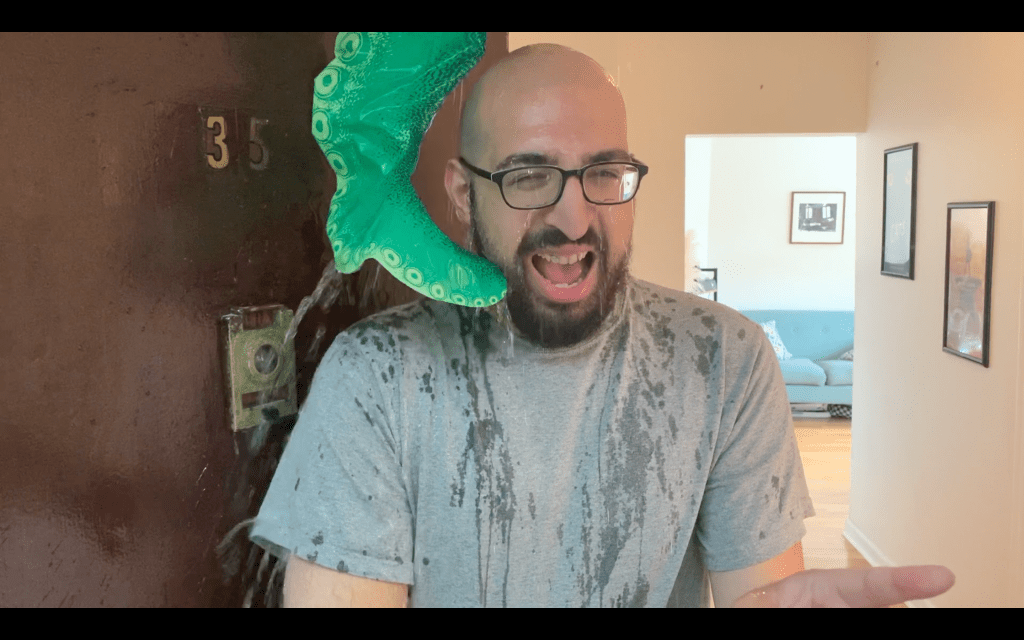
Gamal: One of the crowning achievements of our show’s first episode was our tentacle choreo- we used the thing twice. The first time it showed up was in the fourth scene of our pilot. …How did we land on a tentacle again?
Conrado: Well, we wanted it to make it clear from the beginning that our show was as much sci-fi as it was a comedy. So we needed some weird shit to happen. But I don’t know… why tentacles?
Sajda: Cheapest thing on Ebay I believe.
Conrado: Ha, that sounds about right.
Sajda: But really I think it seemed like a proper visual gag that would be ridiculous enough to get a good laugh while also showing the side effects of having a wormhole in your apartment.
Conrado: Right. We really wanted to come out of the gate strong with all this wormhole stuff, but that ended up being a lot of work because it was the first episode and we had to set up so many other things – the premise, the characters. It was a lot.
The script of the shot discussed in this piece. Courtesy of Showdogs NYC Theater Collective.
Gamal: Writing is hard! Thank God we’re so good at it! But, yeah, we had a lot to convey especially in that first tentacle scene. We had to introduce Gazpacho, that he was the building’s super, that Salman didn’t like him, and that the wormhole was causing major problems for the whole building.
Sajda: Truly introducing one of our main characters and the central conflict of the episode in a matter of, I don’t know, seconds?!?! Genius, succinct!
Conrado: Not only that, we also wanted to establish that they were the only ones in the building with a wormhole in their apartment, so we came up with some subtle exposition in the line “you’re the only ones with a wormhole in your apartment.” Silly, I know, but it always gets a laugh.
Gamal: Writing the scene was easy compared to shooting it, though- should we dive into that?
Sajda: You get a water pun! And you get a water pun!
Gamal: I got wet.
Conrado: So, if I remember correctly the tentacle was a late addition to that scene. First it was going to be just water pouring onto Gamal to signify that the Wormhole was leaking, and then eventually we were like “well, we have this tentacle…”
Sajda: Might as well get our money’s worth and throw in a little foreshadowing here for Gazpacho’s impending mutation.
Gamal: Although, I’d like to say on the record that I originally wanted to use an actual octopus from the fish market.
Sajda: But I knew PETA would have a field day, so that was a no go. So Gamal’s second idea was to use tentacle fingers.
A rehearsal splash. Courtesy of Showdogs NYC Theater Collective.
Conrado: Oh, yeah! I remember that. He found these little wormy fingers – and I guess I was gonna wear them with a fingerless glove or something like that? Honestly, I’m happy we went with the green Cthulu arm. That way we could use it in both scenes.
Gamal: That’s cool, but back to me getting wet… Tell the class what you did to me.
Sajda: Well, as director of photography, I figured the best way to set up the shot was to get pretty tight on Gams so that Coco could hover directly behind the door and pour some nice NYC tap water over his head while stroking his cheek avec tentacle.
Conrado: The big problem was we had to get the shot right on the first try, because once Gamal’s shirt got wet we would have to wait for it to dry. We simply didn’t have the budget to buy multiple identical shirts. So there was a lot of pressure…and rehearsals!
Gamal: Yes. So to make sure we could get it in one take, we just… kept doing it. In other clothes. To be honest, I feel like Conrado kept missing on purpose just so he could keep dumping water on me.
Conrado: Listen, I couldn’t see you from behind the door. I was literally sticking out my hand and hoping for the best.
Gamal: Are you there, Hollywood? It’s me, Gamal. I do all my own stunts.
The final splash. Courtesy of Showdogs NYC Theater Collective.
Sajda: Bada bing bada boom! A little iMovie magic and some zap sounds to seal the deal!
Conrado: Zaps sounds – very important. We kept watching the scene in the edit and thinking something’s not quite there. Then I think Gamal came up with the idea of adding a little zap-wormhole sound when the tentacle pops in. It really ties the whole thing together.
Gamal: Never underestimate the power of post-production sound effects.
Sajda: Never underestimate the power of three theatre nerds with nothing but an iPhone and a dream!
Conrado: Yeah okay, I think we’re done here.
Gamal: Wanna see more wacky sci-fi practicals? Tune into Wormholes every Wednesday on IGTV (@wormholes.tv) and the ShowdogsNYC Youtube Channel starting October 14th! Buh-bye!
Every week, culture critics Diep Tran and Jose Solís bring a POC perspective to the performing arts with their Token Theatre Friends podcast and video series. The show can be found on Spotify, iTunes, Stitcher, and YouTube. You can listen to episodes from the previous version of the podcast here but to get new episodes, you will need to resubscribe to our new podcast feed (look for the all-red logo). The TTF theme song is composed by Sean Mason (with vocals by Angela Ramos). The video animation is created by Brad Ogden, with logos by Jason Simon.
In this episode Jose talks to Michael Breslin, Patrick Foley and Cat Rodríguez, the creative minds behind Fake Friends, a new theatre/media company where they explore their love for pop culture, theatre and politics, through genre-bending pieces that combine multimedia with “traditional” theater.
Their latest project is Circle Jerk, a hilarious commentary on white gays and cancel culture, which they are streaming live from Oct. 18 through Nov. 7th. Jose talked to Michael, Patrick and Cat about criticism, YouTube influencers, creating theatre during a worldwide pandemic, and Fellini.
Here are links to the things mentioned in this episode:
If bad news has become the norm of 2020, the universe allowed an exemption for the young actor Sara Gutierrez, who in the midst of quarantine got the most significant call of her career. “Do you want to be the lead in the first outdoor show in New York City since the pandemic started?” asked director Ellpetha Tsivicos, and playwright Camilo Quiroz-Vazquez, the creative forces behind Quince, an immersive theatrical experience that subverts a traditional quinceañera by centering a queer heroine, Cynthia, a Mexican American girl divided between her culture and her future.
Gutierrez couldn’t hold her tears as she told Tsivicos and Quiroz-Vazquez how much she needed these news at that precise moment. The previous three months had been a nightmare, as NYC became the epicenter of a global pandemic that forced businesses and artistic institutions to close their doors, leaving New Yorkers perhaps for the first time without the possibility of overcoming grief by having their souls restored by art.
“We had a Cinderella moment,” says the director, her voice overcome with happiness as she describes Gutierrez’s habit of sending her pictures in which she’s memorizing her lines. The excitement of the ensemble fills the creators of the show with purpose, “they’re theatre warriors,” says Tsivicos.
Ellpetha Tsivicos and Camilo Quiroz-Vazquez. Credit: Lindsey Winkel
Quince was supposed to be a staged reading back in April. “We probably would have done it in a room in the Williamsburg Public Library,” says Quiroz-Vazquez. But as the pandemic became more unmanageable and total re-opening continued being elusive, the duo settled on two dates in August. Having done outside shows with Double Edge Theater, they were comfortable with the updated setting.
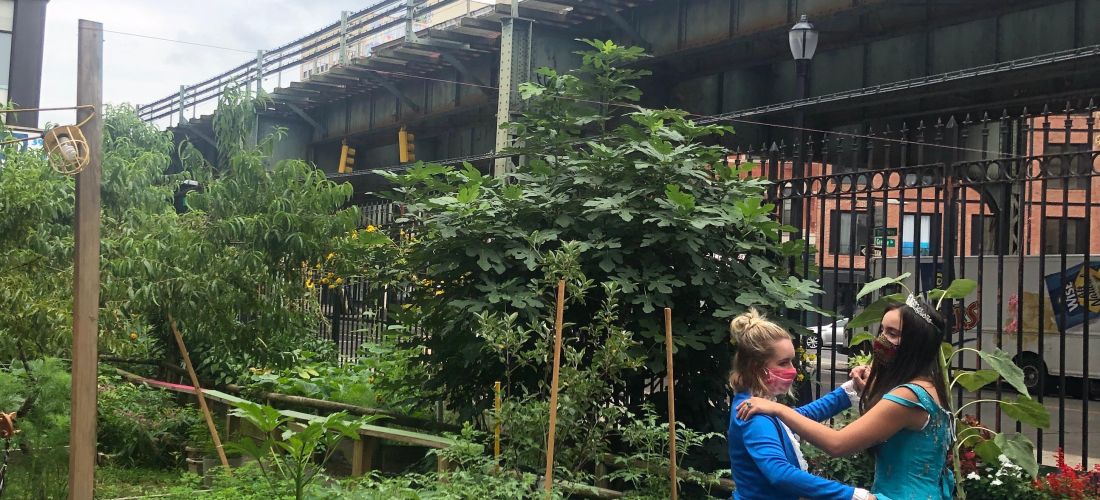
For years, they had wanted to stage a show at The People’s Garden. Located in the heart of Bushwick, the community-built, and volunteer-maintained space, provides a gathering space for the neighborhood that Tsivicos and Quiroz-Vazquez call home. “We know the owners of all the shops in our neighborhood, we’ve always tried to be local and create communities wherever we go,” says Tsivicos. The garden’s unassuming beauty was the perfect setting for Cynthia’s rite of passage, an oasis hidden in a bustling Brooklyn neighborhood.
For Tsivicos and Quiroz-Vazquez, doing the show was no longer just a matter of bringing their work to a stage, it became a way to thank a neighborhood that in years past gave them a home to return to after their daily dealing with the deep inequality New York artists face. The playwright explains everyone doing the show is working one or more jobs, which made scheduling difficult, but it also revealed the misconception that artists belong to the elite, “what could we all accomplish if we could focus on our art more specifically?” says Quiroz-Vazquez.
It’s a strange, but poignant coincidence that on the weekend Quince premieres, First Lady Melania Trump is reopening the Rose Garden at the White House, which she remodeled in the midst of the pandemic. As audience members in Bushwick attend a show created out of love, even tickets were distributed for free, in Washington D.C. a lavish garden will be revealed, meanwhile outside the White House has been barricaded to prevent peaceful protesters from disturbing the President’s day. Which one seems more like the people’s garden?
While most of New York live theatre remains dormant, and few commercial endeavors have risen to the challenge of what the time demands of them, the artists involved in Quince have been able to create a symbiosis of joyful creation and demands for social change. Friends of Tsivicos and Quiroz-Vazquez are contributing artwork to create the setting of the play. One of their friends, whose work is often political, is designing a crochet sculpture to be used as centerpiece, meanwhile every actor cast is from the Mexican or Chicano communities.
Art in New York City has become a luxury only reserved for those who can pay the highest prices, quite the contrast considering many of the performance arts started as folklore and community rituals. From the moment they met and decided to start working together, Tsivicos and Quiroz-Vazquez, have centered their work on the mission of rescuing and preserving cultural practices that are disappearing with the steamroll of globalization.
For Quiroz-Vazquez, the Mexico of his grandparents is something out of memories he will never get to experience. When he visited Cyprus, where Tsivicos’ family came from, he was surprised to realize how many traditions were preserved and practiced, to the point where the Cyprus he saw in the 21st century, has more in common with the Mexico of his ancestors.
Tsivicos had the opportunity to spend lots of time with her grandfather before he passed away, and captured moments of his daily life, so that even after his death, they can stay with her, they’re also memory tools so that she won’t forget where she came from. A land of farmers where her grandmother would still make her own bread and cheese. Tsivicos points out how in quarantine, many Americans who had never considered not buying their food in supermarkets, were suddenly baking bread, making cheese, desperately trying to secure themselves to any roots, as the world shape shifted overnight.
As New Yorkers, Tsivicos and Quiroz-Vazquez are performing a small miracle to remind the city of what it can be when it centers the interests of a community, over greed and indifference. “we need social activities, especially during everything that we’ve been through, it’s important to remind people there are more social activities than just eating out,” says Tsivicos. Quince of course will follow strict social distancing rules and masks will be enforced for the safety of the performers and audience members. It is totally safe, according to the director, who also expresses “a lot of our work goes back to catharsis either for us or for groups of people.”
As audience members leave Quince, they will have experienced a modern version of learning, embracing and loving culture through oral tradition. To eavesdrop on each of their conversations on their way home, as they take in the warmth of the Brooklyn summer night, the fragrance of the plants and flowers, and the power of the story they just saw unfold before their eyes, an honor and a pleasure almost too overwhelmingly beautiful to dream of.
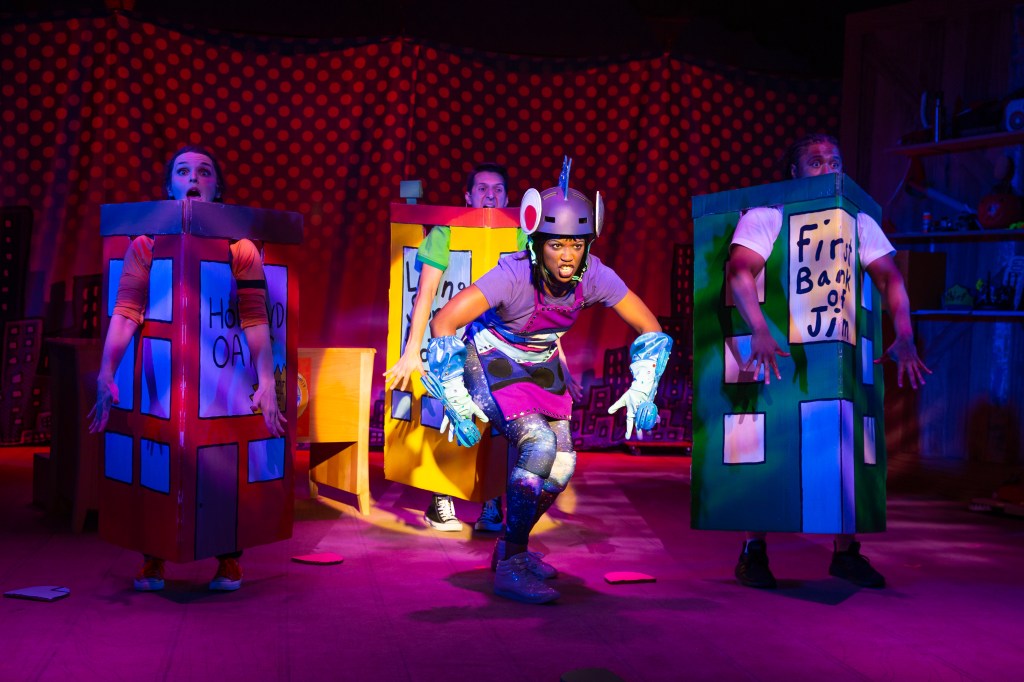
If you know any children between the ages of 7-12, chances are you’ve heard them rave about Dog Man, he’s the half-man/half-dog hero of Dav Pilkey’s eponymous graphic novel series. Although he’s committed to fighting crime, Dog Man often tends to attract chaos in his pursuit of justice. His approach to cases being as messy as what happens when a dog’s head is transplanted to a police officer’s body.
Pilkey’s inventive series combines multiple genres and relies on simple illustrations to teach its young readers about the power of imagination and the importance of treating everyone with kindness, even those who sometimes fail us.
In 2019, TheaterWorksUSA produced a stage version called Dog Man: The Musical, featuring music by Brad Alexander, and book & lyrics by Kevin del Aguila. Although at first, I attended the show simply because I wanted to take a friend’s son – he’s a huge fan of the books – I found myself completely captivated by the production’s DIY aesthetics, the energy of the ensemble (so many BIPOC actors!), the references to classic Broadway shows (most of which most likely flew over kids’ heads), and the songs.
I went to the show once more last summer, downloaded the cast recording when it was released, and there hasn’t been a day since when I haven’t sung “Go! Dog Man is go!” at the top of my lungs.
This summer, TheaterWorksUSA is letting kids be part of the magic by hosting Dog Man: The Musical Camp, an immersive virtual summer program where children ages 8-12 can take part in the magic of the show. Participants take master classes with costume designers, set designers, and vocal coaches, leading to a digital opening night where parents can delight with a performance of highlights from the musical.
I have never resented being an adult as much as I did when I realized I was too old to attend Dog Man: The Musical Camp.
Continuing TheaterWorksUSA’s commitment to providing equal opportunities to BIPOC artists both on stage and behind the scenes, I was keen to learn more about the camp from musical director, Jarred Lee, the 25-year-old gay Black man, in charge of introducing children to how to sing on stage. We spoke while he spent quarantine in London.
What does a typical day at Dog Man: The Musical Camp look like for you?
This has been definitely a learning process for all of us, because I don’t think anyone expected to have to be running a virtual theater camp this summer. But we’ve made the absolute best of it and our students are such a pleasure to work with. My job is teaching the music and how to perform that music with an instrumental track. For an adult or seasoned performer, it may not be that difficult, but our younger students tend to have some issues singing with an instrumental track that doesn’ have a vocal guide, or someone else singing along with them.
Within that period of time, I’m also able to throw in some really cool vocal tidbits about singing and posture, and other cool things that they can just add on to their summer plate of knowledge throughout the camp.
Courtesy of Jarred Lee
How did you end up working in Dog Man: The Musical Camp?
I got the job with TheatreWorksUSA when they were looking for musical directors. I was recommended to them by my friend Rachel, who I’ve worked with at Pace University. We directed a production of Guys and Dolls this past fall. When I got the job, I have to be honest, I didn’t know what Dog Man was. I’d never heard the book, but I listened to the cast recording and I immediately fell in love.
It’s a kids’ show, but it’s honestly a lot of fun. Most of all, it was really cool seeing the kids interact with it and the connection that they have to this material. Seeing that alone definitely inspired me. I’m just having so much fun watching them love this material as much as they do.
I can not get enough of this musical. I sing “Dog Man is Go” 24/7!
The writing of it is so catchy! My roommates here have all been singing the songs as well, just from hearing me teaching it. It’s just so easy for it to get stuck in your head.
What’s a song that you particularly love teaching the kids?
I would have to say the opening number, and I know that sounds really cheesy because in your classic musical theater, the opening number is all about setting up the story. But I happen to love classic musical theater. I love that cheese, so that that song was definitely right up my alley.
Courtesy TheaterWorksUSA
You’re 25 right now, what were some shows like Dog Man that you loved when you were your students’ age?
I should preface this by saying that my musical theatre background started very, very late in my life. I was a freshman in high school and they were having auditions for the big drama, which was Oliver! At the time, I was a sports guy, I didn’t imagine myself ever doing a musical and I ended up loving it. I started by trying it out for fun and here I am all these years later in my career doing professional musical theatre.
I would have to say in terms of something similar to Dog Man, I think High School Musical might be that. High School Musical didn’t have the books that Dog Man has, but it had the movie which at the time was so relatable.
I loved High School Musical too, and I’m much older than you. I wonder if you ever felt the need to justify yourself when you went from sports to theatre? Kids can be quite cruel with their peers who show any interest in the arts.
Throughout high school for sure, I definitely was able to manage doing both sports and musical theater because the schedules didn’t really conflict that much. There was a point when I got to senior year, or end of junior year rather, where I was starting to look at colleges and where to apply. At that point, I kind of stepped back from sports so I could focus on music. Even though music was something I had started doing for fun, I just kind of wanted to stick with it and see how far I could go.
Do the kids call you Mr. Lee, or Mr. Jarred?
It is so strange being a teacher and also being young. I’ve worked in so many situations where the students call you by your first name, and it’s super chill. I never mind but I like to gauge it off of the vibe of the company. TheatreWorksUSA is a very professional company and right from day one, we were Mr. Jarred, Miss Lisa…every adult had a handle on it just because these are young kids and that’s what they’re used to. So for these kids I’m Mr. Jarred.
The other day a teenager called me sir and I clutched my pearls so hard I almost choked myself. Like you, I started doing what I love from a very early age so I want us to talk about mentors. As BIPOC people in the arts, we tend to grow up without any mentorship and especially without the mentorship of other BIPOC artists. People don’t expect a 34-year-old gay Latino to show up when they hear a theatre critic is coming and I’m sure when people think about musical directors they instantly assume it will be an elderly white man. To some of these kids, even at 25, you will be like Yoda! So when you were growing up did you have mentors? Or was mentorship, something that you craved?
At this moment, looking back, I don’t really think I had much of a mentor in my life when it comes to music and theater, just for the sheer fact that my family is not a musical family. They’re all about sports. So when I kind of found that I was good at music, I kind of carved my own way and path to get to where I am.
Obviously I’ve had help from several people, but I can’t say that there’s been one person that’s kind of been around that I looked up to through the entire process. I do take the position I hold very seriously being a gay person of color. I know for a fact that I am not what these kids are used to seeing, as a teacher, as someone working in musical theater, as someone playing a violin. That is not something they’re used to seeing. So it makes me feel so great to know that I might be the first person that this kid has ever seen, do what I do that looks like me.
Being able to change those stereotypes and what the norm is is great because this is the generation to do it with. It makes me really, really happy to know that I can have that effect on these young people. I think because of that, I definitely try to hold myself to a very high standard, not only when it comes to my own work and performance, but also just as a human, following rules and the law. I know eyes are on me so I want to try to be a good example for all these kids that I end up teaching.
I know for a fact that I am not what these kids are used to seeing, as a teacher, as someone working in musical theater, as someone playing a violin.
jarred lee
People never get to see the music director unless they’re working in the show. So giving visibility to positions like these, that again people never imagine anyone but a white man having is so exciting.
What I can tell you is that teaching was not something that I’d seen on my to do list as an adult. At this point in my life, I thought I’d be working a little bit more on Broadway full time playing in musicals. But a big chunk of my yearly income comes from teaching. I teach at an elementary school in Brooklyn, and also do short term projects at various elementary schools and high schools throughout the Tri State Area. I never saw myself as a teacher but knowing that I’m breaking those barriers for those kids is what keeps me in the career of teaching.
What is one thing about being a music director that people get wrong, that even probably you didn’t know was true until you started doing it?
I think a lot of people think the music director is just the guy who plays the piano. I’ve heard that quite a few times. I could go down the checklist of all the other things that we have to do [Laughs] There’s just so much more to it. At times I find myself being a life coach all of a sudden, because when you’re working with actors sometimes we’re in a one on one situation where you have that vulnerability with someone, and a lot of things can come up. All of a sudden, they’re talking about a home situation, because the song that they were singing really brought back a memory. So there’s just a lot of different hats that we have to wear while also being the guy playing the piano.
Because a lot of people assume that you’re kind of like a human karaoke track, right?
Oh, all the time. But what I’ve always loved about music directors is that I have seen them at work. They’re the people who sometimes convince the artists and the performers that this part, or this song, can be for them, and about them with a key change or with some tweaks and stuff.
I wonder if you have any particular experiences where you’ve maybe rediscovered something about a performer and about yourself because of a slight change in a key?
The key thing happens quite often and it gets really tricky when you’re dealing with licensed work with changing keys because nowadays you have to go through the licensing company to request the key change. They send you all the additional orchestra parts in the new key. It becomes a bit of an ordeal rather than just having someone that can just do it on their own that’s on your team. But legally we have to go through the licensing agencies.
I worked on a production of Guys and Dolls at Pace University this past year, and our Nathan had a lot of difficulty singing the songs in the original keys. It was really, really messing with him. It wasn’t like sitting right, but he was so right for the part. So what we were able to do was change all those keys to make it something that would make him feel very comfortable and really in his body singing it. The day when we changed the keys he couldn’t even stop crying, he was just so happy.
Luckily, because TheatreWorksUSA owns the rights to all of their shows, working in Dog Man has made life a lot easier for doing those types of edits. So far, we haven’t had to change any keys for the songs for our kids. But there have been several moments where a child is getting upset because they can’t hit a certain note. So I will do my best to coach them there. But sometimes it’s just out of their range, so what we do is we’ll create a track that’s in the same kind of range of what we’re going for. Watching these kids make that transition, they’re just so happy to know that we can modify the music to make them feel good and feel comfortable.
[Music directors are] the people who sometimes convince the artists and the performers that this part, or this song, can be for them, and about them with a key change or with some tweaks.
jarred lee
I wish I could be in this camp. Is there a piece of musical theater or a piece of music specifically that you wish that you could live in forever?
Okay, it’s gonna sound crazy, but I think it has to be my favorite musical, which is Wicked. That was the first show I ever saw on Broadway. It was the first Broadway album I ever listened to, right at the very introduction of musical theatre in my life. I’d read the book, but when I saw Wicked on stage, I’m sure a lot of people have a similar story, but it was just such an out of this world experience. They made Oz seem like such an amazing place.
Should parents and adults who might want to send their kids to the camp need to worry about their kids not being baby Audra? Is the camp welcoming to those of us who can’t sing to save their lives?
Oh, absolutely. I will say one of the things I’ve loved about this is the fact that we make every single child involved in our shows feel special. We find the place where they fit in perfectly, whether it be a little bit more singing, less speaking part, or more speaking parts with less singing. We’ve worked really hard to make sure that we can accommodate every child. We make sure they’re engaged the entire time during the camp process.
You know, a lot of us have had our first online teaching experiences. I know my first was this past spring when everything was moved online on teaching music at my elementary school via Google Classroom. There are times where you’re not being spoken to directly and it is so easy to lose focus, and kind of just be staring at a screen which is, as you know I’m sure, absolutely exhausting. With this camp, we make sure that every second these kids are engaged and that they’re doing something so that they’re not bored. And that they can truly, truly have fun with the material.
And the last thing I’ll ask you for now is: who’s your favorite character in Dog Man?
It’s got to be Petey. I love a good villain.
For more information on Dog Man: The Musical Camp go here.
Take one look at producer Arvind Ethan David’s credits on the Internet Movie Database, and I dare you not to have the word “adventurous” instantly pop into your mind. He’s behind an award-winning film starring a famous footballer, the television adaptation of a quirky book series by Douglas Adams, and a touching comedy about a Muslim man who discovers he’s actually Jewish. And that’s only the work he’s produced onscreen. David has also managed to write a play, several short stories, and delivered a TED Talk for the ages in which he drew parallels between his journey to become an American citizen and his work as the lead producer on Jagged Little Pill.
Oh yes, he’s also a Broadway producer, a solicitor, a comic book writer, an escape room creator etc. etc. etc.
Name a hat, David has most likely worn it. If none of his works seem to have much in common, they are united by an undeniable thread: their producer’s unique vision and what appears to be a total lack of fear.
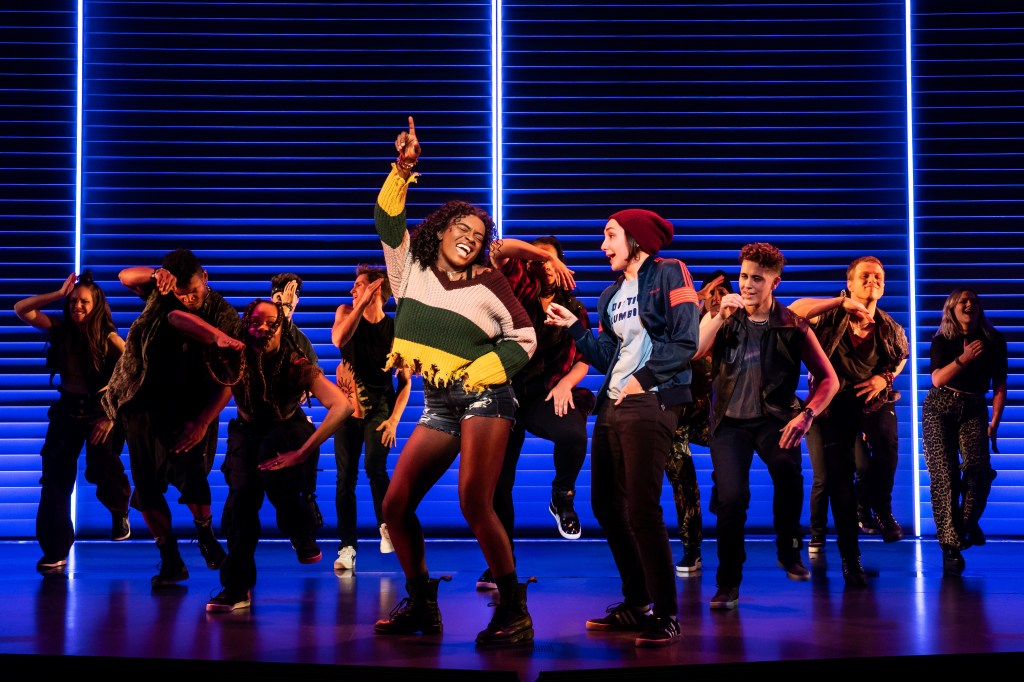
As one of the few BIPOC lead producers on Broadway, it’s no surprise that David has become one of the loudest voices in the industry when it comes to representation and diversity. The book for Jagged Little Pill, which he commissioned from the Oscar-winning screenwriter Diablo Cody, breaks the mold of the jukebox musical by taking Alanis Morissette’s iconic album and turning it not into a bio-musical, but a study of the many issues that plague upper middle class American society.
When Broadway went dark, David immediately found ways to keep the show in the minds of fans and potential new audiences by creating You Live, You Learn: A Night with Alanis and Jagged Little Pill, a special event that reunited the cast of the show and featured a performance by Morissette herself. But less than a week after the Jagged family had celebrated the power of music, we were reminded that America often grieves but never learns, as a white police officer in Minneapolis, murdered George Floyd, a Black man who had allegedly tried to use a counterfeit $20 bill in a grocery store.
The protests and social uprising sparked by Floyd’s murder led David to put his time in quarantine to organize #WhileWeBreathe, a benefit for the NAACP Legal Defense and Education Fund, the Bail Project, and other organizations that seek racial equity in the US. I spoke to the producer about how he put together an all-star event in the midst of a pandemic, his take on streamed theatre, and his moral responsibility when it comes to creating art.
I am really curious about what it’s like to put together an event like #WhileWeBreathe in the middle of a pandemic and what the challenges of something like this are for a producer?
Let’s do the why first. It was the weekend after George Floyd had been murdered. It was the start of the protests. And like, everybody else, certainly everybody of color, in America, we were profoundly depressed. My wife and I are immigrants, she is black, I’m Indian, my daughter’s biracial and we moved to Obama’s America, but the last four years have been a very painful repudiation of a lot of our hopes and dreams. I got an email from Brian Moreland, my partner who I’ve been friends with for a while, he’s one of the only Black producers working on Broadway. And he wrote not just to me, but to about seven or eight lead producers from the senior leadership of the board. He wrote this brutally honest letter about the headlines and the news about George Floyd, and laid out his own experiences as a Black man. He said, “we have a position of power, we need to do something.”
I got that and then everybody started putting out statements, every show, every institution, made a statement. But I knew we could do better than a statement, I texted him back and I said, “I think we should do something, I don’t know what it is yet, but if we do something we’ll do it together.” He wrote back and said yes.
At the same time, I was texting with other friends, one of them was Neil Brown Jr., who’s a great actor, and I knew he’d be angry and depressed that weekend. I said to him, “ if I write something about this moment, and how I’m feeling, will you act it?” He went “Yes, thank you, I need this.”
As a writer, I needed to write something about this moment. And as a producer, I knew I could put something together. And so that’s how it literally came out that night with a bunch of friends. A bunch of producers of writers, and actors of color, being depressed and angry, and texting each other. By the next morning, I wrote #WhileWeBreathe. And everybody was like, “Yes, we’re in.” Then we started emailing friends, and friends emailed friends, and people posted on Facebook groups and WhatsApp groups and suddenly we have a cast of I think 20 actors, a full production and post production team of another 25, 11 writers, 9 directors. Suddenly we have a company.
Almost everyone in our company is a person of color, this doesn’t happen in a normal production where we’re usually the only Black or brown faces. Suddenly, it’s us running the show and it’s glorious.
arvind ethan david
George was not the first person to be brutally killed by the police in front of cameras. He’s not the last even. But the difference is this time, because of the pandemic, everyone was at home, and they had to watch it. Everyone was at home, but they couldn’t just go to the office, or go to the bar, or shrug it off and be sad for two minutes and then move on to their lives. We’ve all been forced to sit at home and feel our emotions. And frankly, you know, a lot of people have lost their jobs and even people who are lucky, like me, who can work from home. I’ve also lost my Broadway show, my escape room business. Those things aren’t happening and I don’t know when they’ll happen again.
So people have a lot of emotions and they have time. So actors were available, directors were available, writers were available, and they had a lot to say. The usual outlets of how we would say it were not available to us because of the pandemic but in a way there was also a moment of opportunity, where a bunch of enormously talented people with something to say, if we offered the platform for them to say it, we didn’t have to deal with a hundred agents and the usual gatekeepers. Almost everyone in our company is a person of color, this doesn’t happen in a normal production where we’re usually the only Black or brown faces. Suddenly, it’s us running the show and it’s glorious.
The trailer for #WhileWeBreathe
How do you describe the work a producer does?
The easiest answer I found is I say I’m the lead entrepreneur. I’m the chief executive of the organization. It’s my job. In my case, normally it’s my job to have the idea and then it’s my job to assemble the team to execute on the idea, and then to protect them, defend them, and steer them. And that’s how I’ve always worked. Jagged Little Pill was an idea that I had in the shower 10 years ago,
In the shower?
I was in the shower, my then-girlfriend now-wife remembers me coming out dripping wet and going, “Hey, I think Jagged Little Pill wants to be a Broadway show.” She went “you don’t work on Broadway.” I was like “no I don’t.” She said “you don’t work in the music industry?” I said “no, I don’t.” She said “do you know Alanis Morissette?” I said “no, I don’t.” She said “OK,” and went back to whatever she was doing. During opening night in Boston, she said “that’s from the shower.”
So what tends to happen is I just have an idea and then try to build the best team around them and then protect them and fundraise for them, and market. This is me personally, but I’ve never been a co-producer, Jagged was my Broadway debut as a lead producer. I don’t know how to be a co-producer, I generally say no because I think I’m not going to add value.
Is the shower usually where inspiration strikes?
[Laughs] I don’t know if there’s a place. Yoga, often is where I’ll have an idea. Jogging, doing exercise. I only have a few things that can take my brain off the thing in front of it. I’m very present, very focused.
I was reading your Wikipedia page and you’re also a solicitor. What about your training in business and also in law has contributed to make you a producer?
I’m used to negotiating deals, right? That’s the training of a lawyer. That’s a lot of what a producer does, it’s constant deals, whether it’s talent, marketing or financing deals. I went to business school, I have an MBA. So I know enough in every discipline to know how to manage people who are good at it. I know enough about marketing to manage a marketing team. I know enough about operations. I know enough about finance to ask the right question. A producer also has to be a journalist.
But I also say because I’m a lawyer, I think about legal solutions, I think about structural solutions to problems. So it’s why when we had the idea of #WhileWeBreathe, I called the Legal Defense Fund and wanted to partner with them, because I believe that racism doesn’t change, just because people make statements. Racism changes when we have the structural, legal, statutory, regulatory solutions we need. And so that’s why they’re our partner, and we’re hoping to raise a lot of money for them and raise attention to their specific programs in the specific focus of police reform, voting rights, and districting.
I think structurally about solutions to any problems, including problems about representation, and inclusion and racism on Broadway, or whether it’s about the bigger issues of race in this country, or whether it’s just the practical issues of how do we structure deals that are fair for our cast and investors on any project that we’re doing.
I come from a family of lawyers, and even though I honestly, I didn’t like being a lawyer, I am proud to belong to that fraternity because that’s the fraternity that is fighting for civil rights and due process, protecting voters not only in this country, but in every country in the world. I’m proud that I have that background.
What about the process of producing #WhileWeBreathe is something you wish you can continue to do if we go back to seeing theater in community?
One thing that’s really interesting is the perceived wisdom on Broadway that audiences of color will only turn up if it’s specifically a show about them. There’s a very frankly hackneyed, and slightly racist way of marketing to Black audiences. Audiences of colors are left uninvited from Broadway. Not just as audiences, as financiers too. There’s a feeling, no, I don’t think anyone’s had any feelings about it. It just hasn’t happened. It doesn’t happen because they can get by without it. Because you can fill 1000 seats with white people from New Jersey every night. You can do that.
When I got into Broadway, that was really surprising to me because I come from film and TV, and in film and TV, you don’t get to ignore 45% of the population. You don’t get to do that. I can’t put a show on television and say I don’t care about marketing to half of half of America, and two-thirds of the world. I don’t get to do that and I wouldn’t want to. It’s not an option. Netflix doesn’t have that option, which is why Netflix has entire marketing teams and divisions, and entire programming divisions focused on this. And when I turned up to Broadway I wondered how come Broadway doesn’t do this? The answer is because they haven’t needed to. Because it’s only 42 theaters, and only 50,000 people a night. That’s not that many people.
I think one of the interesting things about this moment of COVID, is the realization that everyone is sort of having, that the audience is bigger and it’s everywhere, and it’s more diverse, and it will turn up on YouTube. The Broadway Advocacy Coalition had a three-day, three or two hours a day series of discussions with no marketing, just an email blast, and 5000 people turned up every day, and sat for two hours on YouTube to listen to people talk about race and Broadway. That’s a lot of people turning up for three days in a row. That’s like, sold out Harry Potter for two weeks, right? That’s gonna start to tell you something.
It’s always a risk to do something that might kill the golden goose and Broadway is a golden goose.
arvind ethan david
We did a live broadcast of Jagged to raise money for the Actors Fund, and we got two million views in five days. So there’s an audience out there, that will come that is different from the traditional Broadway audience, and they are not that hard to reach. You might have to use different methodologies than you’ve been using day in day out for the last who knows how many years, but they’re not necessarily more expensive to reach. They’re not necessarily that much harder to reach. We just need different thinking and different people doing the thinking.
Unfortunately it’s going to be a long intermission and there’s going to be a long period where all of us whether it’s commercial producers, or not for profit houses, in New York and around the country, are going to have to find ways to continue to connect with our audiences, and continue to give them experiences and stories that move them, and fulfill them because that’s our obligation both morally and commercially.
Then maybe when it goes back to being 42 buildings, hopefully, one more building if the Apollo succeeds in becoming an official Broadway venue. Even when it goes back to that, hopefully everyone will remember that there’s another way of reaching an audience, and another way of selling them tickets and bringing content to them. We can have Broadway Plus.
Credit: Matthew Murphy
I grew up in Honduras watching movie musicals, and for instance, the first Broadway musical that I ever saw was Chicago. I saw it as a teenager after I had seen the movie version a gazillion times. The big myth that producers tell themselves is that if you see the movie version, or a recording of the show, you won’t want to see it on stage, which is a lie. When you put together the Jagged streamed performance did you ever think: oh, no! No one’s gonna want to see my show now because they saw it online? That sounds like BS to me.
Yeah, look, I think it is BS. I think the data would agree with you, and I agree with you. The data is actually pretty clear. When ThePhantom of the Opera came out as a movie, ticket sales for Phantom around the world went up, when the Les Miserables movie came out, the show restarted in a bunch of cities, including on Broadway. The only one that really hasn’t done that is Cats, and that’s a whole different story.
The data is there, so I think the reason that a lot of producers haven’t embraced that is that they don’t need to. They’re making so much money off ticket sales. In a way, it’s a bit like a pandemic. It’s a low probability, but high impact event, right? So if there’s a low probability, let’s say even if you believe 80% likely, or 90%, likely that a movie will sell more tickets, but there’s a 10% chance it will be Cats. And then if you’re making a couple of million bucks a year, by not making a movie, and making a movie could lose you that, there’s a 10% chance that could lose you that, then don’t make a movie. You know what I mean? If you’re rational, it’s purely commercial. It’s always a risk to do something that might kill the golden goose and Broadway is a golden goose. Once you have a long running hit show it’s a golden goose.
I’m not speaking for anybody in particular, but I would guess that that is the concern. The concern is simply that they don’t need it. I have my show running in four cities already, it’s netting me X a year. If the movie’s not gonna make you as much money, normally a big movie deal might make you a million bucks as a fee. But that’s nothing if you’ve got a show running for five years in five cities. And if there’s a small chance it might hurt you, why take that chance?
My position is starting from the opposite, which is I’m a movie and film guy. I’m not happy with only 1000 people a night seeing my work. That’s not enough. I’m not happy with only people that can pay $200 seeing my work. I want Jagged Little Pill seen by people who live in Minnesota, Alaska, New Mexico, and Mexico, India, and Malaysia where I grew up. I want them to see it and if they can’t get to Broadway, then I want them to see it on the screen.
From day one, we’ve been clear about that, and my partner’s of that mind. Diablo Cody who wrote it, is a movie writer, so is also of the same mind. From day one, we’ve been very open to every alternate form. Even though the show is down at the moment, we’re going to have our book come out in October, we might be the first Broadway show, to bring out a companion book whilst the show isn’t on stage, but we’re going to do it. We believe our fans and audience are hungry for it. We’re bringing out an audiobook at the same time to go with the book, and we’re working on a bunch of other stuff that I can’t announce yet.
We are great believers that a good story deserves to be out there. I think Hamilton has just resoundingly proved it. Does anybody believe that Hamilton ticket sales will be negatively impacted by the Disney Plus experience? If anyone believes that I got a bridge that I can sell them.
You mentioned having a moral responsibility which isn’t something that I hear very often. The book for Jagged Little Pill touches on subject matters that liberal audiences in NYC are familiar with. But when you mentioned making the book available and having people all over the world read about subjects like sexual abuse, prescription drug abuse, and all the topics in the show, by default, you’re educating people. When did you realize that as an artist you had a moral responsibility to your audience?
I’m a storyteller first and everything else second, but the truth about stories is that, like Roger Ebert said, stories are empathy delivering mechanisms. A story is the world’s most efficient machinery for injecting empathy into people. And I think that’s incredibly true. That doesn’t mean that empathy can’t be negative, it can be propaganda. A propaganda story created the view that Jews were evil and needed to be exterminated. That’s how Goebbels won the propaganda war. That’s how powerful stories are. They can make people behave differently. They can make people believe differently. In the debate, we’re seeing now about the police, how culpable are 40 years of dirty cops being glamorized on television and in the movies? What responsibility does everyone who has told those stories have to bear? What responsibility does the producer of The Apprentice bear for the state that the whole country is in today?
Listen, if when we made Jagged we were thinking purely commercially, if we didn’t have a moral dimension or at least an artistic integrity, what commercial producer sets out to say: I’m going to take one of the biggest selling albums of all time and I’m going to make a show about sexual assault, opioid addiction, rape, race? Who does that?
Those are not decisions informed by commercial imperative. We were being informed by what the story wanted to be, by what the music was telling us. By what Alanis was telling us were the themes of her life and the themes of her music. I remember my first conversation with Diablo, who was the only we called to do this. We said to her, you need to come up with a story that is as confrontational, as honest, as brave, as shocking, as fearless as this album. And she did, because that’s who she is.
Once you have that and you see its impact on people, when every night from the day we opened in Boston to the day we went on intermission in New York, you have after every performance, not one, not two, but dozens of survivors of sexual assault coming up to the stage door, or reaching out on on social media. When you have dozens of people of color, people who grew up in white communities, people who were cut off from their own identity, people who were adopted, reaching out and going, “you’ve told my story.” When you see people who struggled with their sexuality or their gender expression, coming out and saying, “I feel seen and I feel known by your show.” When that happens every night, how can you not have a moral responsibility towards those people? How could you not feel?
I’m one of those people, I’m someone who found solace and found identity and found friendship through art. I was the geeky, only immigrant kid of color in my high school. Not terribly too clever, not sporty at all, I spoke with an accent. Am I saying anything you feel familiar with?
Yes sir.
Not until I wrote and directed the school play in my senior year, did I suddenly become cool, found friends and purpose. I know what a good show can do to change your life. So I feel responsibility to those people. To speak to what you’re saying about education and the issues, the book is so much more than a normal coffee table book. It has the making off and behind the scenes of course it does. But the centerpiece of the book is a 20-page guidebook to activism and how to be an activist. We worked with a bunch of great NGO partners and with our cast, all of whom are extremely politically committed young people, and we put together a pamphlet, a kind of how-to guide to be a useful citizen in this time.
Credit: Matthew Murphy
There were things in Jagged Little Pill that for obvious reasons didn’t resonate with me specifically. But while I was watching the show I had all these flashbacks of being in Honduras in 1995 and hearing “You Oughta Know” blasting from buses in the streets. I’d see other brown people like me rocking to this song not even knowing what it said. This made me realize how art can resonate with people thousands of miles away from where it was created. So I’m very curious to know what is your own personal memory of the album and the time when it came out?
So this will be a more revealing answer than you probably intended it to be. Alanis and I are almost exactly the same age, like within six months of each other or something. So I was in my second year of college when it came out. My first reaction was this is great, this music is good. But also it’s incredibly literary, and I was a very literary kid. There’s a line in “All I Really Want,” which is possibly my favorite line in pop music ever, it’s certainly my favorite line in the album and in the show. “I’m like Estella, I like to reel it in and then spit it out,” I remember listening to that line and going, “hang on! Did she just reference Charles Dickens in a pop song?” I was like, you’re not allowed to do that.
I thought this is someone who is as clever as me and they found a way to make that clever cool and mainstream. That honestly felt like a gauntlet being thrown down and then I discovered she was my age. I went “Jesus, I’m still in college and she put this out?” So I kind of took it as a challenge and I was very pleased like 20 years later to be able to feel I had risen to the challenge that Alanis, unbeknownst to her, had set for me.
If plays are similar to living organisms, the mark of a great work must be its adaptability. If its power remains undeniable in a multimillion-dollar staging, as well as in a high school production. If its words stir the soul on the page, but also reveal new layers when delivered by actors on stage.
About two years ago when I first read Aleshea Harris’ Is God Is, I was impressed by the playwright’s ability to combine genres and discover something that felt primordial and new. When I saw the Soho Rep production, I was taken aback by the visions it elicited in director Taibi Magar, who imagined it like the pop-up book version of a Southern Gothic fairytale. And listening to the Wilma Theater audio version, I was enthralled by the musicality in Harris’ words, and the way in which her characters’ journey is the stuff of legends, but their pleas remain as urgent as those of our neighbors.
In director James Ijames’ audio play, Harris’ words take on the form of echoes of ghosts doomed to repeat a cursed history they had no part in creating. When the play begins, twin sisters Anaia and Racine are summoned to the Folsom Rest Home for the Weary where their mother lies on her deathbed. The girls haven’t seen her in years, “We got a mama?” asks Anaia, puzzled not only by the invitation, but also by how the woman they presumed dead has found them.
As with many things in the play, this eerie bid for the sisters’ presence, is rooted not in anything related to naturalism, but in the mystical quality of myth, where the extraordinary occurs so that heroes can fulfill fateful missions.
When they arrive to meet their maker, her request is a simple one, they must find their father and “kill his spirit, then the body.” The sisters, who spent their lives from foster family to family, suddenly learn their father is alive as well. More than that, he’s the reason why they became orphans under the system. When they were nothing but babies, he set them all on fire, permanently incapacitating their mother, and leaving baby Racine with burns that rendered her body undesirable but allowed her soul to flourish (“‘Naia is trapped in a prison of sweetness. Girl so ugly don’t get to be mean,” says her sister).
In Ovid’s version of the Greek myths, Medusa had been a woman so beautiful that the god Poseidon raped her in Athena’s temple. Rather than punishing the abusive god, Athena transformed the beautiful Medusa into a creature with snakes for hair, whose monstrous face transformed men into stone with a mere glance. It’s also a violent man who transformed Anaia and Racine into modern gorgons, sent to avenge a mother they begin referring to as God.
Although the sisters assure their mother they are no killers, they agree to her request and the play then takes on the shape of a road trip, as they set on their journey. Daniel Ison’s detailed sound design and original music bring out the pulpy undertones in Harris’ script, as the sisters shed the remains of their innocence to become literal femmes fatales, vanquishing those who stand in their way.
The cast led by Brett Ashley Robinson and Danielle Leneé as Anaia and Racine respectively, bring out the complexity and humanity of the characters through soulful work. Leneé’s nuance as Racine goes from a being of purity into a tortured soul pierces the heart, while Robinson’s no-nonsense approach to Anaia feels empowering, even as she expresses her desire for revenge.
As the title God (or She as her character is named in the script), Melanye Finister gives her voice the tone of someone who’s died and come back to whisper a warning, while Taysha Marie Canales provides some comedic relief as the unaware Angie, a woman who unbeknownst to herself is perpetuating Athena’s mistake of believing women who are attacked by men are complicit in their own destiny.
Lindsay Smiling’s chilling portrayal of the twins’ father gave me chills. His delivery of the line “I didn’t try to kill you all. Just her,” among the most terrifying things I’ve heard through my headphones. Although the play is dense and there are several moments of violence, and the Wilma Theater’s website suggests one should take breaks if needed, there is something almost addictive about Harris’ play. Even knowing what was coming, I couldn’t stop listening.
In many ways, it was almost revitalizing to listen to the play the day after Congresswoman Alexandria Ocasio-Cortez delivered an instantly iconic speech about the rampant misogyny in Congress to her fellow elected officials in the House of Representatives. As Ocasio-Cortez expressed “I am someone’s daughter too,” in response to the insults she had received recently by Congressman Ted Yoho, and generally throughout her life, I couldn’t stop thinking about Anaia and Racine, their thirst for justice recontextualized in a world where men simply refuse to listen to women.
The father in Is God Is, has no regard for the women who were once in his life, deeming them disposable as he moves on to create a new life, completely unbothered by the gravity of his sins. Harris highlights the many opportunities men are given by society by using mirrors as a metaphor. The sisters meet different versions of themselves later in the play, a reminder about the endless second chances men are given when women fight so hard to justify just one.
Although in no way does the play incite to violence, it certainly makes the desire for revenge understandable, especially when human-made laws fail to provide justice. Listening to Is God Is, reminded me of another of Harris’ plays, the indelible What to Send Up When It Goes Down, her ritualistic take on the violence exerted on Black bodies in the United States.
Although Is God Is happens to be a more traditional drama in terms of narrative structure, with both works, Harris has positioned herself as heir and preacher of the stories we pass on generation to generation. The ones our mothers heard from their mothers, and which we’re meant to pass on to our offspring, in hopes we finally learn the lesson. While we heed the ancestral warning, we’re blessed to have Harris living in this era, because for now, if she doesn’t tell these stories, who will?


















 Token Theatre Friends