In ISIS Productions’ “Night, Mother” by Marsha Norman, Jessie makes the case with a singular clarity that she wants to end her life with dignity, even in a world without the resources to do so. By the end of the show I realized, this was her choice to make and not a choice that I have a place in passing judgement on.
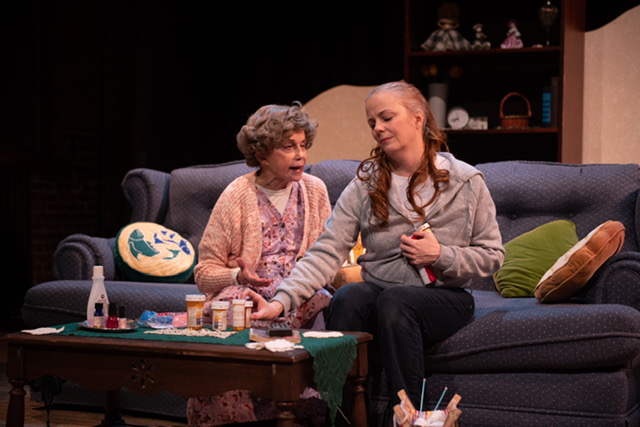
It’s a typical Saturday night, and Thelma (Renee Richman-Weisband) is ready to have her nails manicured by her daughter Jessie (Kirsten Quinn). They have a routine, and at first, it seems like both people have settled into this comfortable domesticity. Suddenly, Jessie asks where’s Daddy’s gun and Thelma learns that Jessie plans to end her life. Over the course of 90 minutes it becomes clear that this decision is not rash, and her decision is resolute. There is no frenzy in her voice, Jessie is precise and purposeful as she explains to her disoriented mother why the decision to end her life is the right one.
The dialogue between this mother and daughter is unadorned. Jessie is very matter of fact as she lists out the mundane details behind the chores that she typically completes, that her mother will now have to manage. Jessie’s words, stripped down to its bare meaning communicates one thing: that she does not fear dying, but instead fears the sadness she must bear if she stays alive.
In this Neil Hartley directed production, the door leading to Jessie’s room takes center stage and provides the nail-biting tension that the dialogue sometimes lacks. The room is where Jessie plans on ending her life and its door is a threshold that Jessie is physically trying to cross, and Thelma is blocking with all her will. As the evening goes on, both move closer and closer to the door, a gravitational pull towards a decision that Jessie is steadfast in, and that Thelma cannot deter her from.
Richman-Weisband’s performance as Thelma is an ode to the caregivers of those who suffer from mental health issues. Richman-Weisband captures the growing desperation of a caregiver who has little left to give but wishes she could give more. But this desperation gives way to bullying as Thelma tries to inflict the same pain she feels herself by telling Jessie that she was considered the runt of the family. But she delivers these words without bite, bumbling through the insult and quickly realizing she didn’t mean what she said. Thelma is clearly grappling with the misunderstood low-hanging fruit of the situation: if her daughter wants to die then she must not be enough as a mother, a friend, as a support system.
Neither character is being fair to the other. It isn’t fair for the mother to assume that her wellbeing is reason enough for Jessie to stay alive and it isn’t fair for Jessie to ask Thelma to be a bystander in her suicide. It’s unfairness borne out of desperation and its heartbreaking to watch.
Personally, that is what makes Jessie’s suicide so horrifying. I did not question her decision but felt so pained to see her carry out that decision without the resources that could have made the process humane and dignified for both Thelma and Jessie.
Night Mother is on at Neighborhood House until March 27th. You can buy tickets here.
This Bitter Earth, Harrison David Rivers’ play directed by Tyrone L. Robinson, chronicles the labor of two men trying to make their interracial relationship work and leaves you questioning what allyship actually looks like.
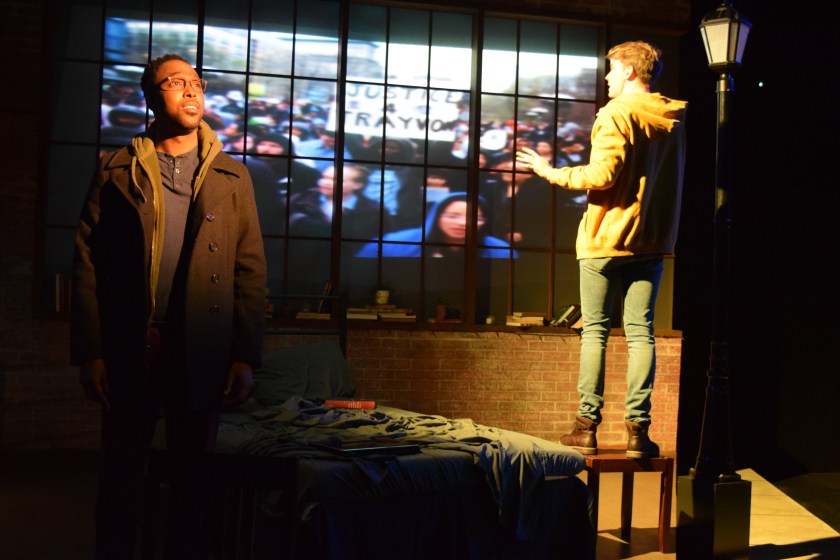
The play opens with Jesse, a Black Ph.D. student from Kansas played by David Bazemore, delivering a monologue on his inability to keep his balance. Ready to knock him off his feet (and not necessarily in the good way) is his love interest Neil, played by Gabriel Elmore, an overeager, capital W, white man who’s ready to do the work of an ally.
Their relationship is backdropped by the near-constant slaughtering of Black men over the course of several years, starting in 2012. Each new murder throws Jesse and Neil into an interrogation of the racial politics at play within their own relationship. An unsurprising pattern quickly emerges as Neil overflows with white liberal hyperbolic outrage and Jesse quietly shoulders the weight of Blackness in America.
Neil already has a version in his head of how this relationship should work. He expects Jesse to be as outraged as he is, fired up and ready to protest the state of race relations in our society together as a couple. During the Ferguson uprisings, Neil packs his bags and hops in a van ready to help. When Jesse takes shelter by burrowing himself into his thesis writing, Neil demands more of him. More anger. More anguish. More despair. Neil demands a performance from Jesse.
Neil doesn’t understand that there is no correct way to react to trauma and there is no singular way to fight against your oppression. Jesse’s existence is a form of resistance. Being an ally does not mean making demands of people of color; allyship starts by listening and asking what one needs. This Bitter Earth is most effective when teasing out what ineffective allyship looks like. Beyond the cringiness of his virtue signaling, what keeps the play churning is the race between, whether Neil will learn how to actually be a better boyfriend (and ally) before Jesse leaves him.
Bazemore and Elmore really capture the emotional tension that swings back and forth between couples that are defined by their racial differences, rather than united by their shared experiences. When they laugh you hold your breath waiting for the unavoidable collision of their differing worldviews. When they fight you hope for them to make up quickly so that they can get back to laughing. It’s a feeling I’ve known all too well in some of my past relationships and friendships.
The moments of levity were far and few between the moments of racial tension. The unfortunate side effect is their exchanges feel sterile and academic. When Neil sleeps with another guy, Jesse wants to learn everything about the other guy. What is his favorite color? What is his favorite movie? How many siblings does he have? What do his parents do?
As the play was ending, I realized that I couldn’t fully answer those questions about Jesse or Neil either. Their relationship was so busy bearing the burden of American race relations that I did not get enough of the little details that reveal who they are or why they are together. I wanted to learn more about them; I wanted them to go beyond being personifications of Blackness and whiteness.
I walked out of This Bitter Earth reflecting on my own allyship to others as well as my connection to the allies in my life. I thought about the times I may have taken up too much space like Neil and the times I didn’t ask for what I needed like Jesse. I am comforted by the fact that unlike them, I am not confined to an 85-minute play and can invest in meaningful relationships a lifelong practice.
This Bitter Earth is available to stream through Interact Theatre from February 28th to March 13th.
Taysha Marie Canales’ The Floor Wipers makes its debut as part of the Wilma’s HotHouse shorts series and illustrates friendship’s capacity for defusing even the most apocalyptic situations with humor.
The Wilma’s Hothouse company is made up of their resident artists who have the opportunity to develop and put on new works. They have put together a series of digital shorts that range in style, with some resembling music videos and others one-act plays. Floor Wipers is part of three digital shorts that are available to view for free.
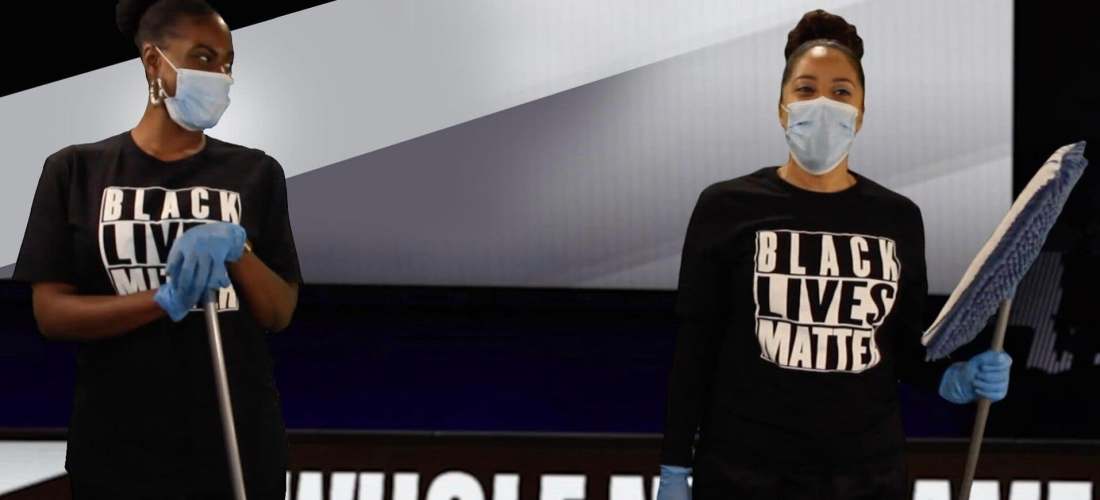
The play is set in the NBA’s Covid Bubble during the 2020 playoffs with Jaylene Clark Owens and Marie Canales portraying floor wipers who are tasked with keeping the court’s floor clean from players’ sweat. Clark Owens’ character has “material girl” ambitions and is determined to find a new husband amongst the players. She even creates a “Player Compatibility Index” to rank which player is best suited to her taste. Marie Canales plays her counterpart, always ready to deliver the punch line that Clark Owens has set up for her.
The two floor wipers bond over the experience of finding refuge from the pandemic within their temporary bubble. If you’ve ever had a workplace bestie, you’ll likely appreciate the hi-jinks and antics they engage in on the courts. For example, Clark Owens’ instructions on wiping the floor with sex appeal brought to mind the many ways that bored office workers―including myself―often enliven the monotony of their jobs. Other distractions include whining about receiving only one work T-shirt while joking that the “B” in NBA must stand for “budget.”
These moments brought to mind the ways that my own friends have elevated quibbles to epic scale as a tool for escaping the horror show of the ongoing pandemic.
When Marie Canales and Clark Owens aren’t riffing off of each other, they are grappling with the dystopian world that they live in―the very same dystopia we inhabit. During the national anthem, they mention the players kneeling in protest. Clark Owens accidentally shows up to a game that is canceled because the Milwaukee Bucks are refusing to play in protest of the Jacob Blake shooting. At another game, both astutely note that “only the wealthy can survive this” pandemic.
However, because this is a bite-sized piece of theatre, their exploration of trauma feels hurried and unexplored. The floor wipers’ friendship is authentic and absolutely nourishing to watch, but I felt that they could have interrogated the trauma of their situation with more than passing remarks. Otherwise the dialogue seems more staged than poignant. I am left wondering what insightful dialogue they might have had outside of their work obligations or the show’s 15-minute time limit.
Near the end of Floor Wipers, Maria Canales reveals that she longs for an extra week or two in the bubble. That sudden acknowledgment of the calamities that are waiting for her in the outside world awakened me from the peace I’d found in her performance. It also brought to mind conversations I’ve had with good friends; moments that brought me to my own refuge. Perhaps that is The Floor Wipers’ point: cherished friendships are the real bubbles that protect us from the world.
The Floor Wipers is available to watch through May 15th. Register for free here.
In The Visitor, the new Tom Kitt scored musical that recently premiered at The Public Theatre, a white professor and Syrian refugee develop a friendship that feels more transactional than earnest. As framed by Brian Yorkey and Kwame Kwei-Armah’s book, the currency that drives their relationship is white savior antics that leave both characters poorer.
Walter (David Hyde Pierce), the show’s “hero”, begins the show in an emotional malaise due to the passing of his wife. Tarek (Ahmad Maksoud) strikes up a friendship with Walter and teaches him how to play the drums. As Walter begins to develop rhythm on the drums he also finds a new zest for life. Tarek is arrested for jumping a subway turnstile and faces certain deportation. Walter attempts to “save” Tarek from deportation and ultimately fails. Walter moves on with his life and decides to finish his book. In short, one family’s traumatic journey through the asylum-seeking process is framed as a set of checkpoints for a white man’s social and emotional awakening.
Throughout the show, Walter is fed a steady supply of trauma porn to consume as a philosophical romp through his white privilege. At one point, Walter offers Zainab, Tarek’s partner, his apartment to stay the night. Zainab steadfastly refuses and provides an account of past sexual trauma that she has suffered. For the first time ever it seems, Walter is pensive over the sexual violence that women suffer at the hands of misogyny and white supremacy. This episode ends with Walter feeling pangs of white guilt before quickly moving on.
Even the driving force of the show, Tarek’s detention, is treated with this level of disregard. During a visit, Tarek drops all sense of agency despite being a long time survivor of American xenophobia and begs, “Walter get me out of here.” It is as if he has no other option for help but his new white friend. Indeed, Tarek’s actual support system is sidelined into an overzealously grateful ensemble to Walter’s magnanimity.
Mouna, Tarek’s mother, who flies to New York after learning about Tarek’s arrest, is reduced to a damsel in distress who thanks Walter for just being there. A semi-flirtatious relationship arises between the two with Walter finding romance for the first time since his wife’s passing. This ignores Zainab’s earlier warning that romantic propositions carry transactional weight when a white man holds all of the power. Though Walter is eager to revel in his white guilt, he does little to change himself or the system that he actually participates in.
As Alysha Deslorieux, in the show’s most believable performance, says through Zainab, “if the charity isn’t silent, then you are the charity.” If only the show had switched from its focus on Walter’s supposed charity to allow this message to actually resonate by giving equal time to other characters in The Visitor.
Instead, we are offered choreographed musical numbers with ICE agents that left one wondering if this was the best format to tell Tarek’s story. Far from entertaining, slant rhymes in a detention center coupled with the inhumane conditions that they are known for make light of the real trauma that refugees experience. Rather than address the power dynamics that accompany the asylum-seeking process, The Visitor sidelines its intricacies to elevate Walter’s finding a new sense of purpose by playing at being the hero.
There is no place for white savior narratives in stories that purport to be about people of color. Previews for The Visitor were pushed back by a week in an effort to restructure the show’s representation of race. That was the right move, but it was clearly not enough. I hope that this musical is seen as a relic of pre-pandemic theatre and warns future theatre makers of the harm they can cause by investing theatre’s precious resources in the wrong stories.
Bells are ringing on the snow-globe inspired stage of The Civic Theatre’s Pride and Prejudice, as young women assemble around a table filled with golden varieties of the instrument. Their fascination quickly turns into urgent, yet elegant, hoarding. A more composed young lady picks up a tiny, rather plain looking, bell almost left behind. She stares at it wishfully before she hides it in her pocket…
Hello, Lizzie. Long time, no see.
As this prologue, and its ringing, end the Bennets settle into their onstage home to a string quartet version of the 2019 electro-pop hit “Dance Monkey.” It’s the correct way to press all the right buttons for the 2021 Jane Austen lover.
Since the pandemic started, Austen has gained a particular kind of traction. The option to meet prospects face-to-face vanished, and dating seemed to regress to a more romantic (albeit physically distant) time. From funny to hopeful, memes, tweets and articles flourished on the subject. The phenomenon climaxed with the record-breaking Bridgerton, currently the most watched show in Netflix’s history. The series delves on the lives, and more-erotic-than-Austen, romantic hopes of young Britons in Regency London. It’s also set in the same year Pride and Prejudice takes place.
One of Bridgerton’s trademarks is the use of string versions of recognizable pop hits, like “Dance Monkey.” Their inclusion (alongside a dozen additional selections, including Ocean Away from the Bridgerton TikTok musical you didn’t know existed) makes the Civic a ten-thousand-pounds-a-year-worth winker to Austen contemporary audiences. It also shows how theatre can, and should, be part of multimedia storytelling universes, while still being just theatre.
The actors wear face masks that match their outfits and alternate in removing them for certain lines. The masks dangle as unobtrusively as grandma specs until they go on again. Anne Beck choreographed each movement following CDC procedures.
The stage is set up à la multi-camera sitcom, the play was recorded from the empty audience. Director Emily Rogge’s set-up makes it easy to stay invested in Kate Hamill’s adaptation, while occasionally focusing on specific details. The simplicity of the space and complementary pops of colors, from backdrop to wardrobe pieces, creates a captivating presentation.
The female actors easily dominate the stage. Megan Tiller does beautifully as Lizzie, with a precise Frankie Bolda as her best friend, Charlotte Lucas. The genuine warmth in their scenes feels the most Austen in the entire show. Bolda, also doubles as Mary Bennett. She’s one of six performers playing dual roles.
Jennifer Sims knows how to fully occupy the stage and Mrs. Bennet’s shoes. She does so in a boisterous manner that makes it quite easy to side with Darcy. Kelsey Vanvoorst fearlessly assumes the comedic relief as both Miss Bingley and Mr. Collins. Gender-bending a character like Mr. Collins is as fascinating as it is entertaining, but it doesn’t go beyond the blatant clashing of Austen’s usually inconspicuous brand of comedy.
Aside from Mr. Wickham, of course, the main enemy of this production is the use of a laugh track. For the Feb. 12th live stream, the track was “manned” by The Civic’s Executive Artistic Director, Michael Lasley, who introduced the tool to the audience and assured them that it would only be used in the parts he genuinely considered deserving of a laugh.
As a promoter of camaraderie, especially in socially distant environments, a laugh track is a great idea that needed a more democratic and, dare I say, female approach. There were worthy comedic moments that did not get the benefit of the track, while others, especially at the end of act two, were overindulged. But technicalities do little to overshadow the genuine charm of this Pride and Prejudice.
References:
Pride and Prejudiceadapted by Kate Hamill from the Jane Austen novel. Streaming at the Civic Theatre.
Cory (Jordan Ho) and Smin (Jamie Lowenstein) are on the precipice of breaking up. The far away romance in Billy McEntee’s Cory and Smin’s Love Conquers the Earth, which had a brief run in director Charles Quittner’s Williamsburg backyard the weekend of October 16th, as ephemeral as it is intimate, is reaching the limit of its realistic sustainability. Not for lack of trying. New Jersey based Cory’s gestures towards solidifying their dynamic are met with reticence. A purchased plane ticket for Cali-bae Smin to spend the holidays with Cory hovers in the air; ready to drop to the pit of Cory’s stomach and weightless, maybe unimportant for Smin. Their online chats, pushing Cory past their curfew, are what they have to hold onto, this intangibility smarting of sharp irony, given their mutual dedication to environmental activism; the very importance of their exchanges with one another nonetheless burrowed into both of their hearts.
Their desire for one another has become vine-like, wrapping itself around Cory’s sincere heart and, perhaps, Smin’s neck, maybe their sense of autonomy, too. I mean, these are high schoolers, still figuring out who they are, what they want to be, how they want to walk around in the world as themselves. Pretty precocious, too, their ambition for how to change the world and make it a better place, to ensure its continued existence, outsized from their adolescent access to resources. “I’ve been thinking about the ecological impact of our love,” begins Smin.
Environmental activism, once something that brought them together (as well as the musicals of Pasek and Paul), becomes shield and weapon; the plane ticket triggers doubts, and they bubble up in Smin’s mind, while Cory simmers across the country. Quittner has them never facing one another, staring out into a void, soundboards as keys to compensate. Smin, once fiery, in control, and curious (as seen in their scenes with Lime Rickey, played by Daphne Always with stunning humanity), stumbles, the prospect of confronting the reality of internet abetted affections destabilizing. Smin wields their environmental justice acumen waveringly. Excuses are made. The inequity of their affections is revealed. And then something breaks.
“You just broke the tropopause,” Cory says, matter of factly. Cory’s optimism about their situation mutates, resigned not to what they once hope it was going to be like, draped in the anticipation and idealism of queer youth, seeped in the endless potential of whatever the internet and queerness in concert could hold, but in an immediacy of imagination that feels not like fiction but a kind of drag.
You just broke the tropopause. A nice little nod to Harper, but without the solace. Cory’s once coquettish invitations become more forthright, a role-play of Smin on the plane en route to Jersey, but tinged with surreal eroticism. Cory authors a fantasy, presiding in an alluring and uncomfortable liminal space between potentially damaging the planet, to use their parlance, and possibly saving themselves, or maybe self-immolating.
Credit: Derick Whitson
You just broke the tropopause. A broken-hearted brew of the world as it is, as it’s coming to be, and who Cory and Smin are, and who they could be. Cory narrates a could-be ending, Smin on the plane, Smin ordering water, Smin landing. Cory narrates the atmosphere around them, its fate paradoxically intertwined with and independent of the trajectory of their relationship. There’s a fragility to this fantasy: wrapped up in speculation of a future queer self, or a queer future period, but McEntee illustrates an unbecoming at the expense of becoming:
“ozone gasping for air, no souls are flying no limbs akimbo no restoring of the cheesecloth it’s just dying molecules coughing and retching and it’s reverberating throughout the atmosphere and only you can see them and your plane is rattling”
It’s not the specificity of this scenario, wondrous and horrible, that arouses Smin necessarily. It’s the fact that Cory can see what Smin does. This dialogue hinges on disorientation and displacement, reorientation and replacement, that their connection to one another recontextualizes the very atmosphere’s topography. Even if it hasn’t happened, even if they’ve never been with one another in person, there is an undeniable insight into the way that Smin engages with the world around them that Cory understands intimately. However different the dynamic might be in person, Cory unearths the rawness and the core truth of both Smin’s longing and fear. And Cory, speaking feverishly, worries not about the projection or performance or artifice in this relationship, but loses themself in the telling, in the writing, in the fantasizing.
When Smin climaxes, random articles of clothing fall from the air, recalling Xavier Dolan’s Laurence Anyways; gorgeous and soiled, luxury and detritus. Internet romances and perhaps queerness itself thrive in contradiction and ambiguity, in making artifice authentic again. If the world were to go down in flames from a flight for love, wouldn’t that be suiting? A death drive trying to make the intangible tactile, the performed material. Up in the air, together and apart, they’re far away, so close.
How horrible that is. How lovely that is. They broke the tropopause.
Dharon E. Jones, Amar Ramasar, and the cast of “West Side Story.” (Photo: Jan Versweyveld)
West Side Story is a musical that wears its liberal heart on its sleeve. Created by Jerome Robbins, Arthur Laurents, Leonard Bernstein, and Stephen Sondheim, West Side Story took a play that was relatively apolitical, Romeo & Juliet, and turned it into a look at racism, gang warfare, assimilation, and poverty. The musical ends with its heroine Maria, a Puerto Rican woman who had tried to be a peacemaker, pointing a gun at a group of Latinx and white teens shouting, “You all killed him! And my brother, and Riff. Not with bullets, or guns, with hate. Well now I can kill, too, because now I have hate!”
When the musical first premiered, in 1957, it was inspired by both Romeo & Juliet but also by news headlines at the time about turf wars among teenage gang members. The Montagues and Capulets of R&J then became the Jets and the Sharks of West Side Story—a white gang versus a Puerto Rican gang, who hate each other not because of some “ancient grudge break to new mutiny,” but a very contemporary grudge: racism. In creating West Side Story, Robbins and co. were reviving Romeo & Juliet and making it relevant to a mid-20th-century audience.
Or at least, as white men, they tried. West Side Story has always had a fraught relationship with Latinx people. Said Hamilton creator Lin-Manuel Miranda in 2009, as he was working on that year’s West Side Story Broadway revival: “I think West Side Story for the Latino community has been our greatest blessing and our greatest curse…As a piece of art, I think it’s just about as good as it gets. It also represented our foot in the door as an artistic community on Broadway. At the same time, because it’s just about the only representation of Latinos on Broadway and it’s about gangs, that’s where it gets tricky.”
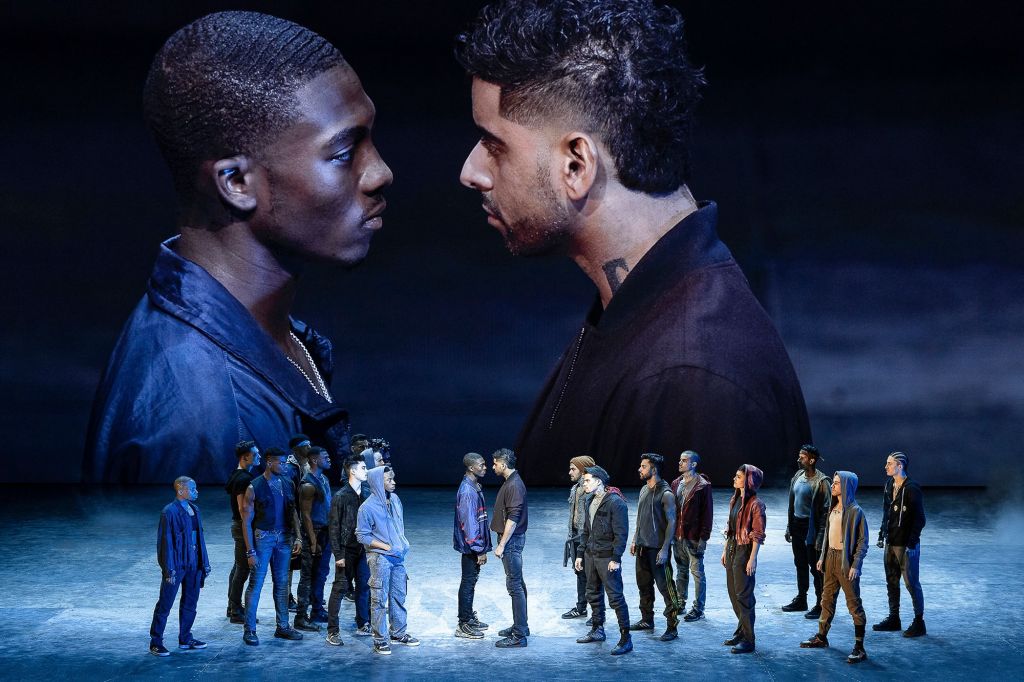
Which brings us to 2020, where two different versions of West Side Story are being released. One is the new film by Stephen Spielberg, scheduled for a December 18 release. Like the original musical, the film is set in the 1950s. Meanwhile on Broadway, Belgian director Ivo van Hove helmed a revival of the musical that began performances in December 2019. This version was set in the modern era, with the Sharks and Jets filming the action on their phones which is then projected onto a giant screen behind them. West Side Story on stage was shut down on March 12 when Broadway shuttered because of COVID-19. But once again, a musical about racism and the lives of people of color in America are directed by white men.
Despite its sometimes questionable qualities, I have always had a soft spot for West Side Story. I own a box set of the 1961 film that came with a bound script. The mambo scene, in all of the iterations I’ve seen of the show (I’ve seen three), never fails to make me breathless. It’s because even though West Side Story is a tragedy, it uses music and dance to remind all of us that there is still hope and beauty in the world, if we can only move past our racial differences to see it.
Which brings me to the 2020 Broadway revival of West Side Story, which I saw twice earlier this year (both times for work). I had come into this revival with misgivings (which I will discuss later), but I wanted to like it. And I left feeling like I’d been hollowed out.
“But What About Black-on-Black Crime?”
I’m not the kind of person who believes you should preserve theater in amber. I think if you’re going to revive a classic play or musical, you should have a reason for doing the show now. And creators shouldn’t be beholden to tradition when reviving a show; they should be allowed to re-imagine it. If Shakespeare can be recontextualized in seemingly unlimited ways, why can’t West Side Story?
This version of West Side Story wanted to be modern; van Hove said he wanted to set it after the 2016 election, when America is “a much rougher world…where people don’t listen to each other’s arguments, but just react to each other, and blame each other for what they are missing in life.” And he also made it multiracial: the Jets are now a Black and white gang, led by a Black teenager named Riff (Dharon E. Jones). If their hatred isn’t along racial lines, then what is it? Said choreographer Anne Teresa De Keersmaeker, “But I do think that both Jets and Sharks are young and are looking for identity. And it’s also about violence, poverty and exclusion.”
On the one hand, the violence should not make sense because hatred and violence is senseless. On the other hand…we’ll get to that momentarily.
The revival also cut out some elements of the original which, on the surface, seem innocuous. It cuts Maria’s only solo song “I Feel Pretty,” and the all-women scene preceding it. It also cuts the ballet that usually accompanies the song “Somewhere.” And it cuts this line from Maria (Shereen Pimentel) in the show: “You all killed him! And my brother, and Riff. Not with bullets, or guns, with hate. Well now I can kill, too, because now I have hate!”
These cuts may seem innocuous but what it does is remove any sense of lightness, joy, and hope from the musical. Maria is the sole voice in the musical who calls for the end of violence and for peace. What her song “I Feel Pretty” shows is a girl who looks at the world with optimism. In a world where Latinas are made to feel invisible and ugly, she chooses to feel pretty. Maria is hope personified. Cutting that song cuts a crucial character moment for her.
When at the end, Maria holds a gun and says “now I have hate,” that hope is seemingly broken and that is the true tragedy. But when Maria chooses not to use that gun, it’s supposed to be the triumph of love over hatred. In the movie, the final line is “Te adoro, Anton,” and the final shot is of Maria, resolute and moving forward. You get the sense that there will be a better world somewhere, and Maria will help build it.
The 2020 West Side Story revival sidelines Maria and the other women, in order to center the violence of the men. The men are also centered in the marketing campaign for the show as well as the images on the marquee. The women do not push back against the hate, or give a hopeful alternative to it. At the end, Maria doesn’t break away from the violence, she just stands on the stage, next to the Jets and Sharks, looking exhausted and depleted. Another Black woman whose lover was killed by gun violence (Pimentel is Afro-Latina). The revival took away what made Maria special.
And who is responsible for the violence? In the scene where Anita (Yesenia Ayala) is almost raped, we see a close-up camera shot of her jeans being unbuttoned, and then a Black man on top of her. During the song “Gee, Officer Krupke,” usually sung by white Jet members, it’s instead sung by mostly Black actors, who are then shown in a jail cell.
During the rumble, Bernardo (Amar Ramasar) kills Riff, who is Black in this production. Tony—played by Isaac Powell who is part Native American, Black and white—then kills Bernardo.
Van Hove may have made the Jets multiracial, but he also took out white supremacy and institutional racism as a source of violence in West Side Story. As theater director Schele Williams put it:
“It’s a very specific story about white people making Puerto Ricans other. The story changes considerably when you make it brown on brown…You put all brown people on stage to show danger and you took the whiteness out of a story that is about a group of people saying, ‘This is America and you don’t belong here.’ In a moment when America is having a whole conversation about putting children in cages on the border and saying, ‘you don’t belong here,’ but you’ve taken whiteness out of that story.”
Schele Williams
“In addition, you have cut, ‘I Feel Pretty’ away from a community that so desperately needs to say out loud, ‘I feel pretty and witty and bright.’ How often does that group of people, those women, those Latinx, Puerto Rican women, get to say something affirming about themselves on the American stage? And that song was cut. Who was behind the table for that conversation? And who thought that only brownness can be dangerous? Because I fear the white boy who comes into my kids’ school and shoots it up. I don’t fear the brown one.”
Schele Williams
Even before summer 2020, America was experiencing a reckoning around race. Black people were getting murdered with impunity by white police officers, the president called a group of white supremacists “very fine people,” Latinx children were being put in cages by white immigration officials. In the original West Side Story, the police officers treat the Puerto Rican Sharks much more harshly than they do the white Jets. That nuance is gone from the revival. Van Hove wanted to make his West Side Story relevant to American audiences today. But by taking away the race element in the musical, he made his version irrelevant, the theatrical version of “all lives matter.”
But this is how white supremacy wraps itself up as allyship. Because you can hire a group of Black and Latinx actors and have them act in a beloved Broadway musical about how hate and violence is destructive. But how you position them onstage matters. In this new West Side Story, young people of color are senselessly violent, and police intervention is justified, because otherwise, these mostly Black and brown youths would keep killing each other. It’s no different than the fear mongering on Fox News.
Said Williams: “That’s why cops shoot first and ask questions later, because brown is scary and white is fine. In this platform with all of these thoughtful, kind, liberal humans, we are reaffirming the prejudices of our nation on the American stage.”
And I’m not saying Van Hove and his predominantly white creative team meant for West Side Story to say those things. But they didn’t even assemble a team that could even ask the right questions.
The cast of ‘West Side Story.” (Photo: Jan Versweyveld)
The Ethics of Consumption
West Side Story is the first Broadway show in a long time to be met with protests on its opening night. That’s because it had cast Amar Ramasar, who was fired (along with a number of other male ballet dancers) from the New York City Ballet for sharing nude photos of female ballerinas. In all of the ensuing media coverage, Ramasar did not apologize. The West Side Story protests were organized by Paige Levy, a senior at LaGuardia High School in Manhattan. Ballet dancer Alexandra Waterbury, whose photos were also circulated, also joined the protests.
A member of the West Side Story cast also wrote anonymously to OnStage Blog, saying:
“I hate that I have to share the stage with him. I hate seeing him smile or laugh backstage. I hate seeing him reap rewards of adoration from audiences who don’t know or who haven’t bothered to look up what happened.
“But most of all, I hate that I can’t say the things I want to say freely. I’m young. I’m at the beginning of what I hope is a long career and as passionate as I am about wanting to scream from a soapbox about this, I’m just as passionate about wanting to continue to work on Broadway and I know people have been blacklisted for saying less.”
Those weren’t the only issues the West Side Story revival faced. Backstage, a number of actors were injured. Isaac Powell was out of commission for more than a month because of a knee injury he got while performing. Another principal cast member, Ben Cook, left the production due to an injury. Multiple actors getting injured within two months of a show’s life is not normal. So besides the sexual harassment issue, there also seemed to be a workplace safety issue.
Maybe that’s why the show rang hollow to me. It’s the equivalent of a corporation saying it supports diversity, but won’t take any actionable steps to make itself more diverse. For a show that seemed to condemn violence in the text, it had little consideration for the humanity and safety of its performers. There’s a difference between saying the words and actually putting those words into practice. A show can have pretty and progressive words, but when there are harmful practices backstage, what value do those words have?
There’s a meme that’s been around a few years now with the phrase, “there is no ethical consumption under capitalism.” If you’re a person living in a developed nation today, everything you consume was probably produced under the auspices of oppression: the people who make our iPhone or pick our vegetables are likely underpaid and overworked, the air conditioning we use or the planes we travel on is contributing to the harming of the planet, Jeff Bezos is the richest man in the world because he underpays his factory workers and doesn’t give them bathroom breaks. Oppression and harm is woven into the fabric of a capitalistic society.
For me, it’s become steadily harder to separate the artistic merits of the work with how the work was made. I haven’t been able to enjoy anything Harry Potter related after I found out that J.K. Rowling is a transphobe. That is because living in the now is a constant negotiation of how to put the things that I value—humane and safe working conditions, diversity in storytelling, anti-racism and justice—into active practice in an imperfect world.
That is why I didn’t want this essay to just be about, “I hated the new West Side Story and here’s why.” Because the artistic merits of a show is one thing, we can talk all day about that. But should the conditions in which a piece of art is made impact your enjoyment of that art? That’s the tougher question.
This is not to shame anyone who enjoyed the Broadway revival of West Side Story. Let me know what you liked about it. But when Broadway reopens again and if West Side Story comes back, I hope we will all be able to have a more open conversation about the way the art is made, in conjunction with talking about the work itself. And how inequitable artistic practices can damage the art itself.
There is a reason why the We See You, White American Theatre demand letter devotes just as much space to artistic practice as it does to the product. Because if we are serious about a better, more equitable environment for artists from marginalized backgrounds, then we need to have a frank discussion about how we treat those artists. And we need to have those discussions in conjunction with whether or not the work is “good.” What happens offstage is just as important as what’s onstage.
And if in the next decade you have to revive West Side Story again, give it to a Latinx person to direct.
If plays are similar to living organisms, the mark of a great work must be its adaptability. If its power remains undeniable in a multimillion-dollar staging, as well as in a high school production. If its words stir the soul on the page, but also reveal new layers when delivered by actors on stage.
About two years ago when I first read Aleshea Harris’ Is God Is, I was impressed by the playwright’s ability to combine genres and discover something that felt primordial and new. When I saw the Soho Rep production, I was taken aback by the visions it elicited in director Taibi Magar, who imagined it like the pop-up book version of a Southern Gothic fairytale. And listening to the Wilma Theater audio version, I was enthralled by the musicality in Harris’ words, and the way in which her characters’ journey is the stuff of legends, but their pleas remain as urgent as those of our neighbors.
In director James Ijames’ audio play, Harris’ words take on the form of echoes of ghosts doomed to repeat a cursed history they had no part in creating. When the play begins, twin sisters Anaia and Racine are summoned to the Folsom Rest Home for the Weary where their mother lies on her deathbed. The girls haven’t seen her in years, “We got a mama?” asks Anaia, puzzled not only by the invitation, but also by how the woman they presumed dead has found them.
As with many things in the play, this eerie bid for the sisters’ presence, is rooted not in anything related to naturalism, but in the mystical quality of myth, where the extraordinary occurs so that heroes can fulfill fateful missions.
When they arrive to meet their maker, her request is a simple one, they must find their father and “kill his spirit, then the body.” The sisters, who spent their lives from foster family to family, suddenly learn their father is alive as well. More than that, he’s the reason why they became orphans under the system. When they were nothing but babies, he set them all on fire, permanently incapacitating their mother, and leaving baby Racine with burns that rendered her body undesirable but allowed her soul to flourish (“‘Naia is trapped in a prison of sweetness. Girl so ugly don’t get to be mean,” says her sister).
In Ovid’s version of the Greek myths, Medusa had been a woman so beautiful that the god Poseidon raped her in Athena’s temple. Rather than punishing the abusive god, Athena transformed the beautiful Medusa into a creature with snakes for hair, whose monstrous face transformed men into stone with a mere glance. It’s also a violent man who transformed Anaia and Racine into modern gorgons, sent to avenge a mother they begin referring to as God.
Although the sisters assure their mother they are no killers, they agree to her request and the play then takes on the shape of a road trip, as they set on their journey. Daniel Ison’s detailed sound design and original music bring out the pulpy undertones in Harris’ script, as the sisters shed the remains of their innocence to become literal femmes fatales, vanquishing those who stand in their way.
The cast led by Brett Ashley Robinson and Danielle Leneé as Anaia and Racine respectively, bring out the complexity and humanity of the characters through soulful work. Leneé’s nuance as Racine goes from a being of purity into a tortured soul pierces the heart, while Robinson’s no-nonsense approach to Anaia feels empowering, even as she expresses her desire for revenge.
As the title God (or She as her character is named in the script), Melanye Finister gives her voice the tone of someone who’s died and come back to whisper a warning, while Taysha Marie Canales provides some comedic relief as the unaware Angie, a woman who unbeknownst to herself is perpetuating Athena’s mistake of believing women who are attacked by men are complicit in their own destiny.
Lindsay Smiling’s chilling portrayal of the twins’ father gave me chills. His delivery of the line “I didn’t try to kill you all. Just her,” among the most terrifying things I’ve heard through my headphones. Although the play is dense and there are several moments of violence, and the Wilma Theater’s website suggests one should take breaks if needed, there is something almost addictive about Harris’ play. Even knowing what was coming, I couldn’t stop listening.
In many ways, it was almost revitalizing to listen to the play the day after Congresswoman Alexandria Ocasio-Cortez delivered an instantly iconic speech about the rampant misogyny in Congress to her fellow elected officials in the House of Representatives. As Ocasio-Cortez expressed “I am someone’s daughter too,” in response to the insults she had received recently by Congressman Ted Yoho, and generally throughout her life, I couldn’t stop thinking about Anaia and Racine, their thirst for justice recontextualized in a world where men simply refuse to listen to women.
The father in Is God Is, has no regard for the women who were once in his life, deeming them disposable as he moves on to create a new life, completely unbothered by the gravity of his sins. Harris highlights the many opportunities men are given by society by using mirrors as a metaphor. The sisters meet different versions of themselves later in the play, a reminder about the endless second chances men are given when women fight so hard to justify just one.
Although in no way does the play incite to violence, it certainly makes the desire for revenge understandable, especially when human-made laws fail to provide justice. Listening to Is God Is, reminded me of another of Harris’ plays, the indelible What to Send Up When It Goes Down, her ritualistic take on the violence exerted on Black bodies in the United States.
Although Is God Is happens to be a more traditional drama in terms of narrative structure, with both works, Harris has positioned herself as heir and preacher of the stories we pass on generation to generation. The ones our mothers heard from their mothers, and which we’re meant to pass on to our offspring, in hopes we finally learn the lesson. While we heed the ancestral warning, we’re blessed to have Harris living in this era, because for now, if she doesn’t tell these stories, who will?
It seems that in quarantine, the act of binging has become a no-brainer. Indulging in any activity to the point of excess is the way in which many of us cope with boredom (binge that TV show you love or haven’t had time to watch in the past), anxiety (binge on chocolate or vodka to make the pain more palatable) or the uncertainty brought on by the COVID-19 pandemic (binge on natural supplements and home remedies in hopes that the virus will pass you by).
And yet, binging is also accompanied by an insidious side effect: numbness. If we spend days in a row watching the same television show we might stop caring about the plot twists, the characters’ emotional journeys, or find ourselves scrolling on our phones because eventually, we need an escape from the escape. Too much chocolate can lead to indigestion, and there are few things as painful as a hangover brought on by drinking alone.
It’s no surprise to realize that even binging must be done responsibly. Enter the ironically titled Binge, a one-on-one performance created by Brian Lobel (I loved, and wrote about, his You Have to Forgive Me, You Have to Forgive Me, You Have to Forgive Me here) commissioned and produced by La Jolla Playhouse, in which Lobel and friends (nine other multidisciplinary artists) become your TV doctors, creating a tailor-made performance for one, which ends with a soulful prescription: the right television episode for you right now.
Before your Zoom session, you must answer a thorough questionnaire meant to pair you with the performer you need. Filling out the survey, like anything else in the show, requires a commitment to mindfulness and a profound examination of self. Don’t approach this Binge, if you’re not ready to look at yourself with the same level of attention you give your favorite TV characters.
Leslie Knope-types, the optimistic lead of Parks & Recreation, will be ready to answer questions about how they’re treating themselves, or how workplace inequality has affected their mind, body, and heart, but might need a little bit more time (and research if they’re very Knope) to answer questions inspired by The Flavor of Love franchise. I aced the Sex and the City portion of the survey but spent more time than I’d like to admit pondering the answers to questions inspired by Star Trek: The Next Generation, Deep Space 9, and Voyager.
Although you don’t have to answer every single question, and you certainly are allowed to skip the survey altogether, I found the pre-show portion to be essential to my enjoyment of the experience. Thinking how my life relates to Gilmore Girls, which I love, and The Real Housewives franchise, which I have sworn never to watch, made for an interesting exercise in which I meditated on the ways in which pop culture, even in the iterations we haven’t experienced or that are more foreign to us, have seeped into every aspect of our lives.
I can’t tell a Star Trek: Voyage apart from a Star Trek: Deep Space 9, but I know about Dr. Spock’s over intellectualization of emotions, and how it relates to my inner Miranda (that’s Cynthia Nixon’s character from Sex and the City for the uninitiated).
Although you’re not told how your performer is assigned to you (I crossed my fingers I wouldn’t get a reality show recommendation) based on the care with which Lobel approaches his work, I knew I could trust him and his friends to provide me with precisely what I needed. And boy, did they do just that.
On a muggy Brooklyn afternoon, I connected via Zoom with the Berlin-based artist Season Butler, whose warmth instantly made me feel like I was talking to a lifelong friend. Like Blanche DuBois I find that the kindness of strangers is sometimes more dependable than the weary ears of those closest to us, who perhaps expect us to grow faster than we do, but don’t always have the heart to tell us so.
Within minutes I was telling Butler about my childhood, sharing stories about my father and grandmother, and showing them my apartment. What surprised me was to see Butler distill the essence of what I shared into a couple of phrases, written in a small blackboard, that took my breath away. How a stranger so far removed from my life and history had come up with what I announced would become a new mantra is the power of Binge.
Live performances usually hold a mirror to show us who we are as a society, but rarely do they look directly into our souls at such a personal level. Rather than hiding my discomfort as when I feel a character in a stage show has “read me,” Butler’s kind wisdom disarmed me.
This is why I find Binge’s title to be ironic. Binging requires a certain level of disassociation from self and from others, to become so immersed in something that we forget ourselves. At this Binge, I was affirmed.
When Butler reached the portion of the performance when I was to be prescribed TV episodes to soothe me, I took their recommendations of The Simpsons, as the bonus to what had already been a spiritual experience. That my episodes were so fitting to my favorite character in the show (I’m a total Lisa) wasn’t as surprising as the fact that Butler also mentioned keywords that had come into play in a conversation I’d recently had with my Homer Simpson.
Rather than dwelling on the coincidence and mystery of it all, after saying our goodbyes, I sat on my couch grateful for the spiritual connection I had made with someone I wouldn’t have been able to share with were it not for where I am in the world today. In Binge I also found the unthinkable: a Zoom call I wanted to last forever.
To have one’s soul touched by a stranger through a screen is after all the reason why time after time we revisit our favorite TV shows when we’re aching. To overcome the numbness and revel in our humanity. This is truly why we binge.









 Token Theatre Friends