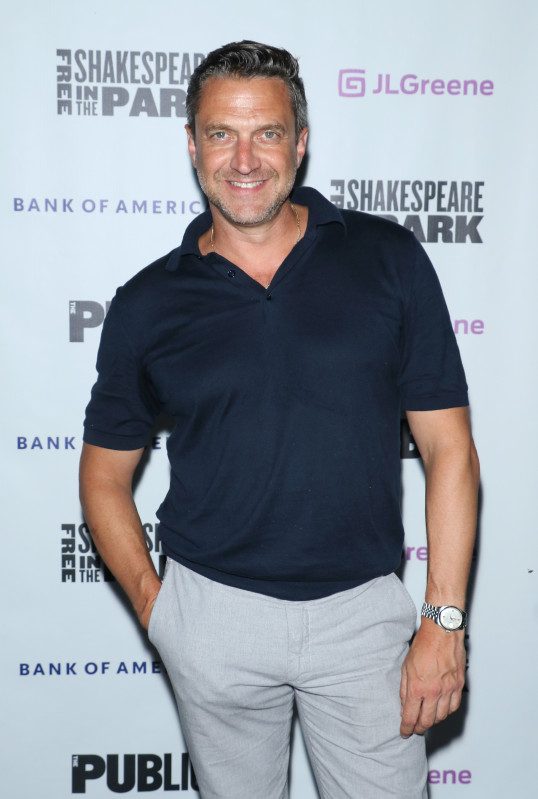
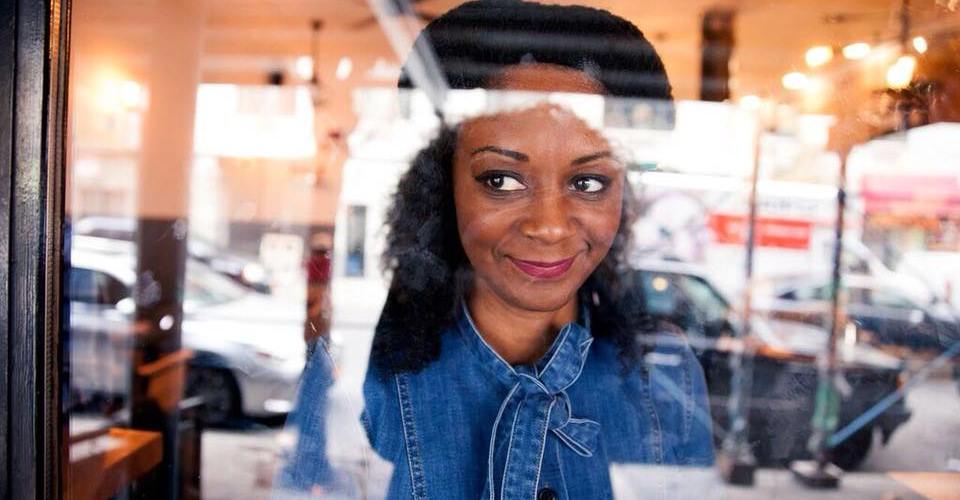
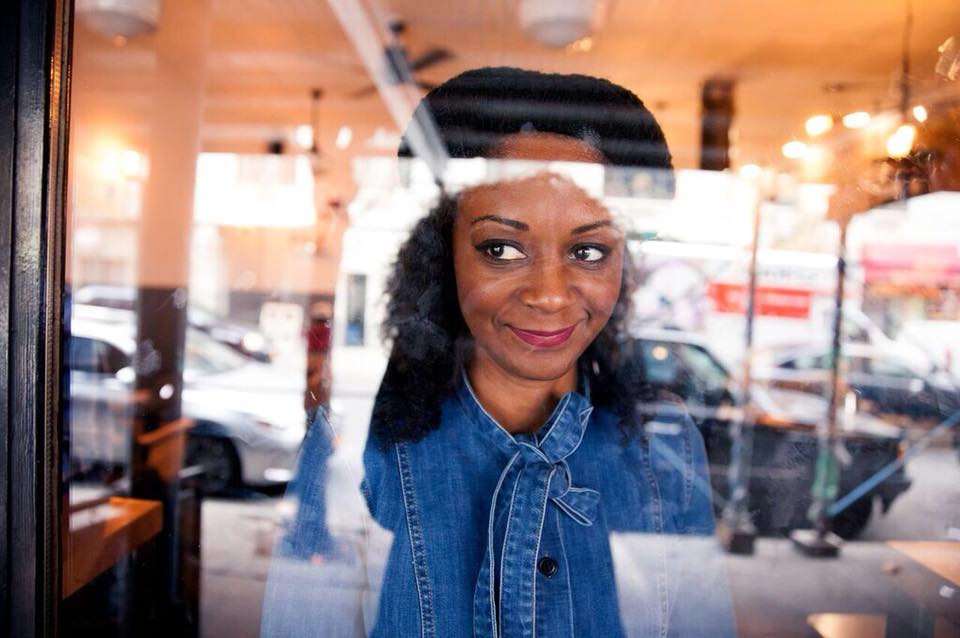
Guadalís Del Carmen and Darrel Alejandro Holnes Are Working Together for the Greater Good

Interviews
Guadalís Del Carmen/Darrel Holnes. Courtesy of the artists.

From an early age, Darrel Alejandro Holnes learned the importance of giving in order to help sustain communities, “especially in times of need, like now,” he explained by email. The Panama-born artist carved a path for himself as a multidisciplinary creator. He’s a musician, theatremaker, educator, and poet, who in one of his most vibrant pieces describes superstar Rihanna as “the rude girl is with child in the Instagram pic,” showcasing his ability to convey the zeitgeist, only to top it off with “I was raised by her kind.” One foot into the future and an awareness of all those who came behind.

His work is inspired by Panamanian Congo, Afro-Cuban masquerades, experimental German theatre, and opera. For Holnes, “it’s all theatre.” Noticing the lack of industry support and representation when it comes to Afro/Black-Latinx stories and characters, Holnes teamed up with Guadalís Del Carmen, a playwright/actor and co-artistic director of LatinX Playwrights Circle, to create the Greater Good: Commission and Festival, an initiative meant to provide Afro/Black-Latinx writers with small grants so they can create short plays that reflect the times.

“One of the things that we’re really excited about is allowing Afro/Black-Latinx writers to have a space where they can create work that speaks to the now and then that work will be archived,” said Del Carmen, also by email. Del Carmen’s own Bees and Honey, was featured in 3Views’ Spotlight Series as one of the works of 2020 that had a production canceled or delayed because of the COVID-19 pandemic.

Bees and Honey was set to have its New York City premiere as part of LAByrinth Theater’s residency at the Cherry Lane Theatre, after having been developed with The Sol Project and LAByrinth’s Summer LAB Intensive. Del Carmen’s perceptive world-building, and richly imagined dialogues are evident in this modern romance which, if theatre producers are smart, should be a no-brainer to produce even digitally.

Del Carmen and Holnes working together to increase Afro/Black-Latinx representation is a breath of fresh, and rather quick, air at a time when systems within the American theatre are being challenged for the ways in which they’ve upheld white supremacy, but the effects of demands being made by BIPOC artists might not be seen until after live theatre is happening again.

Excited to play with the form and medium of the works they will commission, the plays will be presented at the 2020 Greater Good Plays Festival produced by LPC and Pregones Theater/PRTT, Del Carmen and Holnes are kick-starting year one, of what could become one of the most thrilling initiatives in NYC. They discussed their work, philosophy and identity in an email interview, which has been edited and condensed for clarity. 

Why did you want to make theatre?

Darrel Alejandro Holnes: I saw Heather Headley in Aida when I was a kid and my family did a tour of the US that included New York. My mom had seen her perform on the Rosie O’Donnell Show and decided to bring us that summer. It was the most compelling way I had experienced story at the time. I knew in that moment I wanted to experience and explore more but it wasn’t until college that I was able to explore it more with Mark Medoff, an early mentor of mine, in the Edward Albee summer workshops at the University of Houston. Albee and Medoff taught me that theatre is not just a way to tell a story but it’s a way to create and share energy and experience with others. And that’s one thing that sets it apart from film for me, if the play is “the happening,” then the audience is in “the room where it happens” when they are in the theatre. It’s an incredible and a one-of-a-kind experience. 

Guadalís Del Carmen: I sometimes ask myself this same question, but I’m continuously reminded of the wonders that theatre creates in people. I still remember the first play I did when I began pursuing an acting career, the adrenaline, the rush. It was a Tato Laviera play, Bandera a Bandera, a meaningful piece that was rooted in the community we performed in. The reaction from the audiences when my first play was produced. The feeling of bringing folks into a space where they can come together to share in receiving a story is why theatre is special. Feeling the same energy the actors are feeling in real time, there’s nothing like it. But for me, being able to see, hear, tell stories of nuestra gente, of the people I grew up around, of the heroes history classes have ignored is so important. We playwrights are Griots. My ancestors preserved their histories through storytelling, and it feels right to tell their stories in this way.

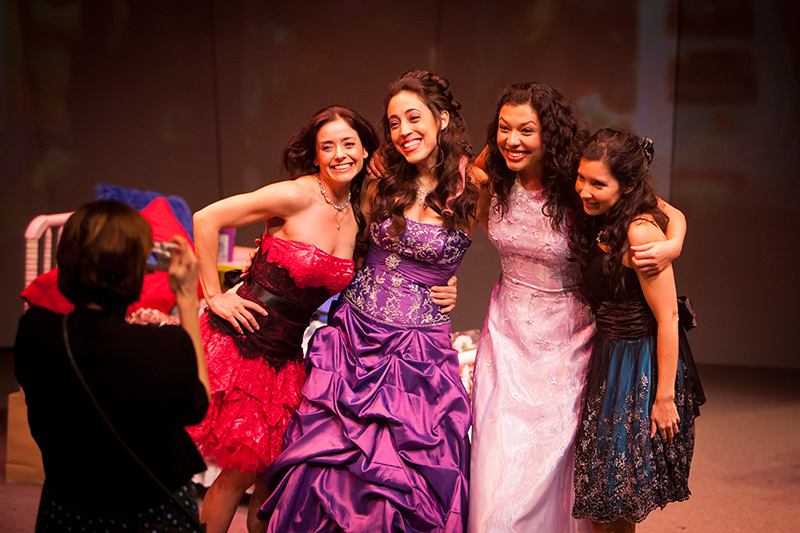
Scene from Blowout! Credit: Oliver Aldape.

Guadalís you didn’t have a formal education in theatre, did this in any way affect the way you were perceived when submitting plays, both in terms of how gatekeepers reacted, and also in your own confidence? Did you doubt yourself because you didn’t do this in college?

GDC: I’m gonna need you to stop looking into my soul, thank you. Yeah, I’d say not having a formal education in theatre has very much affected how people have perceived me and my work. All the things from “she’s not ready,” to “this isn’t the right format or structure” (all while praising María Irene Fornés and other structure breakers…) 

But on top of that there’s the thing of not seeing worth in the characters I write about. I already had this feeling of: “I’m not trained, I shouldn’t be doing this.” I’ve learned that a degree doesn’t make you a storyteller, or writer, or an actor. It gives you the tools you need and prepares you for the work to be done, so this is by no means any shade to trained artists. But my biggest truth is that I have been a storyteller all my life. It’s what I was put on this earth to do, just ask my mom.

We playwrights are Griots. My ancestors preserved their histories through storytelling, and it feels right to tell their stories in this way.

Guadalís Del Carmen

You’re both Afro-Latinx, have you ever seen yourself represented in theatre? If not, what’s the closest you’ve been to seeing yourselves represented?

DAH: I’ve seen Black actors cast in In The Heights; I don’t think their roles described the characters as Afro/Black-Latinx but to see a Black body represent Latinx culture was great. Every time I see Black artists with connections to Latin American and the Caribbean like Colman Domingo, Ruben Santiago Hudson, and Black Panamanians like Tessa Thompson, Saunas Jackson, Y’lan Noel, Donnetta Lavinia Grays, and Tatiana Ali perform, I feel represented. 

I also, personally, identify as African American, the two are not mutually exclusive to me. Not anymore. The way I see it now, Black/Afro-descended is my race and Panamanian/Latinx and US American are my nationalities. So every time I see African Americans onstage I do see that part of my identity represented.

GDC: To be honest, not really within Latinx work, this is partly because there isn’t enough Latinx work being produced, and because the work that is produced is a very specific narrative that many times isn’t inclusive. In The Heights was the closest thing to me seeing myself as a Dominican performer represented on stage, and it’s the show that inspired my first play, Blowout

Carmen Rivera’s Julia De Burgos: Child of Water was a pivotal turning point for me as a female artist, I played the title character. It was during this time that I was growing out the relaxer in my hair so there was a lot of ugly crying I did in that play. The struggles of being an artist, yet being misunderstood and disregarded by your fellow artists, and being Afro Latina at that. Marco Antonio Rodriguez’s work makes perfect Dominican sense to me. Beyond that, most of the work that has touched me the deepest or I have been able to see myself represented have been works by African American playwrights. 

The pains and the struggles, but also the joy and resilience that is birthed from that is unique to being Black. There are nuances obviously, in being Black from the U.S. or being Black from the Caribbean or being Black from the U.K., etc. I found healing in Aleshea Harris’ What to Send Up When It Goes Down, and I found so much of myself in Suzan-Lori Parks’ The Death of the Last Black Man in the Whole Entire World A.K.A. The Negro Book Of The Dead. Pearl Cleage, Katori Hall, and Ntozake Shange are also writers where I often see myself represented. And while these works are somewhat culturally removed from how I was raised, the conversations around being Black, or the experiences that come with being a Black woman definitely allowed me to see pieces of myself that I don’t often see in theatre. 

I’d be remiss to say this COVID-19 interrupted season had some of the most inclusive Latinx works being produced, from Ren Dara Santiago’s The Siblings Play, to Marco Antonio Rodriguez’s adaptation of The Brief Wondrous Life of Oscar Wao, and my own play Bees and Honey, it was one of the rare times Afro/Black-Latinx stories and characters were front and center in one season on Off-Broadway stages. Not to mention productions from Andrew Rincón’s I Wanna Fuck Like Romeo and Darrel’s workshop showing of Bayano, both incredibly epic and beautiful stories. It definitely felt like there was a shift happening. 

How has the intersection of your identity affected the way in which you’re perceived in a field that still prefers to think in the binaries of Black and white?

DAH: It’s so frustrating that American theatre rarely looks at race and ethnicity outside of the Black and white binary. I’ve thought about quitting several times because the battle to tell Afro/Black-Latinx and Black Caribbean stories seems like too steep a hill to climb sometimes. That’s one of the reasons I am co-creating this initiative, I don’t want other Afro/Black-Latinx  playwrights to look at this landscape and feel as if there is no place for them, no place for us, to wholly exist. I don’t want them to consider giving up as I have considered giving up many a time. I hope this initiative helps us all keep moving forward, para que podamos continuar la lucha.

GDC: I think so many people, especially gatekeepers, have an incredibly narrow view on Latinidad. There’s this big confusion on race vs. ethnicity. And, in many ways, the work that has been done for the most part has completely erased Black Latinx folk, has barely acknowledged Indigenous people, and there is never any kind of mention of Asian Latinx folks. So when I write about being Dominican or being a Black Latina, theatre decision makers seem to have a glitch in their systems where they have a hard time computing what being Latinx is.

It’s a disservice to try to cram a story into a play that is reflective of the 20 plus countries and the multiple races that make up Latin America. It’s an infinite spectrum and that’s all the more reason to explore the different narratives that make up being Latinx. It’s also been frustrating to be in NYC where the largest group of Latinx are Dominican (almost a million of the total city’s population) and we aren’t part of the larger conversation in this city. NYC also has a large Afro/Black-Latinx community from all backgrounds. Both of these demographics go largely underrepresented or not represented in theatre (and many other mediums for that matter) because we don’t fit in a neat box of perceptions. And there’s also anti-Blackness.

Darrel, you’re Panamanian which is one of the few countries in Central America where Black people seem to be acknowledged by the rest of society. I grew up in Honduras and lived in Costa Rica, both countries in which Black folks were either discriminated against or totally ignored. Can you talk about the differences in how we speak about race in Central America and in the States?

DAH: My parents were leaders or very successful, so they were the first Black Panamanians to accomplish a variety of goals in their fields. As you can imagine, they had to suffer a lot of racism because there are fewer Black people at the top of any industry, even in a country that is as Black as Panama. So, I grew up very aware of racism at home and as their child, I was often the only or one of few Black kids in privileged institutions like the private schools I attended. I experienced a different kind of racism than I imagine the average Black kid in Panama experienced because in most of these spaces I was never the majority. 

But that also meant that when I was in spaces where I was the majority I was usually around family, and I come from an incredibly large family. So, to an extent, I’m always looking for that sense of family when I interact with other Blacks, especially Afro/Black-Latinx, sometimes I find it. Those are really good days. 

Race in Panama is largely determined by your skin color, which is where the concept of “mejorar la raza” (improving your race) comes in. If you married white and produced lighter-skinned children, in the old days, some self-hating people would say you were “improving your race” because lighter or whiter in their minds was safer. Lighter skinned kids lived longer; they weren’t as affected by racism as darker-skinned kids.

When I grew up in Panama, people no longer thought this way but the racist legacy that thinking created, like the Canal, still runs straight through the country. It’s taken a long time for the white Latinx or white-adjacent Latinx oligarchy that owns most Panamanian businesses to hire non-white or non-light-skinned models, actors, and folks like TV reporters to represent their businesses or projects because many believe that in order to compete with or be as good as US media they have to be as white as possible, even when US media has become more diverse. 

We still see this now on networks like Telemundo and Univision all throughout Latin America and the US. It’s awful. So much Black Latinx, Indigenous, and Afro-Indigenous talent in Latin America gets overlooked and ignored even when we are the majority. 

We talk about people as if they were made from dry and wet ingredients instead of love.

– Darrel holnes
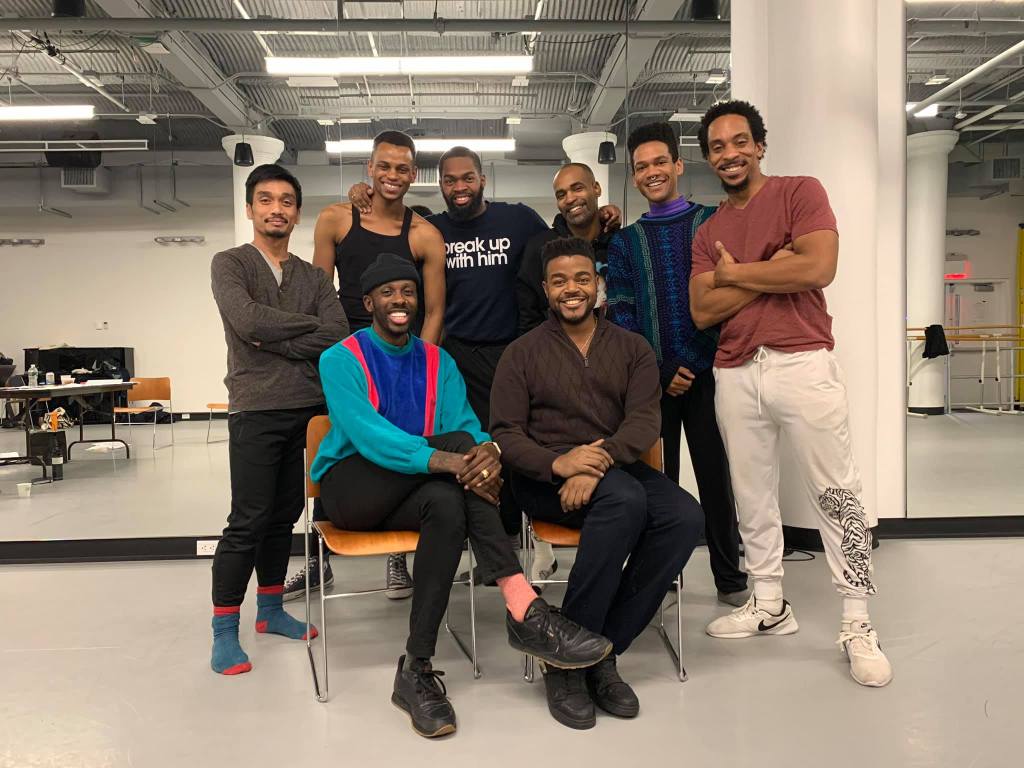
Carlo Antonio Villanueva, Taylor Blackman, Kemar Jewel, Arthur Thornton, Ashton Muniz, Will Cobbs, Darrel Alejandro Holnes, Raja Feather Kelly, and more in a workshop of Starry Night produced by Page 73 at the NYU Centre for Ballet and the Arts. Credit: Gracie Garcia.

A major difference when defining race in the United States versus Latin America is that in the US one drop of African blood historically made you “Black” in the eyes of many laws to deny legal privileges to as many as possible and to discourage miscegenation. But in many Latin American countries, one drop of White/European blood meant you could claim an “other” category that fundamentally distanced you from African-ness or Blackness. This is one of the reasons we have so many different terms for people of mixed race en español, depending on the person’s mixture and how far removed they are from the mixing they could identify using a wide variety of terms.

It’s strange to talk about this history using this idea of “drops” or “mixes”; I feel as if I’m talking about pancakes. But that’s what it is like sometimes. We talk about people as if they were made from dry and wet ingredients instead of love.

Can you share what your experience as Afro-Latinx has been during the Black Lives Matter protests?

DAH: It’s been really hard for me to watch state sanctioned violence against Black bodies on repeat. It makes me constantly question if migrating to this country was worth it. There is even more state sanctioned violence against Black people in Latin America, countries like Brazil have higher rates of cases than the USA. One of the victims was a Black Panamanian named Javier Ambler; he died in Austin at the hands of a police officer who used excessive and unnecessary force. My heart goes out to him and his family. For these reasons, I urge Afro/Black-Latinx  people who are not taking this seriously, who see themselves as separate from African Americans, to take it seriously, and to join our call for police reform and justice.

GDC: During the protests after Eric Garner’s killing, my timeline was half about soccer and the other half about racial injustices and police brutality. Real talk: it gave me anxiety. This time around it’s a bit more cohesive with some reckoning within the Latinx community and its centuries old anti-Blackness beginning to happen. It’s a slow progress, but it’s happening. It still gives me anxiety, but that has more to do with social media in general than with the divide. There’s always this fine line that I feel like I’m walking sometimes, mainly because this country does define everything through a Black and White lens. 

Even though I was raised in the U.S. and have always been surrounded by African American and Black American culture, at home I was raised culturally Dominican. I learned English in school and navigated two very different worlds growing up. I’ve felt this triple or quadruple consciousness that has intensified over that past few years. What it means to be Black in this country, what it means to be Latinx in this country, what it means to be Black in the Latinx community, and overall, what it means to be a Black woman in these spaces.

Regardless of where I am, I am perceived racially. Now more than ever I do feel that it’s important to put in the work to address the anti-Blackness in the Latinx community and foster better relationships with the African American community. If Black Lives really Matter to this community, that needs to include your Black primo (a,x,e) as well.

Guadalís, you’re an actor as well, Darrel, you’re a poet and a musician. How do these other hats come into play when you put on your playwright hats?

GDC: When I wrote my first play, it was two-fold: write a character for myself (because casting directors never knew what to do with me) and write a world I wanted to see onstage. Although, I’ll admit once I wrote Blowout I wanted to enjoy it as a playwright and not perform. I do enjoy writing roles for actors that haven’t been given the opportunity to flex their range. I don’t know if it’s a “the actor in me recognizes the actor in you” type of thing, but knowing what it’s like to be typecast sucks, for lack of a better word.

It’s incredibly detrimental to a performer to not do roles that challenge them and push them out of their comfort zones, testing the full range of their abilities and allowing them to soar. It’s so much the case that white actors are allowed to play anything (Black, white, Latinx, Asian, cis playing trans, etc) and allowed to grow and explore, yet BIPOC actors are limited to the imagination of one or two dimensional characters or stereotypes of race, ethnicity, and gender. There are so many worlds and so many characters I want to explore, and it may very well be that it’s the actor in me that keeps pushing me to create roles that are deep and complex.

If Black Lives really Matter to this community, that needs to include your Black primo (a,x,e) as well.

guadalís del carmen

DAH: Like Aristotle, the playwright is a poet in my book. I incorporate poetry in all of my plays, typically through monologues, and I try to bring music into everything I do. When I was a kid music is what drew me to language. The first thing I ever wanted to write were songs. That’s why musical theatre hooked me into theatre, it was the music. And seeing Heather Headley and the cast of Aida perform changed my life because it showed me how many of the forms of art that I loved could work together to create an exchange of experience and energy with the audience. 

BIPOC often end up having to create spaces for themselves in industries that fail to recognize them, how did you identify the lack that led to creating the Greater Good: Commission & Theater Festival?

DAH: I know that theatre itself isn’t to blame for the bias of producers and artistic directors who don’t understand or value Latinx or specifically Afro/Black-Latinx voices and stories. So, I wanted to create this initiative to encourage Latinx playwrights and theatre makers from my community to keep making and to not wait for other people’s approval or permission. This isn’t about creating another gate to keep, this isn’t about me, this is about artists helping artists during times of need, this is about the greater good of the community, that’s why I gave it that name. 

I am inspired by my family’s tradition of simple giving to make this gift for ‘the greater good’ of the American theatre community. I have seen, firsthand, how LPC and Pregones Theater/PRTT help sustain Latinx theatre in New York and how they continue to make important contributions to the American theatre, so I am happy to partner with them on this initiative. I have also seen firsthand how artists in our communities help each other find housing, afford rent, buy food, and support each other’s productions. I want to honor that spirit of generosity by simply doing my part with this gift.

GDC: Darrel came to me with this idea to create a commission in the earlier stages of COVID-19, right before the protests erupted. When we circled back to plan things out, it really felt imperative to make sure Afro/Black Latinx work was being highlighted. One of the things that we’re really excited about is allowing Afro/Black-Latinx writers to have a space where they can create work that speaks to the now and then that work will be archived. Ten years from now when folks are looking at the work that was being created in 2020, there is a specific place to find Black Latinx voices. What happens many times, all the time let’s be real, is that marginalized voices are left out of the narrative, and while it is a lot of work to put this together, we know the responsibility we have to make sure we’re carving a space out for each other in a very intentional and meaningful way. I’m also excited to see the new and different ways folks are thinking about doing theatre. This is a small step to larger things coming.

Cornelius Davidson and DeVante Lewis in Darrel Alejandro Holnes’ play, Bird of Pray. Credit: Jake King

I never realized how much I craved mentorship until I became a mentor myself. What do you wish you had when you were getting into theatre?

DAH: Like most people I experienced theatre education in college, and I wish theatre departments would decolonize their curriculum, create more financial support for students to study theatre, and spend money on initiatives to recruit a more diverse and inclusive student body. There are several colleges throughout the country that are predominantly of color but have theatre departments that don’t reflect the diversity on their own campuses. Why is that? I’m inspired by folks like the alumni of FSU/Asoló Conservatory Program who have called out the racism and white supremacy in their college’s theatre department. We need to see more of that across the academy in this country. 

GDC: I do wish I had more nurturing and more access to spaces and resources when I started out. I’ve worked outside of theatre full time to be able to pay for rent and living expenses, so while I’ve had unofficial mentors and folks looking out for me, I haven’t had the time and space to fully dedicate to my work. I’ve learned so much in the time I’ve been doing theatre, so if I wish for anything, I’d probably wish I was a bit more aggressive and more unapologetic starting out so I’d get more of what I needed.

What do you want playwrights who submit their work to the Greater Good: Commission & Theater Festival to know that this initiative is not?

GDC: This is not something that is going away. We are building and creating to keep making space. This is just the beginning. But also, this isn’t the end all, keep writing and submitting your work everywhere.

Ten years from now when folks are looking at the work that was being created in 2020, there is a specific place to find Black Latinx voices.

guadalís del carmen

Many playwrights think of Broadway as their goal. Is that the case for you? How has the idea of Broadway changed for you during the pandemic?

DAH: I think there should be a Broadway theatre in every borough of New York City, and that it should be more affordable. It pains me that so many of my students who are raised in New York City see their first Broadway shows in my class because they were never able to afford it before. It’s ridiculous to me that the tickets have to be so expensive that only privileged tourists and wealthy New Yorkers can afford it. I’d love to follow the steps of some of my mentors and see my plays on Broadway one day. At the same time, I don’t want anyone to have to choose between eating and seeing my show on any given night. So, I hope things will change. And I think moving beyond “The Great White Way” is a start to make Broadway more equitable. And don’t even get me started on the need to decolonize opera at the Met… 

GDC: Sigh. This pandemic has spurred so many feelings, and depending on the day, you’ll get a different answer from me. One of the things is I’ve been getting sleep. It’s erratic and all over the place, but I’m not running around the city going to work, then rehearsals, then a show, then a meeting, then this or that. I’ve been following the Nap Ministry and I’ve followed Ariana Huffington who is a huge advocate for proper sleeping. As a society we take sleeping and rest for granted. It makes us more stressed, gives us high blood pressure, and causes early death. 

And if you’re BIPOC, multiply that times ten. There’s been a huge pause for me during this pandemic and learning to be mindful of myself and the habits that I picked up when I was on survival mode have taken over much of my thinking. I’m also hella stressed cause people are more volatile than ever, but I digress…What does this have to do with theatre/Broadway? Everything. NYC in particular is such a hectic, go-go-go type of vibe that you don’t realize the effects that it has on your body and your emotional health. Before, my goal was productions, building my organization and creating community. During this pandemic, community is more important than ever. 

I think that the pandemic and the Black Lives Matter protests have exposed so much of the inequities not just in this country, but also in our industry. I’m very interested in finding the ways in which Broadway can be more inclusive and more accessible. I don’t know that Broadway was ever a goal, it’s always been a nice thought, but I’m more interested in figuring out how to make theatre more accessible to the Dominicans on Dyckman. If Broadway is a goal it’s how to take Broadway to Dyckman. Anyone has any thoughts, or any producers wanna holla at me, please send them my way, I got stories.

Read more about the Greater Good: Commission and Festival here.
Paula Vogel’s Advice to All of Us Right Now: “Follow Your Joy”

Interviews
Paula Vogel

If you think Paula Vogel is upset that the Broadway premiere of her Pulitzer-winning play How I Learned to Drive was delayed because of COVID-19, think again. “I’m just figuring it’s gone,” she said of the revival, that was supposed to open in April and star Golden Globe winner Mary Louise Parker. The actor also starred in the play when it premiered Off-Broadway in 1997.

“[The play’s] given me one million times back. And if it gets done on Broadway, all right. So I’m fine about that part,” said Vogel on a video call from her home in Wellfleet, MA.

The esteemed playwright is not sitting idle. After getting sick in March, she’s since recovered, Vogel decided to produce the plays she’s always wanted to see. She has started a series of play readings called Bard at the Gate, of plays that have been overlooked in the American theater. The first play, Kernel of Sanity by Kermit Frazier, written in 1978 and has never been produced, is about the marginalization of Black actors in entertainment. The reading of the play that was done last month had more than 2,000 viewers.

The next reading, The Droll {Or, a Stage-Play about the END of Theatre} will be on July 15 at 7 pm EST (if you want a free preview, the play is available to read on Vogel’s website). The next three will be Bulrusher by Eisa Davis (Sept. 17), Origin Story by Dan LeFranc (Oct. 7) and Good Goods by Christina Anderson (Oct. 29). Every reading will benefit a different charity.

Vogel sees this moment as a time to get back to basics. “It’s almost like we had to burn the entire country down in order to see how terribly broken and morally bankrupt America has been,” said Vogel. “I’m feeling some hope. I’m still in love with the art form because of the writers I’ve worked with.”

Vogel likes to speak in pages, so instead of truncating her words in a through-written piece, below is our conversation with her, with only a little editing. Read below to see how she’s finding joy in this time, how she always wanted to be an artistic director and her advice for all of us.

Jose: Every day in 2020 seems to be getting even more preposterous and there are things happening, that sometimes I see them and I laugh. If God or the universe or whatever, is writing this script, it is the most cliche script of all time. So what would your advice be to this universe or this God, that has given us this script that really looks like one of the trashiest disaster movies ever made?

This is history. This is a hysterical and historical period. And they will pass. I’ve been thinking about Elizabethan drama a lot. And the notion that when there is moral corruption on the human scale, it actually triggers natural disasters. It’s tied to the natural world. And if we think about it, actually, I think that everything has been reflected in the trailers for what we would call high-concept movies for a long time. I do believe that studio films are actually a very good mirror of cultural anxiety. Whether it’s aliens bursting out of Sigourney Weaver’s stomach. Just look at the films in the last five years, there’s something in the very high-budget disaster film that I think was an awareness of how morally corrupt our government is.

I think at some point, the trailers will change, there will be different movies. We may go back to low-concept films, which means character-based—everything that I feel great playwrights give us, which is not necessarily high budget, epic Broadway musicals. It is the listening and the empathy and the character. So, I’m thinking that’s going to flip. But for now, it’s like a car crash that you can’t not watch.

This is the first time that I haven’t been able physically to protest. So I feel very indebted to people who are marching and obviously, there’s a lot that I can do—writing the letters, barraging the representatives. But I have to watch as much as I can on every news program, just to witness because if I see something, even if it’s by the phone or through my computer, I have to respond to that. I actually am feeling so much better, to see the bodies on the streets, to see Black Lives Matter in neon letters outside the White House, to know that now that’s going to be on Fifth Avenue in front of the Trump Tower. But the other thing that’s really touching for me is: this is a fishing village and I see BLM in letters posted on the pine trees here. That’s how much this movement has changed the DNA of small towns. We did have a protest, there were 300 people in front of our tiny little town hall.

The reason that I started Bard at the Gate is because I have asthma and diabetes. I was actually in rehearsal in New York, and all of us got tremendously sick and we thought, Oh, no. And I came back home to Wellfleet. And then I thought, “Well, it’s possible that the virus has my number.”

I don’t want to die before I see the play that I quit my job over in 1978, Kernel of Sanity [Vogel read the play when she was a 27-year-old assistant to the artistic director of American Place Theatre in NYC]. So I started with that. And now I actually have about four seasons worth [of potential plays].

So starting with Kernel of Sanity, The Droll—which is looking in a critical way at the whiteness of theater in the period of time that the theaters were shuttered, and looking at theater and authoritarianism in a really interesting way. Bulrusher, which has been done, but they’ve been done in smaller theaters. Origin Story by Dan LeFranc, which has never been produced and a lot of people think it can’t be produced—it’s a mind-blowing look on gender and looks at suburban whiteness in a way that could only be done in a graphic novel.

And Christina Anderson’s Good Goods, I thought, you know, I should see if we can put the Zoom together right before the election. It’s an extraordinary play. I think it’s only been produced once or twice. But it is an exorcism of racism, a literal exorcism. That is one of the most exciting things I’ve seen.

Apart from this, I would love to do Dipika Guha’s work. I think she’s a genius. But I’m also thinking that if this increased, what would be wonderful is that we have different curators. Like David Henry Hwang, all of the work he’s mentored, and say to him, “Can you show us four writers, four plays, where it just tugs at you?” And then he would tap the next curator and on and on we go. 

I think the blessing of COVID is that we can take this moment, that everybody takes this moment and say, “It’s not about returning to the status quo. It’s about redefining what brings us joy.”

“It’s not about returning to the status quo. It’s about redefining what brings us joy.”

Paula Vogel

Diep: You’re self-producing Bard at the Gate. As a playwright who’s always dependent on other people saying yes to your work, you’re the producer now. Has that given you another lens into the theater? Has it given you some of your autonomy back?

I’m really happy. I have enough money to get Netflix. I’ve got everything I need. I’ve got a senior shellfishing license so I can pick up my own oysters. I’m living high. But when I was working the three jobs in New York, I was so frustrated that I started a theater company called Theatre with Tea. And realized I’m not good at asking for money. It lasted two shows. Then in Providence, I started something called Theatre Eleanor Roosevelt. I just like starting theater companies because I loved coming up to friends saying, let’s come up with a name. And that lasted a year. So for a very long time, I thought about being an artistic director because of the lack of autonomy.

And then the last go round, I was a finalist for artistic director at American Repertory Theater [in Boston]. And I knew that if I got that job, it would end my writing forever. But I also thought, what an opportunity because I still think that theater is actually about community and community education. And I thought, what an opportunity to take down the gate around Harvard. So I basically pitched and started making up seasons of new plays and playwrights, and matching them to classes and workshops. And opening up the classical canon. I could see the Provost going, “Oh man, this is a money loser” [laughs]

I made it in front of the hiring committee, and they were like, thank you. And then Diane Paulus got that gig. So that was the last time that I actually went for it. But what I actually do believe is that every 10 years, we need to be able to change over artistic directors, we need to be able to change over university faculty to be able to keep up and push the field forward. And that push is very important.

“I think it’s very, very hard for us to believe in ourselves. We are our first worst critics.”

Paula Vogel

Jose: I want to talk a little bit more about joy, especially because we’re all writers here. And sometimes the process of writing is something that we have a hard time finding joy in. And I would love it if you could share how you find joy in the process.

I need to put it on my wall: “Follow your joy.” Because what you’re saying so resonates with me. I think that’s right. And I think that the difficulties is that we internalize the gatekeepers, and we sit down and we’re hearing the gatekeepers—I’m still hearing people who literally said to my face when I gave them And Baby Makes Seven, “You’re a sick woman.” One agent called me up and said, “I wouldn’t pay $20 to see this, I wouldn’t see it for free.”

Once somebody says something like that, how do you get rid of the poison? Because what I think what we are all fighting against as writers is that there’s an exposure that’s necessary for the theatrical form. And you have to put up the breastplates. But when you find the remarkable artists, when you’re in a room with an actor or a director, it’s our obligation to quickly dismantle the breastplate and take it in and be absolutely visible. So the question is for me being visible, and getting rid of the poison when I write. I have to say, the poison accumulates, it takes me longer and longer and longer.

But what I do is, I literally take scenes and lines and characters, and not until it’s written do I tell people. There was a stage direction in Indecent [Vogel’s Broadway debut in 2017], when I wrote: “Lemml shows them America.” I felt that was a Sarah Ruhl line, here’s a Valentine for her, you know. Sometimes I’ll think about Quiara Alegría Hudes and the amazing things she’s told me about music and theater. She’s really changed the way I look at it. And sometimes I’ll try a scene where I actually try to do just a rhythm. You know what I mean? And then I’ll say, this is my love poem. This is for her.

Always in my plays, always, always, I put something in for my brother Carl [who died of AIDS in 1988]. And I think no matter what I’m living through, what I’m experiencing isn’t anywhere near the experience he felt being an out activist in the ’60s and ’70s. And so I’m trying to find ways that even as a kind of insider fun game to myself, that I bring in the positive energy.

The other thing that helps is really being very careful to accumulate your fellow travelers. To accumulate the first readers around you, to accumulate people who will do you no harm, but actually believe in you more than you do. I think it’s very, very hard for us to believe in ourselves. We are our first worst critics. And so I asked my friends, “Will you hold me to a deadline where I have to send you 20 pages?”

And all they have to say back is, “I read it, keep going.” I don’t need them to critique, I don’t want a critique. I just want someone saying, “Come on. Keep it going. Keep it up.”

And then likewise, when the thing is finished, I have first readers. The other thing that I feel that we do accrue, which is wonderful, is that we accrue actors and directors. Now we need to have at least five accrued, that’s all we need—that will tell us the truth. So five mentors who will invest that emotional commitment. And that’s it. I mean, that’s basically the lifetime. All of those things I think we all can do and not wait for the permission.

Andre Bishop is a remarkable artistic director, but I’m not sitting around waiting for permission to get into Lincoln Center. And the truth of the matter is, is that Andre did me a favor, he’s like, “I’m not your mentor.” And that’s so much better than pretending to be. And a lot of theaters do that. And they do it as tokenism. And then they’re not there. They’re not there. They’re not giving an emotional investment. Quiara had the courage to write about that. And to say, “I need to take care of myself.” Because if they’re not true mentors, you’re getting poisoned. So that’s about it, I think.

And I’m so glad you’re feeling joy. And the thing that I really am wishing is that both of you are taking this positive, incredible energizing step and then using this as the fuel when you sit at the computer—this is what you have to put into your own writing, that you are giving others that energy.

Karen Zacarías on “The Copper Children” and How History Keeps Repeating Itself

Interviews
Karen Zacarías

Throughout her career, Karen Zacarías has tackled a myriad of genres to create an oeuvre that speaks to the ways in which nothing is more quintessentially American than reinvention. From children’s plays to sumptuous telenovela-inspired melodramas, the Mexican-American playwright has married her cultural and intellectual sensibilities in a way that satisfies audience members, challenges what artistic directors deem works worthy of being produced, and has turned her into one of the most popular writers in the country.

Currently, Oregon Shakespeare Festival is streaming The Copper Children, a play inspired by what was once called “the Trial of the Century,” in which the custody battle for a child unveiled the ways in which class, religion and immigration intersected in people’s journeys to become American. The copper children in the show title were orphans, mostly Irish, who were put on trains as toddlers in 1904, to be adopted by families out West. In the play, one of those families is a Mexican couple, who is at risk of their adopted child being taken away from them.

I spoke to Zacarías about Copper Children, how she found her mission as a writer, writing during a pandemic, and telenovelas.

Is this the first play of yours that’s a premiere that’s happening not on stage but rather that was filmed and that’s going to be streamed? 

I had a Destiny of Desire which had already had a life day and it got canceled. It was going to be at the Guthrie [in Minneapolis], Cincinnati Playhouse [in Ohio] and Milwaukee Rep [in Wisconsin] and that got a stream. It had two weeks of performances [in Ohio], and right when they cancelled, they kept all the actors one more day to film it. And this one [Copper Children], we had two previews an opening night, and then it closed and they had just taped it for the understudy actors, which is what they do.

Destiny was filmed on purpose, knowing that it would be streamed, but this is taking the video that they already had and trying to make something out of it. So, we did have an opening, we had the two previews, opening and then I left and I think there was one more performance and then it closed. You always have a very weird schedule. As you know, you do previews and you go back to the rehearsal hall for two days. Because the other plays that are in rep are having previews and then you go back for another preview and you know. So anyway, it’s early in the process. These are before the play opens basically.

So there were three audiences that got to see the play live?

Yes, there were paying audiences that got to see it. Those audiences you see in it, were real paying audiences. My last normal day was opening night of this play, and I flew home and then we went to hell in a hand basket. 

Armando Durán, Carla Pantoja, Sarita Ocón and Eddie Lopez in “The Copper Children.” Photo by Jenny Graham, Oregon Shakespeare Festival.

You called it your last normal day, what have your non-normal days been since while you’re in quarantine?

Well in quarantine, I have three children and a husband and a dog, so I’m trying to keep a house joyful and safe. My husband got COVID early on in it, we didn’t know till afterwards. We’ve had lingering issues here, and my former agent died of COVID and his husband died of COVID and my best friend died, so there’s been a lot of loss. This was the biggest year of my career with The Copper Children opening and Destiny of Desire being in three theaters. I was doing a bilingual Romeo and Juliet so it’s weird to work for 25 years in the theater and have your best year and then of course it never happened.

In other ways we were lucky—we live in a house with windows that we can look outside and my children are not fighting with each other. We watched My Brilliant Friend and my parents are helping, so it’s that kind of thing—of taking pleasure in the small things, and from an hour to hour basis. I feel lucky. You are living by yourself, meanwhile I have a whole menagerie of people in my house and there’s other challenges, but it’s a different kind of challenge for sure. It’s a weird process, a weird way to both try to grieve and survive and move forward and be positive all at the same time. 

You mentioned finding pleasure in the small things. Maybe because I spend so much time by myself, I have come to realize that those small things are the big things. I wonder if your writing ritual, if you have one, has changed, or have you found a new way to connect with your pen and paper, or hand in keyboard, that you hadn’t or that you weren’t aware you could before quarantine? 

As a writer you always want more time. I travel a lot for my work and all of that, and so suddenly there’s all of this time, but it’s also a little bit like running through water, so it doesn’t really feel real, it’s a little disconnected. I know some people have been really productive. I’ve been productive but mostly in other genres. I’ve been doing genres that aren’t theater per se, like a little bit of TV, a little bit of novel writing, just to try to find the words to connect.

“As a writer you always want more time.”

Karen Zacarías

I started writing The Copper Children five years ago and it ended up becoming such a story of our time that I don’t know what the story of this time is exactly just yet, because we’re all living it. So I find that going back to the past is really, really interesting. I’ve been writing a lot about my family, which I always meant to do years ago. And now finally, I’m writing all of these short stories based on years and years of coming from a very large, very crazy, very complicated family. So kind of capturing that has been a delight. There’s just really no deadline. I work well with deadlines, there’s no pressure, which is good and bad.

Your grandfather, film director Miguel Zacarías, who inspired The Copper Children spiritually, lived over a century. I was heartbroken to read his wife passed away decades before he did. I’ve wondered what it was like for you to have someone in your life whose life had spanned a whole century because in a way when I was reading The Copper Children, it felt like a century’s worth of history in a single play.

My grandfather is a complicated character. He was a movie director in Mexico and part of the reason why I’m writing this book is because he was bigger than life, but not always the kindest person in the world. He was very charismatic, but also kind of self involved in ways, and he was an artist in a very different way than I wanted to be an artist. I think in many ways he’s inspired in my work, but the reason why I write and the reason why he did are very, very different.

The idea of play is that when you see it’s set in 1905 you think, “Oh, that is so long ago, that’s so crazy.” And then when you find out at the end that people were dying in the ’80s that were alive through this century, you realize that’s part of our current situation. Those children [in the play] lived in my grandfather’s age, so that made them more real. These are not just characters in history, but we actually found the grave of one of the kids about 90 miles from Crescent City, and these were ordinary people, some good and bad, with good and bad ideas, but all their stories have been lost.

Kate Hurster, Rex Young, Gabriela Fernandez-Coffey, Caro Zeller and Christopher Salazar in “The Copper Children.” Photo by Jenny Graham, Oregon Shakespeare Festival.

You have this complex relationship with the legacy of your grandpa. In a way, I find it very poetic that this play that is in a way about him, ended up being almost a movie without you wanting it to be a movie. 

Yeah.

Growing up, I remember the elderly women in my house saying “ahí viene Martín Corona,” which is a reference to one of the most famous films your grandfather directed. I never knew what that was and then I ended up watching the movie. So I guess we were connected, Karen, even before we lived in the same country.

Wow, yes, this is a very challenging story to tell. And so finding a theatrical way that is authentic is what led to the Brechtian style.

Once I read that every movie, in a way, is about making movies. I was very touched with the fact that in The Copper Children, you establish that Katie’s a puppet and that everyone helped Katie move and work and come to life, which in a way makes this theater about making theater.  

Yeah, and she has no voice, she never speaks. But she’s present during the whole play. She doesn’t even have red hair. She’s completely bald. But by the end, I think hopefully what happens, is that the audience sees her with red hair and she’s transformed from a prop into a person—from a Catholic, Irish immigrant to an American Protestant in the scope of the play. That transformation happens and she goes back to being a prop, because children are used as props a lot in politics. It was fascinating because we didn’t have a puppeteer, everyone learned to puppeteer and everyone manipulated Katie at some point in the play. 

None of your plays are like the other, and usually if critics and audiences can’t put you and your work in a box, they don’t know what to do with you. Which for me makes you quintessentially American, because you defy genres and you defy what people expect from you. I think that’s more American than being able to say, Karen Zacarías does this one thing. With that in mind, how do you define being an American?

It’s so interesting, I became a US citizen two years ago, and it took me a long time to get a green card. But I held on to my Mexican citizenship, because it’s something that made me proud, I wasn’t ready to let go of it. But when Trump became president, and I live in DC, where, you know, voting is…anyway, I learned a lot in the last election. I finally said this is the time to actually go for citizenship.

When I moved to this country, we were going to be here for nine months. My dad had gotten a scholarship to work on socialized medicine at Harvard, and we came here. And there’s political reasons why his work was controversial, because he was helping prostitutes and men in prison and he dealt with sexually transmitted diseases. And that was the year AIDS started popping up, and it completely changed the course of our immigration story. We stayed and my dad became part of the CDC and worked in public health and changed people’s ideas and attitudes—putting the health of young gay men as essential to the health of this country and that the marginalized are part of it.

So we grew up in this environment where my dad told us, don’t worry about being happy, worry about being useful. And that’s really hard when you’re an artist, right? Because it’s self indulgent for me to sit down and write. And so part of the idea was that writing for me became a weird, different public health thing where you hold up ideas to examine, about what that means in different ways. And hopefully, ways for me to heal or other people to heal.

“My dad told us don’t worry about being happy, worry about being useful.”

Karen Zacarías

So on purpose, I never wanted to be boxed in. I wrote for children. I wrote comedy, I wrote drama. I didn’t want anyone to ever just say, “Oh, I know who this person is. What they do, this is their thing.” In some places, I think it might have hurt me, and in some places, it helped me because of how I navigate the world. I see things and can relate to them because I’m Mexican or because my great grandfather was born in Lebanon. I grew up in a very multicultural home and actually found ways to connect with people on a lot of different levels. If you don’t learn, if you don’t grow every time you write, then there’s no point, no matter what happens on the other end.

Adriana Gaviria, Fidel Gomez, Ruth Livier, Cynthia Bastidas, Mary Bacon and Yunuen Pardo in the Denver Center Theatre Company’s world premiere production of “Just Like Us.” Photo by Jennifer M. Koskinen.

How do you know when you have learned something after you finish writing, are you your harshest critic? 

Yes, of course I am my harshest critic. I think over and over again of the audience and when you start writing a lot of theater for young people, young people are very, very honest in their response. They will let you know if they’re bored, they will laugh at something you did and adult audiences tend to be much more cagey for that. But a lot of what I’ve written, why I enjoy comedy, or breaking the fourth wall, is that I am not interested in writing the perfect play. I’m interested in having a connection with the audience. So it’s very exciting to me, that the audience starts talking about the play or where people gasp or something like that. Going to a play where everyone is quiet, unless it’s because they’re on the edge of their seat, is very weird to me.

Is there a sound that once you recognize it from the audience, you take a breath of relief? Like, OK, someone got it.

Yeah, it’s different for every play every and every time. There’s a moment where an audience is sitting there with crossed arms, saying, “Entertain me, show me what you’ve got.” And then there’s a moment you almost don’t even hear, it’s a shift in the seat. They’re starting to understand the language or you can even feel confusion. What’s happening? And I see it in myself. I feel like that. I feel that way with Shakespeare, where in the first five minutes I don’t understand anything. Then something clicks and you need to trust the storytellers here and there’s a moment where that happens.

And I’ve learned that talkbacks aren’t that helpful to me anymore. What’s helpful is sitting at the back of a theater and seeing how the audience kind of moves like an ocean. There’s a moment of surrender that happens. And you have to be patient because people give up the ghost at different times, and you can’t just write for the one person who doesn’t want to get it. 

When I was reading about your childhood and growing up with your dad and his work on HIV and AIDS, I wondered what it was like to talk about COVID with him. It’s the same all over again, the failure of a government to act has led to disaster. Are we doomed to be repeating the same mistakes over and over again?

When I started writing The Copper Children, the policy of child separation had just started. It just was originally a story about the trial of the century that dominated newspapers, and it isn’t even a memory in any of us because none of us were taught about this. And then all of a sudden history caught up with the play. That moment where the kid is ripped out [from her adopted parents], that’s exactly what’s happening at our borders now 115 years later. We see the importance of history repeating itself and the idea that just because we want something not to be that way that it will go away.

“It’s really, really weird how many people are committed to an attitude that denies other people their truth.”

Karen Zacarías

I see with the pandemic that not talking about something is the worst thing you can do for this type of thing.  That relentless examination and reckoning is something that’s important. I don’t even know if Ronald Reagan brought up AIDS during his lifetime. I think it wasn’t until Bush, that the word AIDS came out of the mouth of a president. The politics of pandemics, racism and viruses and all those are actually solvable by the idea of public health—all that needs to change in attitudes, and we can find solutions. But it’s really, really weird how many people are committed to an attitude that denies other people their truth.

And speaking of that, now we can talk about New York theater.

[Laughs]  

One of the things that gives me the most hope about being in quarantine right now is that I hope that the country and the world are going to realize that NYC is not the theater capital in any way. This idea that Broadway is the ultimate goal and that New York is very hip and avant garde is a lie. New York is, in fact, very provincial, it’s very commercial. Meanwhile in quarantine, I’m able to see one of your plays for the very first time! I’ve been seeing theater from all over the world, from all over the country, and that makes me very excited. Is the idea of decentralizing NYC something you hope we’ll be able to maintain as an industry?

It’s so interesting, because you look at me or Lauren Gunderson, some of the most produced playwrights in the country, we actually don’t have a presence in New York. And part of it is because we don’t live in New York City. I don’t know a lot of the people who are involved in making decisions. I loved going to New York when I was younger but my work was working in the community here in DC and I built a theater company that works for young people and in community, and that’s how I did work.

During the Obama years, we saw young people running for office, realizing that we have to work on our garden at home—from the bottom up, change things at the top which I think is really exciting. And I think you’re right, it’s happening in the theater. People ask me why I was allowing the video of the play to be seen, when the play is on the dock and might be done next year, and I said, well because this way my family in Mexico can see it, people who never had access can see it. Considering that it was not meant to be presented around the world, I think it’s a really good quality video and because it’s so theatrical and so presentational, it works well as a video. I am hoping it makes people want to be in the theater.

New York is not the center of my theatrical world. Would I love to get New York’s stamp of approval? I would be a liar to say no. Because in some ways it feels like a weird rejection. But I had such a healthy, lovely, robust career doing what I believe in, working with people that I do like and having relationships with different theaters around the country. In some ways it took the pressure off to just do what you want.

So, yes, I’m so excited that people now have a choice. Whether they want to see one of my plays or not. Luckily we’re all going to have to figure out how we create theater, hopefully in open spaces. We’re going have open things up, both in a metaphorical way and in a literal way to make sure to let a lot of infectious and problematic behaviors out of the room. 

The word telenovela is something that we have discussed before on Twitter, because of the way in which white critics attach it to anything in Spanish without any of the knowledge of having actually watched a telenovela. But we actually have never talked about telenovelas, so my last question for now is: What’s the ultimate telenovela for you?

Oh, my goodness, I saw so many. I will tell you my favorite one was the first one I ever saw as a little girl, in Mexico, because it made such an impression on me. I don’t know if it was the best, it was called Viviana and it had Lucía Méndez and Héctor Bonilla who were both theater actors. It involved a woman running down the beach in this torn up dress and she suddenly sees one lover on a horse. It was awesome! He was on a horse and then the other lover is in the ocean and she can’t decide. My cousins and I, whenever we go on the beach, we do the Viviana run.

I have this delightful memory of being eight or nine years old, and my sister and I would do telenovelas, we pretended to slap each other and it was just so much emotion. It was so delightful to do. And then as we grew older we had to look down upon them—we have this whole complicated relationship with melodrama. Playing with and testing and also honoring the genre was really an interesting exercise of coming to terms with so many issues and both the poetry and the problems of the political life of being a Latinx person who was born in Latin American who came here. Telenovelas are such an interesting avenue for that.

The title sequence for “Viviana.”

I agree and you blew my mind right now. Lucía Méndez started in theater?

Si and Héctor Bonilla too, I saw him in a musical about a Noah’s Ark that was out of control. Telenovelas are such a disparaging form in so many ways. And yet it’s one of the things that kind of hold and defined us, it’s an interesting paradigm. And it’s been really interesting to see people’s response to it, both to delight in it, but also to use it as a subversive way to talk about important things. Not everything needs to be a straightforward drama or a tragedy like The Copper Children. It’s been fun to be a Latina that writes things that are important to our culture, but also are not necessarily just about being on the outside, being the other in a society.

The Copper Children is now available to stream at the Oregon Shakespeare Festival through July 22.

Taylor Reynolds on Creating Work Outside of the White Gaze

Interviews
Taylor Reynolds
(Photo: Brandon Nick; Creative Director: David Mendizábal; Hair: Jeffrey Bautista; Makeup: Natalie Lageyere / Glamsquad; Photographer Asst: Malik Childs)

This spring was supposed to be a busy time for director Taylor Reynolds. On March 12, the day that New York City shut down because of COVID-19, Reynolds had directed Noah Diaz’s Richard & Jane & Dick & Sally, which had just closed at Baltimore Center Stage and was getting ready to open in New York City at the Playwrights Realm.

Reynolds (who blew many minds last year when she directed Will Arbury’s Plano) also helps run the Movement Theatre Company. The theater was getting ready to remount their hit play What to Send Up When It Goes Down Off-Broadway in the summer (which would have been so much more relevant since it’s about anti-Blackness and collective healing). But then the call came. “I was like, in Columbus Circle, and everybody’s walking around. I was like, ‘Everybody, theater just shut down, what is happening!?” Reynolds exclaimed.

But since being at home, Reynolds hasn’t been idle. The Obie-winning Movement Theatre has started a new initiative: 1MOVE: DES19NED BY…, where they commission designers who then present their work digitally (since if there’s no live theater, designers aren’t getting work). They’re also currently presenting a new online work by What to Send Up… playwright Aleshea Harris called soft light.

Below, Reynolds talks about why she considers art a form of activism, and why we might need to burn everything down. This conversation has been edited and condensed.

Can you tell us a little bit about how the Movement Theatre was founded? Because from what I know, it’s not hierarchical. It’s very consensus building and it was founded by young people of color.

So in 2007, a group of recent NYU grads and NYU students of color met in the Astor Place Starbucks—it’s such folklore. And they essentially formed a collective. In 2007 it was really like, you can play the drug dealer in a movie or you can write the text for the drug dealer. So it was founded on the idea that artists of color could come together and create their own spaces and allow for the exploration of various artistrys. And then about five years into the company’s existence, they were doing strategic planning sessions where they were like, “Well, this model of hierarchy doesn’t really work for us.”

And so the model that we’ve had since then is the producing artistic leadership model. So there are currently five of us who run the company collaboratively. So that means we’re making all of the decisions collectively, from big, top-tier decisions (like what artists to support, what plays to produce, all of that down), to me making an e-blast and sending it to everybody and be like, “read this.” Over the last like two years, we’ve started to expand our staff positions or more specific, task-oriented positions, so that we can step away from doing so much of the every day that takes our energy and capacity away from being able to dream bigger and focus more on the leadership part of our title, rather than the line-producing part of it.

Right now, with Movement Theatre Company, you’re commissioning pieces from designers, and you’re gonna do several movements like this. I love seeing how adventurous, how original, and how inventive all the work that so many people are doing right now. And I would love for you to talk a little bit about this movement and how this came about.

When the theater first shut down, we had a meeting that first Monday. One of the first things that we talked about was really just, how we were doing as people because that’s the most important, and then also just a weekly check in about how we wanted to use our voice and use our platform during the pandemic. The first week after theater shut down, there were artists individually putting things out. There were theater companies just throwing things out and making digital content. But we didn’t have the emotional, physical, or mental capacity to really do any of that. And we didn’t want to just put things out into the space, out into the digital space, unless we knew that it was going to have a purpose, and that it was going to fulfill us in some kind of way, or fulfill the artists that we were working with.

We noticed that a lot of the content was either playwright-driven or actor-driven, which makes sense, because you can write a thing, e-mail it, somebody can say it, put a camera up and then you made art, which is awesome. But there was not really a public representation for the other aspects of theater workers—directors, stage managers, producers, and designers.

And just through our check ins, reaching out to folks seeing how they’re doing, we were hearing a lot specifically that immigrant designers were having many issues. Because they’re on F1 or O1 visas that are work based, where you have to prove consistently that you’re an extraordinary artist that deserve to be working in the United States of America. So the entire industry shut down, and suddenly there’s nothing that you can do, because it’s also not like you can go out and get a different job—it has to be specific to the work that you stated that you were coming to the US to do. And so what we really wanted to do is just give the designers a platform just to work to prove that they were still working.

We also paid them and gave them a budget. And also making sure that the weight of finding or providing their own kind of like creative materials wasn’t just on them. Because if you want to buy a certain light that costs $25, but like you don’t even have $25, then you’re not gonna be able to make the art that you were hoping to make. So we did all that. And we also were introduced to a lot of new designer through co-curators Clint Ramos and Cha See. They’re all so incredible. And so now we’re gearing up for the second round of 1Move, which is going to be focused on all Black designers, which is really exciting. And our co curators for that are Dede Ayite, Stacey Derosier, and Paul Tazewell, so it’s like a dope ass group! And so those videos will be launched in mid July. And then past that the Movement is taking a sabbatical in August, which I suggested because I’m exhausted at being alive.

The producing leadership team of the Movement Theatre: Taylor Reynolds, David Mendizábal, Eric Lockley, Deadria Harrington.
(Photo: Brandon Nick; Creative Director: David Mendizábal; Hair: Jeffrey Bautista; Makeup: Natalie Lageyere / Glamsquad; Photographer Asst: Malik Childs)

Thinking about what you’re doing right now with the designers, where you are literally using art to save people’s lives, you’re giving them the opportunity to keep their visas and save their lives in a way. As an artist, who’s also by default I would say an activist, I wonder if you could talk a little bit about where those two meet and how they intersect.

I think for us at the Movement, we are very much identifying as a social justice organization just as much as we identify as a theater company. We’re just more focused on creating change and transformation with the work we’re doing. And that doesn’t mean that it can’t just be a two-person play where people are talking on a park bench, but it just means that, you know, there’s something underlying or overt that is going to push and engage audiences to start conversations, but also hopefully to just take action. Even if that action is like Googling, “racism.”

Even with our production of And She Would Stand Like This by Harrison David Rivers—that production featured Black trans women on stage and put them in lead roles. And even with Look Upon Our Lowliness, which was also written by Harrison, putting nine gay men, most of whom are of color, on stage and just letting them live their fullest, most emotional lives. And representation without pandering to white people. Honestly, I think a lot of our work is successful because it’s not really pandering to anyone—it’s not made for the white gaze, it’s not made for an audience that would feel great under a white supremacist structure.

And that’s not necessarily just white people. There are plenty of people of all intersecting identities who just want to go and see a play or a musical, you know? They just want to see The Music Man (The Music Man shouldn’t be on Broadway and it’s upsetting). Our acknowledgement that we are both a social justice organization and a theater company is really our guiding light when we’re talking to artists. I think it’s part of the reason why we operate the way that we do. It’s not just about one person going out and being like, “This is my voice. These are my ideas.” It’s about uplifting the community and uplifting all of us so that we can destroy these terrible systems that we all exist within.

That’s the thing I’ve always loved about the Movement and your work. It’s the fact that you all created something because what you needed wasn’t within the systems that were present. I have a lot of conversations with leaders of theaters for people of identities that aren’t white, there’s always a common theme that comes up of, why are we trying to change these white institutions instead of supporting the institutions that have been doing the work in these communities? And so when you think about the future of the American theater, do you think right now we’ve been focusing on the wrong thing and trying to fix it, rather than just destroying everything and starting a new thing?

I think it’s a little bit of both. That question makes me think about when all of these like different theaters were putting out their like, “We love Black people” statement. I’m sorry, I don’t mean to phrase it like that. Although it’s like, cool—some theaters that I know and support put out really heartfelt statements. Some theaters put out like what I thought were well-written statements where I was like, “Yeah, but I didn’t like expect you to say this. You’re not like overtly against Black people but also you don’t support them. And that’s chill, you do what you do, you know? I honestly don’t want you to produce this Black person’s play ’cause you’ll just ruin it and then I’ll just be mad so like, it’s fine.”

My personal hot take is like, yes, destroy everything, unseat all the Gregorian mammoths. But if they want to keep existing—honestly, there are some audience members who I don’t want to come see my work ’cause like it’s not for you, you’re not gonna have a good time. It’s fine, there’s a lot of stuff that I don’t go see it because that’s not for me. So why would I go and spend this money and take a seat from somebody who wanted to be there?

I think that there needs to be systemic change, absolutely. If the traditional sense of theater is to continue at all. But I’m also not interested in that. Like, I don’t really care. I don’t really honestly care what Broadway does. Just don’t actively hurt people, stop taking money from smaller organizations that could really use it. And produce The Music Man if you want. I’m not going.

I think that where I’m interested is in the sort mid-range smaller companies, that are already making the change, that are already more flexible because they likely have smaller staff. But the goal is not like, “Oh, I hope people enjoy this. I hope people like remember this forever.” No, the goal is to come and engage with what’s happening on stage. The goal is to come and be transformed in some way—whether that’s the planting of a seed, and then a year later, a global uprising happens and they’re like, “I remember when I saw What to Send Up When It Goes Down because it was in the New York Times. And at the time, I thought, ‘What a nice play.’ And now I’m like, ‘Oh shit, what they were saying in the play was correct!'”

Listen to the rest of the conversation with Taylor Reynolds on the Token Theatre Friends podcast.

Mirirai Sithole on Being an Artist, a Citizen, and Building a Future World

Interviews
Credit: Gabriela Della Corna

If silence can be eloquent, few actors deliver wordless soliloquies with the precision and grace of Mirirai Sithole. In stage productions of Tori Sampson’s If Pretty Hurts Ugly Must Be a Muhfucka, Ngozi Anyanwu’s The Homecoming Queen, and Jocelyn Bioh’s School Girls; Or, the African Mean Girls Play, she painted lush emotional landscapes in the moments where all she did was listen to other actors. Her alert, expressive eyes, often uncover new layers in the dialogues of the bold playwrights whose works she favors, her body language is always ethereal but grounded.

It turns out that Sithole’s empathetic listening goes beyond the stage, as an activist she has shown to be deeply in tune with the requests and pleas of her community, and throughout her career has worked to create opportunities for those who aren’t always given the chance to be heard. This led her to create Aye Defy, an organization that advocates for inclusion, equity and empowerment through art.

Mirirai Sithole in “Mother Courage”

I first encountered Sithole’s work as Kattrin, the tragic mute daughter in Bertol Brecht’s Mother Courage, and I was impressed by the way in which she made moments from one of my favorite plays feel completely new. Seeing her work in Kattrin’s last scene, knowing what was about to happen to her, was one of the few moments where I can recall wanting to jump off my seat to intervene in the play. I knew then that I would follow Sithole’s career wherever she went next. Having seen her act in several mediums, it’s a joy to follow her as she puts on a new hat. I spoke to her about acting, streaming and always defying expectations.

Was Mother Courage your big break into the New York theatre scene?

Mother Courage was a major part of my break into the industry as an actress. And then I feel after that it was a steady stream of things Off-Broadway, Off-Off-Broadway, and then School Girls; Or, the African Mean Girls Play happened and it was like “oh, this person, right! I either remember her, or I never knew her. Who is she?” Those two feel like major turning points in my career as an actress. 

Before that I weaseled my way in through internships. It recently was the 10th year anniversary of my first internship at New York Stage and Film. I didn’t know anything about theatre. I did it in high school and then I went to college to study theatre, but I learned everything that I know either through internships or on the job as an actor. Before coming back to the city, proper New York City, I spent time at the Actors Theatre of Louisville. So it was just a steady stream of interning and apprenticeships, and learning the different ways in which to be an artist. And then getting the privilege to be an artist in New York City, which is magical and confusing, very confusing.

Why did you want to become an actor?

That question? [Laughs] It’s one that eludes me. I’m trying to figure out the concise answer. I don’t think I knew why I wanted to become an actor or be an actor until recently, quite honestly. I do believe and understand that I’ve always wanted to be a theatre artist because it’s perhaps the first place that I found community. It’s where I was able to, I don’t know what the word is, whether it’s access or utilize all parts of myself. 

I definitely was not the person that was like, “I’m three years old and I know I’m going to be on Broadway.” I didn’t know any of that. I was a Zimbabwean growing up in Massachusetts with two parents who worked very hard and was just figuring out how to keep myself occupied as the youngest of three. 

Now I say I’m an actor because I love to embody different stories and learn about myself and various characters. At the end of the day, storytelling is one of the most healing and transformative experiences we can have, whether that’s on the design side of things or the performative side of things. It brings me so much joy to be with people telling the story, which feels so basic, but it’s indigenous, you’re around a fire telling the story. And the fact that I’ve just realized that at my big age of 29, made me realize this is inherent in my DNA as an African. We tell stories of our various lineages, and it could be as simple as just orating that to a young child or adding the elements of design and sound and projections. 

I can tell you for instance about the feelings that you ignite in me as a journalist, as a critic, and as a human being. But I’ve always been curious about what actors go through on stage, would you be able to describe what it is that you feel when you’re onstage telling those stories?

[Laughs] A metaphor to describe the alchemical experience of my inside?

I’m sorry!

No, I love that. I’m smiling. You can’t see me, but I’m smiling because I don’t think I’ve ever been asked that. Wow, it’s purely magic. And I feel comfortable saying that and knowing that that’s true for me. The memories that I immediately thought of as you were asking that question was performing School Girls while rehearsing The Homecoming Queen in the winter and being so sick that at one point I didn’t have a voice, I was overworked. I definitely didn’t do self care practices or tools to release one show and enter into a rehearsal space for a different show.

And yet I remember doing this one show where I got to the Lucille Lortel Theater, from rehearsal from the Atlantic, and I was a mess. Of course we don’t have understudies, so I’m thinking, “Here I am, $700 a week, super grateful, thankful that the show’s only 60 minutes.” I had to sing at one point in that show, and I had no idea what was going to happen, but this is what I did know: I had all these beautiful Black women around me who trusted and supported me and I can only do my best.

In certain rehearsal rooms we say, “You bring yourself to the character,” and if an actor is sick that day, then your character is sick that day. We’re not going to pretend, but we’re going to trust that for all the other times that we’ve done this in rehearsal that we can do it that night as well. So you trust and you believe, and I don’t know how I got through that show, but I did, we did. It was just as powerful and just as magical because the audience had no idea [laughs] and we’re truly so powerful and magical when we lean into the trust of our instruments.

It’s this magical combination of practice, which is rehearsal trust, and also honoring where you are at in the present moment. The lines will come out when they’re supposed to come out, and if they don’t, someone else knows the script well enough that they will jump to the next part. That’s what’s so magical about a live theatrical experience and being able to be a part of it as an actor: we know this story and we know that anything can happen. 

I always get nervous, I wrote in my journal a while ago that the day that I stop being nervous before a performance, before a self-tape, before being on set, is the day that I have to reevaluate if this is what I want to do. It’s those healthy nerves of knowing: who knows, you might choke on an orange today! But putting yourself out there is the joy and is the practice.

I often tell myself that the night that I go to the theater and I feel tired of being there, not because I’m sick or because the subway sucks or whatever, but because I just feel tired, I’m quitting and I’m finding a new career.

Yes!

School Girls was recorded and has aired on PBS and streamed during quarantine. During the run of the play you got feedback from audience members, critics and from friends and family who came to see you. But then when you have a show that’s recorded and people can see it beyond NYC, have you been getting feedback from people who found School Girls for the first time when it was streamed?

The short answer is yes. That one’s been difficult though, because as far as I know, it’s only released to the Tri-state area, so it hasn’t had the global reach of the Goodman production that got cut short, that people were able to buy tickets to. The response to the PBS recording of School Girls has been varied in the sense that some people don’t know that it exists and when they realize it exists, they get sad if they’re not in the Tri-state. I wish I knew how to help them access this thing. 

Mirirai Sithole in “School Girls; Or, the African Mean Girls Play”

For those people who have access to it, it’s this beautiful reminder of the legacy of that piece and the legacy that Jocelyn Bioh put into the world and the gifts that she gave us that keep on giving truthfully. Despite me wanting to be able to share that with my friends in Brazil and my family in Zimbabwe, I know that the energy of that piece has ripples beyond what I think any of us could have ever imagined, so it’s always nice when you have this kind of living document that something existed. So no matter when people discover it I forever get to go back into that memory box that makes theatre feel less ephemeral.

The part of me that is an artist who got paid one time for that day of recording is like, “darn, I wish we had residuals on that.” Or what would happen if we could move it out of the Tri-state area and what does that look like contractually. My castmates and I talk about that sometimes, what is the reach? We’re not getting those numbers. We don’t really know. So it’s interesting because it’s both really great that it’s out there but also we don’t know why it can’t be shared even to a wider audience, you know?

I didn’t know that, it shows my New York privilege, doesn’t it?

It’s accessibility. I had a friend of mine who’s in Massachusetts, but was living in Long Island before quarantine and she was so excited to watch it but she can’t access it. It’s so sad and I can’t really help. Not because I don’t want to, but because I don’t know what to do. Should I reach out to PBS? Do I let it go because I have other things to worry about? I know there are DVDs, but it’s accessibility, and the conversations that we have about how to make things more accessible are having them in a holistic way and who experiences something and who doesn’t. It goes back to bureaucracy and contracts and asking why are they allowed to watch this? If we allow everybody in the United States to watch it then what does that say for the artists that originally made this who got X amount of money for it? So it’s definitely a weird position to be in: I want everyone to see it, and I don’t necessarily want to get paid for this, but why are we not making this accessible? What is the holdup?

It’s so scary to me, even just as an audience member, to think that once the pandemic is under control, and things become more flexible, that the theatre community specifically is just waiting for things to just go back to like they were before March 12th. And that is insane to me, because the world is already so different, so let me have a Barbara Walters moment and ask you: what have you discovered about yourself as an artist in quarantine that you are not willing to forget or put behind when this is over?

I love this question, Barbara Walters Jose. It’s so many things. I’ll start with how transparent I believe things have been. I started quarantine on March 14th and delved into the live-streamed readings world, where I realized pretty quickly that this is really beautiful because the barriers to access, whether that’s for artists, actors, or playwrights, are gone. Brick and mortar theatre, as I’ve been calling it, does not exist. So how do we bring some of the things that were working in the old world to this new world? 

It’s shifted so drastically and I love how open many artists have been to doing a reading or putting their words towards the developmental work. They have been honoring their status or social currencies to give back to vulnerable communities, artistic spaces that they believe in and want to make sure survive. 

When I started reaching out to folks to do work it was never a question to me that this was for the love of the art but that they would also be paid. I’m definitely not going to pretend that we’re going to pay you the hundreds of dollars you probably deserve, but you will be paid and you will be paid this transparent amount. Full transparency as much as possible. That’s what we ask of our people in power, whether it’s in government or other businesses and a lot of times you don’t get it and I think it creates this fear.

When I was working on If Pretty Hurts Ugly Must Be a Muhfucka, it was the first time that a company of Black actors were talking publicly about money and about our contracts. Maechi Aharanwa, one of the artists involved who in my eyes is veteran and so vocal about artist’s rights, was just so adamant that we had to start talking about these things. She’d say, “This is what’s in my rider, what’s in yours?” And I’d be like “Oh, I can ask for that? I didn’t know I could ask for that.” And I’ve been doing this for how many years? 

Even on Twitter, I think it started with the #PublishingPaidMe hashtag, and that’s not my world, I’m not a playwright, but I like seeing it, because I think that’s love. I think truth is love, transparency is love. When you can say “Hey, y’all, this is what they said I’m worth. I think you’re worth that as much as well. So that should be your starting rate.” Sharing what you get with other people that you believe should be getting that amount, or should be getting more allows us to actually be equitable. 

Another thing that I had to reframe for myself when we were dealing with casting for readings was a phrase that I realized was really problematic, the phrase, “We want a name.” I told all my collaborators, “Everybody has a name actually.” So what you’re asking for is you want someone with status. We know it’s business, but the way in which we frame these things and say these things is really important because I don’t want anyone to feel some type of way if I say, “Okay, let’s ask this actor who ‘isn’t a name.'” Does that mean they’re not as important that they shouldn’t be treated as well as we treat Tessa Thompson? No, it’s just that someone like Tessa Thompson, who we are grateful for and who is so badass, and who we were able to have on a reading, has this different social status and that’s okay. Because what we’re trying to do is raise money.

I’m not willing to sacrifice this sort of equitable playing field that we had during quarantine, and this autonomy of we don’t want people to feel used.That has to be across the board for everybody, no matter what systemic list they’re on, we must respect their time and really realize that doing work of any kind is work and that the rules of the old world no longer apply. I don’t feel comfortable asking people to spend 29 hours on a reading knowing that they probably have other job things or time that they’re trying to spend with their family or friends and happy hours. We’re creating these new digital lives for ourselves, and yes, things are starting to reopen and you can balance that now with a little bit of outside time, but there’s a new, emotional map to the world that I think is being built, which is a future world.

One of the things also that I don’t think I knew about you before quarantine is that now you’re a producer. When you started developing Aye Defy, was this the first time you took on creating work for others?

Credit: Gabriela Della Corna

I’ve always had my hands in something. In high school I was theatre kid, but also on the newspaper and on the dance team. In college I was part of the student government, student activities and a member of the performing arts community. I had friends in the music department and the dance department and I think I just really took to heart a phrase that was a part of my college experience that we would say before shows three times: first I honor life and with it my life in the theatre. And for me in order to honor life, I needed to be outside of the insular theatre walls. I needed to be experiencing life in other perspectives.

Like my acting career, I never wanted to be a producer, but I took a class in college for a credit and to learn about that side of things, and it all felt like it was serving the larger purpose of me as an artist and figuring out the system from the inside. So before Aye Defy, which honestly started as a blog and a place for me to heal a romantic relationship, I had executive produced a short film with Níke Kadri, who’s also a multi hyphenate artist who I’d been in multiple plays with. 

Before that, when I first moved to the city after college I started a theatre company called Rooftop Theatre Productions. I was living in Brooklyn in Bed-Stuy and wanted something to do and had a bunch of friends that wanted something to do, and we had this beautiful roof. So we had a night of 10 minute plays. We held auditions and we did them on our roof and it was a party. That was the only thing we did, Rooftop Theatre Productions was that one night, but I still have a few collaborators from that time. I was 21 years old about to turn 22 and I just wanted to do stuff.

Of course alongside that I was proving to my dad that four years as a theatre maker was worth it. [Laughs] I was trying every single way in. I had to make it work. I moved here, cliché or otherwise, with a duffle bag, a backpack and a job that was $200 a week, and I didn’t know where I was living. I think we’re all storytellers and we’re all producing our lives, figuring out what is the best way to tell this story of my life, which includes art and theatre and business. I also have a minor in business and human resources, which is a thing that I forget and a lot of people don’t know about me truly.

How did Aye Defy happen?

At first I thought this was a blog, then I thought this was about how to be an artist and a citizen in relationship to the crap that’s going on in our country. And what is this country? Because actually my home country is something else, but now I’m a citizen of America and an artist. And now it’s a pseudo production company that’s in the digital realm. I did not plan this out, and I think in relation to how I feel about being an actor: that this whole life that we are gifted is a mystery and it’s magic, sometimes it’s painful and confusing.

Trusting our innate personal power is something that I’m learning. Impossible truly is nothing. Yes, there are barriers and yes, there are systems that really want to tear down Black people, women, other POC, those are true things. And what’s beautiful is moving past those blockages and understanding that we can do anything. I truly believe that. Whether the label is producer or actor, or CEO, it’s really fascinating watching people realize that we have so many tools to help us create the life that we want to honor.

Something you just said right now resonated with me so much: my very first review that I ever wrote was in my journal when I was 10 years old. And here you are talking about how you turned your journal, something that was so precious to you, and so personal, and so private, and you transformed it into Aye Defy. But then you called it a pseudo production company, which is what I call myself often, not the production part, but the pseudo part. How do we get over imposter syndrome? How do we tell ourselves: you matter, you’re not pseudo, you’re the real thing?

[Laughs] Oh my gosh, how do you get over imposter syndrome? Well, we’re going to have to help each other on this.

I hope so.

I don’t know the thing that’s coming to me right now is that I believe that I am in this position that I’m in, whatever it is, where I’m stepping into all that I am capable of and all that I know of myself, because I was able to sit with my failures, and able to acknowledge when I didn’t get something right, or when I did hurt someone unintentionally. 

I say that because I think it’s something that I think a lot of leaders, the people in positions of power are not comfortable doing. And it’s what we’re seeing reflected in our community, in the larger theatre community where it’s like, “yo, y’all like, I didn’t get here by having the money by having parents who are like, ‘Oh yeah, let’s get you into this program’.” They were like “all right, we’re still co-signed on those loans sis.” I had support but there were mistakes, and failures, and roadblocks, and things that I did wrong. 

But there were also things that I did right. So not to be masochistic or mean to myself, but I sit with myself and acknowledge that I am both perfect and imperfect. I am not my flaws, but I am flawed. And that’s okay. As a leader that allows other people beside me, “under me,” I’m trying to figure out how to be a leader in a non-hierarchical set up, which is really hard because people are looking to me. But I think what I try to give my friends and colleagues, especially the ones that are working on Aye Defy right now, is to be empowered, to tell them “you know what you’re doing, and if you need help ask for it.” Which is something that I had to learn for myself too, I can ask for help. I can ask for someone to help me figure out a way to do this better.

I don’t know that this answers fully the imposter syndrome thing, but I feel like I get it right, when I tell myself “I know, I know I can do it. I know I can do it. I know it.” And yet sometimes I can’t and that doesn’t mean that I’m an imposter. Sometimes you just need to reset and ask for help. Do I need to spend five hours on Google? Or do I just like call that friend that’s been doing this for three years? I don’t know everything and yet me having the humility to say that out loud is what makes it possible for us to be the badasses that we know we are.

Where do you want to take Aye Defy and what can we let audience members know they can do to help? How can we help your production company grow?

I spent a lot of time in our soul work, figuring out the best way to do this. I actually launched this before quarantine and it was for the brick and mortar theatre, and eventually for film and TV. We have a mission, we have a philosophy, we have the pillars of the work that we want to do. And there is a GoFundMe campaign that will help us do this work with the understanding that these tools are needed because we are building tools and we’re building programming that allows for dramaturgs, directors, artistic directors, to see where the future is.

It’s really interesting that there are different communities, factions, organizations, whatever you want to call them coming out that are getting ready to lay out demands for what we want the theatre to look like. And I think for me, my team has been doing that work actively. We’re not a theatre company. I want to be very on the record about that. We are helping create tools for more streamlined intersectionality in terms of marketing and artistic advocacy and community building. 

So we would love some folks on the mailing list so that we can tell you all of our programming which for the foreseeable future will be digital. I’m interested in what people want to see in a digital platform. I had a conversation yesterday with an actor friend that was more in the veins of artistic advocacy, because as people are starting to call people out, which I will not say my opinions on, we need tools for healing. Aye Defy started as a blog for me healing from a relationship, and I think of people’s relationship to the theatre and the interconnectedness of that.

Aye Defy is a space for everyone where you can come and pitch your projects and we’re there to support it in any way, shape or form that we can. And it’s also to help heal the processes that happen in a rehearsal space. We’re doing our first workshop, which will lead into a one night only benefit reading, so now I’m watching my friend and collaborator start a rehearsal process for a workshop that’s not 29 hours, and that’s in house, that has a black dramaturg and a black director, which was the goal and the mission of the playwright. My karmic lesson right now is to really amplify writers and their mission, and making sure that whoever they want to see their work, we reach out to them and we do our due diligence on marketing, not just being a word, but a way of being, a way of connecting, a way of creating the world beyond just logging into a link or stepping into a theatre space and letting whatever information transpires for 90 minutes to three hours. 

Actually you inspired a different interview that I had about a month ago when I was thinking about your experience at Second Stage, and I said what makes an experience to me theatrical or otherwise is when it’s holistic. It’s not just when Jose sits in his seat, but what is the experience when you enter the space at the box office. I’m someone who works in merchandise, so I see all the different types of beings that have entered these spaces and it hit me when I was reading about your experience, because that’s crazy. We’re not taking care of people from the minute that they enter our spaces, and now they are digital spaces and we don’t know what’s happening on the other side.

For me it’s not just: this is the play that we’re presenting. It’s also: were we available to you? Was it clear that this is starting at 7:30, but we’re opening the doors at 7:15? All of it feels like a part of the process. I’m very much interested in changing the process of creating through Aye Defy and making it as joyful and holistic as possible so that people feel listened to. I know that I’ve been in spaces where people didn’t feel like they could talk to me openly and I didn’t know that until I asked you that information.

I want people to feel whether they’re the playwright or the actor or the person reading stage directions, that they can ask their questions and that no one’s gonna feel harmed. So, join our mailing list and support us as we figure out how to start companies and our businesses in a quarantine where there are so many causes that totally need our energy and time and resources. I want people to understand that Aye Defy is a resource, a space for people to come and gather and get what they need out of it more than anything.

Raúl Esparza is Tired of Being Told He’s Not Latino Enough

Interviews
Raul Esparza

Raúl Esparza has been very productive while in quarantine. He admits that at the beginning of the COVID-19 shutdown in New York City, he was sad, like everybody else. And then he helped produce the Take Me to the World concert special for composer Stephen Sondheim’s 90th birthday (which, despite some tech mishaps the night of, was joyously received by theater fans). Esparza soon realized that making art was a way to make himself feel better. “It began to fill the days in a way that was really nice,” he said.

That’s why on Saturday, June 27, the four-time Tony nominee will perform opposite Samira Wiley and a full cast in two livestreamed performances of Tartuffe, produced by Moliere in the Park, at 2 p.m. and 7 p.m. EST. The video of the performance will be up on YouTube until July 12. Below, Esparza talked to the Friends about how the hardest parts for him to get casted in are Latino parts, and his favorite Spanish curse word. The conversation has been edited and condensed.

We’re here talking to you about doing Tartuffe, the Moliere in the Park production. You’ve been doing a lot of these virtual acting experiences.

That’s a great description for them! They are experiences. It’s been a couple of interesting months for all of us. And this is not the way to make theater necessarily, but it is a way to make theater. Honestly, the first month of the pandemic was intensely hard for a lot of personal reasons. We had a very big loss in our family: Santiago Miranda, who died in Madrid and he died by himself—he was like an uncle to me and a dear, dear, dear man. And then I had a teacher that died in Miami and then relatives who were getting sick. So the beginning of this felt like, what’s the point in getting up in the morning?

So in the midst of all that, I had the idea to create the Take Me to the World concert for Steve’s birthday. For a week or two, it felt like we were in a room together. And then friends would reach out and say, “Hey, you want to sing a little song here?” And then you say, “Okay.” Because it began to fill the days in a way that was really nice. And I can say about Tartuffe right now, it feels like we’re in a rehearsal hall. Of course we’re not. But we get on these Zoom calls, essentially, and we’re rehearsing and we come up with ideas. You’re not moving around, you’re still in your apartment. But you are creating something. And that’s extraordinary. It’s a great feeling. So all of this is a long way of saying that all these experiences have helped to fill my days. And they have helped to make me feel like I own a little bit of my creativity, and can share it a little bit more.

Because as actors, we’re always spending our time asking for permission to do the thing that we know how to do. And I’m not saying this is the way to do it. But I think our future opportunities potentially may change, given that we have all had to come to terms with the fact that right now, if we don’t create something for ourselves, there’s nowhere to go. So yeah, I didn’t realize how many doors I had opened to this. It’s not easy, but at least it’s filled the time and has alleviated some of the sadness.

There’s people who know you from Law and Order: SVU, but they’re like, wait, he can sing? And they have never seen you on stage. And what’s happening right now is giving access to Latinos, to people of color, to people that are often kept from theater. I wonder if you’ve encountered that.

I’ve always thought we should have done a musical episode of Law and Order. Benson hits her head and then we all end up in the courtroom singing and dancing. Mariska [Hargitay] would totally go for it. I know she would. She was so obsessed with Hamilton. I think she saw it 22 times. How could she get tickets is what I want to know!

Theater has always been my love because I love the relationship to the audience. And I never thought that I would be an actor who made a lot of film or TV because I never really felt like I cracked it. Law and Order came out of the fact that [show-runner] Warren Leight and I had worked on Leap of Faith, and it was supposed to be a couple of guest star episodes. And then it turned into a really wonderful thing. Because he wrote beautifully and I really hit it off with Mariska. As the show goes on and on, you’re suddenly recognized all over the world. And that opened doors to people who didn’t know my work before. And that comment about, “Oh, I didn’t know you could sing,” it was constant, you know, it’s constant.

But if the work on television brings people to my work on stage or any of the other things that I’ve done, then I think that that is extraordinarily good in terms of what’s going on now. In the world of being a Latin actor, I can’t tell you guys the number of times I’ve been told, “Change your name. You don’t look like what we expect you to look like. You’re not Cuban enough.” And what they mean by that is, “You don’t look right to play drug runner number three.” It was a very big deal to me to hang on to who I am and where I come from, and to own that over and over and over again.

When I saw [the marquee] for Company, it said Raúl Esparza, over the marquee. All I could think about was: That’s my dad’s name. And that’s my grandfather’s name. And that’s my great grandfather’s name. Because we’re Cuban, and we all call each other Raúl. There’s a whole history there of men who lived in Cuba, who came to this country. And then the fact that I get to be up there and carry their name forward was just a really big deal to me. And I hope that whatever little bit I did helped open doors to more Latin actors getting the opportunity to play whatever parts they want to, instead of being told you’re not enough of what we think the stereotype is. So it seems to me that it’s very important. And it’s also really great to talk about it now and to own it and to not apologize for it. Because I do feel like we’re still pretty underrepresented in the theater world and on television and film, but I hope that we’re gonna be able to take that into our hands.

Did you ever play a part where you were actually surprised that you got it, because you thought that the cards were stacked against you?

That’s a good question. I was surprised I got cast to play George Seurat in Sunday in the Park with George. But that was because I was so new here. I have never felt like the cards are stacked against me in any way because I’m Lat necessarily. Except when it comes to Latin parts and then I just simply don’t get cast. Barba [on Law and Order] was a Cuban character because Warren made him a Cuban character and we decided to go for that. And that was a part of his story. But I think that’s about it for major things I’ve done professionally, where someone will see me as a Latin. So the cards are stacked against me in the opposite way for Latin parts. Again, I don’t look like the expected stereotypes and I’m not really even sure what they mean by that, to tell you the truth.

The last time Esparza was on stage, “Seared” by Theresa Rebeck at MCC Theater, where he played a chef. (Photo: Joan Marcus)

Do you think it’s because of what’s stereotypically Latin versus what the people actually look like, which spans a whole range? The identity is varied. And American culture not being able to recognize the fact that there’s a diversity within Latinx culture.

Yes, I think Latinx culture feels too varied and too multiple to be contained. And people in Hollywood especially—I feel a little bit less so with the theater because the theater is a physical place where talent can really blossom, talented people can come in the room and kind of blow you away and they’ll get hired, hopefully. With Hollywood I think that there are constant efforts to put people in boxes because it is easier, because you are casting personalities, types. And I think that also, in American culture, there is such a constant interest in things being Black and white, yay or nay, A or B, and there’s no room for complexity. And that means there’s no room for complexity in human experience either. There’s no room for the difficult explanations. I think of Hillary Clinton who kept saying, “I can’t give you an answer that is a soundbite about these issues. That man can, but I can’t.” And then they attack her for that. Or anybody—Obama was too intelligence, he spoke to well, you know. They don’t want to hear the clear, more complicated version of things, they want to hear the easy answer.

And I think it also applies to what we’re talking about here, that multitude with many different colors and shapes and sizes and varieties of experience, within something that they want to call “Latin” is uncomfortable. It’s very uncomfortable and not at all the way that is easy for decisions to be made, particularly in entertainment and also in politics. My experience as a Cuban American growing up in Miami is very different from someone who is Nuyorican. We carry our cultural heritage with us and we carry our families with us, our ancestors, and all of the history that shapes us. In Miami, to be Cuban was to be king of the world. Whereas I had met other kids who were raised to feel almost ashamed of speaking Spanish, of being part of the culture and had to rediscover it later. I wanted to be so American when I was growing up among all the Cuban kids in Miami, and then I left and all I wanted to do was be Cuban. So I think that yeah, I feel that we complicate things on a bigger scale than people are comfortable with.

Let’s celebrate the culture then, what’s your absolute favorite word in Spanish? And if it’s a curse word, then we’ll love you even more.

Comemierda! That’s my favorite. I’m always trying to teach people how to curse in Spanish. English is alright, but you got nothing on us.

It’s music.

Yes it is. Also because we can say it so fast and emphatically. My favorite words are always curse words, but I don’t know a Cuban who doesn’t curse every other minute.

When all of this is over, are you looking forward to being in a show or seeing a show?

I’m looking forward to seeing shows. I really am. I took it for granted that I could just kind of go see my friends do stuff. And now I wish I hadn’t. First of all, theater’s too expensive. So I hope that one of the things that changes right now is—nobody can afford a $300 ticket or $400 ticket or $200. Hopefully this will make some intrinsic changes in the structure of how we price theater and who theater is available to. But that being said, I took it for granted that I could go see stuff and support stuff. But now I’m like, I want to go back. I want to be out there and see what people are creating. This is the greatest city in the world. I think it’s the capital of the world, New York, and I miss the energy of it. It’s so inspiring. And I want to get out there. Joe Papp once said that, “The artists need an immediate environment to create.” You get chipped away at, like a block, a sculpture. “Well, there’s no more immediate environment,” he said, “than New York City.” And I think it’s true. And I’ve been so aware of it in the silence for the last three months of, God, we live here so that we can all shape each other. That’s how we get better. I’m really looking forward to that.

Listen to the rest of Esparza’s interview on the Token Theatre Friends podcast.

In the Future, April Matthis Wants Less Tokenization in the Theater and Better Pay

Interviews
Photo: Christine Jean

If you miss seeing April Matthis on the stage, then you’re in luck, because this spring and fall, you’ll be able to hear her voice. Matthis is an Obie-winning stage actor whose star turn in Toni Stone (where she played the first Black female baseball player) by Lydia Diamond earned her an acting nomination from almost every single New York theater awards this spring. Her acting resume includes healthy doses of both weird experimental theater (like the six-hour Gatz from Elevator Repair Service and the Pulitzer-winning Fairview by Jackie Sibblies Drury) and classic plays like Shakespeare’s Measure for Measure at the Public Theater.

While in quarantine, Matthis has been doing some voice acting. She recorded two episodes for Playing on Air, a podcast where playwrights create original short plays. Matthis appeared in Night Vision by Dominique Morisseau, about a Black couple who witness a crime, and G.O.A.T by Ngozi Anyanwu, about tennis star Serena Williams. She says she’ll be doing more with the podcast in the fall. Below, Matthis called into the Token Theatre Friends podcast to talk about acting remotely, Zoom theater and why actors are undervalued in the American theater. The conversation has been edited and condensed.

We’re talking to you today because you just did two podcast episodes with Playing on Air: Night Vision by Dominique Morisseau and G.O.A.T by Ngozi Anyanwu. When did you record it? Because it just came out like right after we all got locked up, at the most convenient time.
We did it a while ago, maybe sometime last year. Because I think I was doing Toni Stone and would do these during the day. I hear Dominique Morisseau and I’m like, yep, here. Ngozi Anyanwu, yes please. It was just fun to do and to be in the room with them. These are really quick and dirty, like you might get a version of the script beforehand. Then you basically read it with the people you’re going to read it with that day and meet them that day if you don’t already know them. They’re just great to do. I like reading. I like reading plays and like doing readings, that’s kind of how I’ve gotten most of my theater jobs, not so much through auditioning, but through doing readings and workshops that turn into full productions.

Have you been consuming any like of the Zoom theater experiences? Do you think it’s a stop gap or you think that’s like a potential future for the art form?
I think it’s a stop gap. Of course, nobody wants that to be how it’s going to be—everybody wants to be back in space together. I haven’t been consuming a lot of them. I’ve watched some of the 24-Hour Plays because they’re a little easier to watch: look at this one person. The ones that I’ve been a part of, I feel like maybe it is more for us. You know, maybe it’s more for those of us participating. The act of doing it is satisfying, because you’re not scrolling, scrolling, scrolling on your phone. You’re not obsessing about the news. You’re not putting hazmat gear on to go buy some oat milk or whatever. You’re doing what you used to do, which is acting, saying words with folks in real time. So that’s something that I’m hanging on to in the meantime—the immediacy of theater that we can maybe approximate for the time being.

As someone who has lived for so long in the experimental theater world, are you seeing things right now that also excite you, things that you’ve learned in that kind of work that you want to see apply to streamed theater or to Zoom theater?
I have conceptual ideas, and I’m like, should I share them? With Elevator Repair Service, we work on things for years, you can see that in the work—it’s not just something that somebody threw on the wall. The dumbest little moment will be something that we have worked on for weeks to get perfect, to get the timing perfect. When somebody has been like, let’s make this perfect, because this dumb thing is essential. And it must be done this way to get the maximum perfect dumbness out of it. Like you have to be that nerd serious about it.

It’s interesting about this moment, about responsibility and safety. And how art, especially experimental art, is not always responsible or safe. And what does that look like right now? Can we be transgressive? Folks are going outside in large numbers in close proximity, because they must, but is it 100 percent safe? You can’t say it is but, I don’t know what to do with those thoughts right now. What do we say is essential? What in our work as artists is that essential that we say, I’m gonna risk it anyway? How do you do it in a way that’s not harmful? What does outdoor performance look like? What does performance that’s distanced look like? Do you ventilate the theater? My artist brain just has a lot of ideas and trying to find receptacles for those ideas and testing them out, while at the same time being where we all are, which is like: Where are you today? Where are you right this second? Do you need to take care of your body right now? Do you need to go lie down right now? Do you need to scream and make make some stuff happen? Those are questions that I feel like we’re all kind of asking.

April Matthis in “Toni Stone” at Roundabout Theatre Company

Lately, I’ve just been wondering, what does that look like in a new environment when we’re also trying to navigate like physical health safety? And we’re asking actors essentially to risk their health in the future in order to do the art form. How do you ask people to do that while trying to have these conversations that we’re having around around representation and diversity?
You pay them what they’re worth is a very easy answer. What I will say is, maybe week two or week three after we shut down, I got a lot of things coming into my inbox from institutions being like, will you do a Skype version of this or do a video version of that? And no mention of pay. And this was right when unemployment was crazy—I spent my full 72 hours calling the line non-stop just trying to get through. You’re asking me to perform out of the goodness of my heart and put on makeup and look good and be chipper and dive into characters. What? I don’t know where I’m going to get groceries. So I start with that because when the dust starts to settle—and I’m not talking about just theater, I’m talking about TV and film—let’s support small businesses. I’m a small business as an independent contractor. I think there’s this idea that because you love it, you’ll just do it. But we all have a bottom line and we all need to eat. And we can win awards. And those awards don’t come with monetary benefit, you know. So I would say that first and of course, health coverage.

And when I was dreaming beyond those things that should be basic, I was thinking: What would it look like if I could be in a show with five of my favorite Black actresses? Instead of us in the room, being nice to each other being like, “If I don’t get it, I hope you do.” What if there were room for all of us in the cast? I would like that more and more and more and more and more and more and more and more and more. There’s just so much talent out there and this idea that there can only be one or two. I have issue with the white institutional theater and the tokenism that’s in there. There can only be one or it becomes a Black play. Well let it be a Black play. And plus, can that be the default? Can that be the universal default story? Instead of just, “Okay, we’re going to do Raisin in the Sun or we’re going to do one of August [Wilson]’s plays.” There’s so many people writing out there. Kirsten Greenidge is one of my favorite playwrights on the planet. I would love to do a season of Kirsten Greenidge. That is what’s exciting to me.

Listen to the rest of the Token Theatre Friends podcast featuring April Matthis here.

Jasmine Batchelor on How “The Surrogate” Asks Tough Questions Around Disability and Pregnancy

Interviews
Sullivan Jones, Jasmine Batchelor and Chris Perfetti in “The Surrogate.”

In one emotional scene in the new film The Surrogate, the main character Jess is having an argument with her mother, Karen. Jess (played by Jasmine Batchelor) is pregnant and discovers that the fetus has Down syndrome. She wants to keep the baby, but Karen (played by Tony winner Tonya Pinkins) advises against it. “Honey, think practically. You don’t have the time. you don’t have the resources,” she tells Jess.

Jess responds with: “That’s eugenics.” And suddenly, The Surrogate becomes a film not just about one woman deciding whether or not to keep a baby, it also hearkens back to America’s racist history and how it connects to the present day and intersects with other communities, such as the disabled community. As Jose of Token Theatre Friends put it on a recent podcast episode: “The movie then turns into this moral study and this very adult film, in the way that movies were being made in the 1970s—where you went to see philosophical argument and existential things, with characters who are also very human and very alive.”

The Surrogate, which was supposed to open at South by Southwest, is receiving a “virtual theatrical release” on June 12, a new invention in the time of COVID-19. Patrons can buy virtual tickets to stream the film and support their local indie film theaters in the process. Below, Batchelor talks about casting mostly theater actors in The Surrogate, and how the movie has opened her eyes to the struggles of the disabled community. The interview has been edited and condensed.

Can you tell us a little bit about The Surrogate and who you play, and also you’re an executive producer. So tell us a little bit about that.

The Surrogate was written by Jeremy Hersh and also directed by Jeremy Hersh. And it is about a 29-year-old woman named Jess who decides to be a surrogate for her two best friends. And they are played by Sullivan Jones and Chris Perfetti. They are fantastic actors. And about a couple of weeks into their pregnancy, they discovered that the fetus has Down Syndrome. And  from there on, it’s a dilemma between them and everyone that would be impacted by the birth of this child—to figure out if they’re going to continue with the surrogacy. And if they do, how can they be the best parents to the child, learning about the Down Syndrome community, learning about parenting community, and in that learning, learning about each other.  I like to think of it as an odd coming of age story for Jess. Because sometimes, it’s not until you run into something that is so SO challenging that you get to figure out who you are. And so I think that in this movie, she gets to figure out who she is.

I am also a producer on the film. I am an associate producer, and it’s my first time producing anything and yeah, I feel so weird. My job was partly helping throw ideas in for casting. Erica Hart, who is an incredible casting director, got everyone on board from the New York theater scene, and really did her job so well.

Can you tell me about the virtual theatrical release that’s happening June 12 for the film because that’s unprecedented in terms of how these things are distributed.

We were supposed to premiere at South by Southwest this year, but in light of the coronavirus, obviously South by Southwest was canceled. And so for a while, we did not know what was happening. And so about a month ago, Jeremy told me that we’re doing this thing where they are now putting tickets on pre order for actual theaters throughout the United States—indie theaters, that are actually reaching out to independent artists and cultivating a library of incredible and nuanced art. Those kinds of theaters, the mom and pop theaters, the theaters that you go to to see the movies that fellow theater artists really want to see. A lot of those theaters are going to be showcasing the film on Friday. So you can pre-order tickets, and you can order them through those theaters. And I think they’re like $18 each, and you get to watch it from home. But you also get to support your local theater, which is a big plus and a big reason why Jeremy decided to do it that way. So not only are you getting to watch us and support theater artists making films, and support Jeremy’s movie, but you also get to support your local theaters and they need it right now.

Tonya Pinkins, Jasmine Batchelor and Leon Addision Brown

So Tonya Pinkins plays your mom in this movie, and I’m sorry to say this, but the scene where Tonya Pinkins is yelling at your character Jess were some of my favorites.

When they said she’s gonna be my mom, I was like, shut up! She’s incredible. And she has such a political voice and she’s so outspoken about the things that she believes in, and she’s not afraid to say what she feels and say what she thinks. And that, as I guess the world is realizing now, for Black women can be a dangerous thing and an unwelcome thing. So the fact that she is so unafraid—who knows if she is afraid, but she is so bold in her approach and her words, as well as her talent is something, it’s something to be recognized. And, you know, obviously Jeremy was like, “Well, that kind of person should be Karen. Because the woman who plays Jess’s mom is unapologetic in how she feels and is very direct, so it makes sense.”

I actually wanted to ask you about just the morality question in this. As really woke liberals, I feel like we really haven’t reached the complex parts of the disability conversation. And so in doing this, did it open your own mind to how inaccessible the world is?

Oh my god. Yeah. If I’m being honest with you, I started thinking about that when Jeremy and I were going through the script. When we would have weekly meetings, every Saturday we would go to like a park or something and talk about the movie or talk about our lives and get to know each other. And he started opening my eyes a lot to the simple things. Like there’s a scene in the movie where Jess walks by a bar and notices that the only way that you can come in are stairs. And I live my life and I am an “able bodied person” as they say, and I never have to worry about that. And the only times that I’ve actually been woken up to things like that are when I’m coming up in the subway (side note, I really missed the subway at this point) with a huge bag or my suitcase. Or I see a mom and her stroller, or I see someone with the wheelchair on the train and they can’t get off at the stop. They have to take another, the longer route perhaps, or take a bus or go out of their way when the shortest route should be accessible to them. That stuff that if you don’t see it, if you don’t experience it, maybe you haven’t really thought about it before. 

So I’m really thankful to this movie for just opening my eyes to that and understanding that. Right now a lot of people are opening their eyes to the Black Lives Matter movement, right? And because a lot of them have not ever had to consider the way that Black people look at the world. And now they have to. And so now there’s this great awakening of people reading books and people asking their Black friends what’s going on—people please stop doing that. But in this movie, I had to check myself and kind of do the same thing. I care about this community. So in what way can I use the privilege that I have?

So Leon [Lewis] in the movie, I love that kid so much. There are people and situations, they’re going to be obviously against Leon because of the way he was born. And obviously that is not fair. He has no control over those things because he did not ask for this. And none of us did. We didn’t ask to be born so why do we have to put up with the shit that comes our way? But in thinking about that, I was like, what can I do? He’s a kid right now. He’s a child. He doesn’t know about half of the things the stupid shit that’s gonna happen. But I think maybe get a head start on that. And helping that not happen. Like in some way, he can be equipped to know that he is loved, that he is unique, is special, that he is valued, so that shit doesn’t hurt so much. In the same way that I try to do that for like, my little brother.

Leon Lewis, Brooke Bloom and Jasmine Batchelor

Can you talk about that incredible column that you wrote for Talkhouse, “Say Her Name“?

Thank you for reading that. And I gotta be honest, it’s very nerve wracking to publish it. Because pre COVID I might have been like, Oh, what will future employers gonna say? And I also struggled with, is it selfish to publish how I feel in this moment? Because honestly, it’s not about me. But then I reread it and I was like, No, this is important because I might be speaking for someone else who had a similar, or is having similar experience. And I also think it’s important that people realize that it’s not just about one time. And it’s not just about the past, it is also about our future. And it’s also about what’s happening in our lives daily.

I try to balance being an active protester with writing and researching because I think the two for me go hand in hand. And I realized that I protest best with my words and with my brain. And I support the protesters and I also think that people are more important than things. So if you are really concerned with things more than you are concerned with lives, then you need to take a second look at your priorities. That’s all.

Listen to the rest of the conversation at the Token Theatre Friends podcast.

https://www.buzzsprout.com/1124636/4123046-ep-2-jasmine-batchelor-talks-the-surrogate-and-why-theater-should-be-streamable.js?container_id=buzzsprout-player-4123046&player=small