What Are White People Risking?

Features
Photo by Life Matters on Pexels.com

This may be a controversial statement, but I’m grateful for COVID-19. Not because of the death toll or the economic instability for many. But because it’s given all of us something that we didn’t have before: time and focus. As I write this, in New York City, we’re on our 12th continuous day of protest. On June 14, over 15,000 people showed up to Brooklyn, dressed in white, for a protest in support of Black trans lives (Riah Milton and Dominique Fells were murdered last week). Would we still be protesting if we all had to get up and go to work? Or would the murders of George Floyd, Breonna Taylor, Rayshard Brooks barely register in the minds of non-Black people and then fall by the wayside due to the distractions of regular life?   

Last week, I was tuning into the New York Times’ Offstage broadcast on Youtube, where they were showcasing musical numbers from Broadway shows this season. The event opened up with a panel of Black artists talking about racism on Broadway. During one emotional moment, Adrienne Warren, the star of Tina: The Tina Turner Musical on Broadway, said this: 

“I’m not thinking about Broadway right now. I’m thinking about how I can help my people. And that is what I care about right now. I will not perform. I will not sing a song that does not mean anything. When I get back to my art, if my art doesn’t mean something, then what am I doing?”

Adrienne Warren

For so long, artists have been told to stay in their lane, that audiences want them to entertain, not be political. But with the pandemic and no way to create art, art has become activism. Last week, Beyoncé wrote a letter to Kentucky Attorney General Daniel Cameron calling him to press charges against the three police officers who murdered Breonna Taylor. Taylor Swift called for the take down of Confederate monuments. More than 50,000 theater artists (including Sandra Oh and Lin-Manuel Miranda) signed an open letter decrying racism in the theater industry in a letter that read, in part: 

“We have watched you program play after play, written, directed, cast, choreographed, designed, acted, dramaturged and produced by your rosters of white theatermakers for white audiences, while relegating a token, if any, slot for a BIPOC play. We see you.”

Last Friday, I was on a Zoom call with over 200 artists and we were phone banking, calling the New York City Council to tell them to cut the budget of the NYPD by $1 billion. At night, I signed onto the third night of the #BwayforBLM, a three-day virtual event organized by the Broadway Advocacy Coalition, to discuss racism in the American theater and what can be done to make change. Right now, artists are bringing their power to build community, and to sway hearts and minds, to bear. They are pushing for both societal transformation and a better theater industry. 

The lanes no longer exist, because systemic racism affects everyone. At the same time, maybe those lanes were a function of white supremacy to begin with, as a way to tell BIPOC artists that their lived personal experiences did not matter. And allowed white artists to live in blissful ignorance. These productions and institutions call themselves a family, and yet in the past two weeks, countless artists have spoken up about the painful racism they have encountered in those very spaces. Being an artist doesn’t render you immune from police brutality, sexual assault or income inequality. When your own body is political and the powers that be tell you to not be political, it is an erasure of the self.

BIPOC artists are creating change through first-hand accounts of their experience with racism in the theater industry. Day one and two of #BwayforBLM was for Black artists to tell their stories, first for each other, then for allies. “I and every speaker on this program is risking something in honor of honesty, humanity and restoring justice into our community,” said actor Britton Smith, who is also the president and cofounder of Broadway Advocacy Coalition. 

But for BIPOC artists, there is a cost to speaking out, whether that’s an emotional cost that comes from reliving trauma, or financial one that comes from the blacklisting that inevitably happens. Black pain once again being put on a platter for white consumption. At #BwayforBLM, Tony-nominated director Liesl Tommy spoke frankly about how she’s blacklisted from multiple theaters because she’s spoken up against racism in theater. 

While Black artists are telling their own stories as part of a call to action, white people need to ask themselves: What am I risking? As Tre Johnson writes in the Washington Post, “When black people are in pain, white people join book clubs.” On Friday, a bunch of white Hollywood celebrities released a video where they said variations of “I see you” and “I take responsibility” to a camera. They were rightly criticized for their superficial display. Because what good are these phrases of solidarity when Black people are still being lynched? As author Adrienne Lawson wrote on Twitter

“I encourage each of these actors to hire a team of BIPOC feminists knowledgeable on intersectionality to review and advise them on script choices. No more white savior films, racially tokenized roles, and stereotype-perpetuating shenanigans. Take responsibility AND take action.”

Adrienne Lawson

Last week, chef Sohla El-Waylly took to Instagram to call for the resignation of Bon Appetit editor-in-chief Adam Rapoport, because the magazine underpaid staffers of color in comparison to its white staffers. El-Waylly’s white co-workers joined her in that call, refusing to appear in any more Bon Appetit videos. Rapoport stepped down from the magazine a day later, something that wouldn’t have happened had El-Waylly not bravely put herself on the line, and had her white colleagues not supported her.

In order for change to happen, it’s going to take every single person, BiPOC and white, risking something. Black artists are risking their careers and future employment. The activists on the streets are risking their health. What are white people risking? Are they able to call out the most powerful, and the most inequitable, among them?

During #BwayforBLM, Broadway Advocacy Coalition board member Richard Gray said: “In these moments, it forces you to rethink whether you actually are a good white person—you shouldn’t be thinking that. You should be thinking, how can I become a better one. You live in a place of change. If you just dwell on what you think you’ve done well in the past, you are never going to change because you are going to be satisfied.” He said that white people need to think about what they’re “not doing.” 

The creators of the We See You White American Theatre campaign said in a statement that they are currently gathering a list of demands for the white powers-that-be in theater. Meanwhile, #BwayforBLM is collecting signatures for a Public Accountability Pledge that reads, in part, “I pledge to use my social, cultural, and financial capital to amplify institutions and productions led by people of color, and to call out those that do not involve this leadership.”

The letter ends with: “Hold me accountable.” But as we move forward, I hope it’s not just BIPOC artists holding white people accountable. I hope white people continue to hold each other, and themselves, accountable. 

empty seats

Always the Quota, Never the Norm

Features
empty seats
Photo by Tuur Tisseghem on Pexels.com

“I don’t want to be a quota, I want to be the norm.”

At first I didn’t recognize those words, although I wrote them almost three years ago. They were the opening statement in an unfinished draft I titled “Why I Left the American Theatre Critics Association,” back in the fall of 2017. After a honeymoon period during which I felt welcome into an organization of my peers, it didn’t take me long to realize the feeling wasn’t mutual. 

To the elderly white members who congratulated me for learning their language (I’m fluent in two languages and can read and understand two more), who joked around asking me if I was with the catering when I wore a suit, who advised me not to wear jeans to a cocktail party (although most of them were also wearing denim), and who told me “I didn’t know racism,” I wasn’t a peer, I was an invader.  

The exoticism of someone with a darker skin tone, a different accent, and life experiences based not in all-white suburbia but a developing country with inhuman amounts of poverty, wore off pretty quickly. Suddenly I became the person who knew more about technology than most of their members, but couldn’t be trusted to take the reins of their social media (in a volunteer position), because how dare I know more than them? How dare I know how to schedule a tweet, and how dare I know it without asking their permission?

The microaggressions (which are often macro, but POC are also told to minimize their pain in order to show gratefulness) continued to escalate and by the time we held a conference in New York I’d had enough. Elderly white members announced to an Asian colleague that they wouldn’t even try pronouncing their name right, someone else said I stole their dinner roll during a luncheon (insert me singing “What Have I Done?” from Les Mis), and during one of the most humiliating moments I’ve encountered as a professional critic, staff at an event had to set up a table for me to sit on my own, because none of my peers welcomed me at their tables.

As a person of color in America I’m often bound to make a compromise with myself: I will endure x number of indignities in order to fit in. After I met my x number, I left the organization. 

The systematic racism they were encouraging and refusing to acknowledge (“you don’t know racism, kid”) was too much for my soul to bear, too exhausting for my body to engage with. And yet, everytime I join a predominantly white organization, I go in with the purpose of opening doors for my fellow journalists of color, who most of the time don’t even know they’re allowed to enter.

By the time I left ATCA, I had become a member of the Drama Desk Awards. As a journalist based in New York, it presented me with more benefits, and less of the constant justifying of my existence I encountered in the national organization. I was welcomed with open arms for the most part, but even surrounded by fellow New York journalists, the so-called “liberal elites,” so feared by the xenophobic commander in chief, I’ve faced an uphill battle when it comes to the decolonization of white spaces.

I’m the only POC who’s on the board of the organization, and the only POC who serves in their nominating committee, which means I spend a lot of time surrounded by white men and women whose backgrounds could not be more different from mine.

This also means I’ve had to be in rooms where I’m the only person asked to separate their “politics” from their “profession.” I’ve had to sit and listen to white men and women question whether works by playwrights like Aleshea Harris and Jeremy O. Harris are “even theatre to begin with,” but delight themselves in the umpteenth Chekhov adaptation they saw that week. I’ve sat appalled in silence as white men and women choose to abstain from selecting from lineups comprised of POC, because they didn’t believe they met their standards of what quality theatre was. 

When I’ve spoken out, I’ve been silenced. When I rose my objections about a work that actively erased POC and humanized white supremacists, white men told me “this is not the room to have those discussions,” and that I was making things “awkward,” when I explained I couldn’t easily divorce the way the world saw me from who I was. Without wanting to or asking to, POC become banners for their “politics,” because every single day in the United States we’re reminded of the slogans, ideals, and threats we represent for the status quo.   

Although in an ideal world these would serve as the perfect “teachable moments” white allies constantly crave in fiction, in real life they despise them. These moments remind them that things are rotten even in the progressive apple they call home. 

And so I’ve often left those rooms where “objectivity” is placed above “humanity” with weeks of material to discuss with my analyst. But it’s not fair I’m the only one who ends up taking the traumas of their “profession” home with them. 

It’s also not fair that I spend so much time trying to convince my POC colleagues to join me in these organizations. When they ask me “why should I join?” I can’t tell them lies. I tell them the pros and the cons; the latter of which often outweigh the former.

When I was a kid I loved spy stories, I spent hours imagining myself as a James Bond-type conducting secret missions behind our couch or under the kitchen table. As a teenager I dreamt of being Sydney Bristow, the fabulous CIA agent played by Jennifer Garner on Alias. As an adult theatre critic trying to convince POC to join all-white organizations I feel like the villain those spies battled.

Why would I want POC to deal with aggressions and have folks question their professionalism, temper or civility? I tell myself it’s to make change happen. Only if we infiltrate (I’ve even appropriated the language of spies) these organizations can we change them from inside. Only if we work twice as hard, hide our emotions, and gently place our tushies on the seats we’re constantly reminded to take, will we be able to see tangible progress.

I’ve never fashioned myself as a martyr, for starters I don’t suffer fools gladly. Secondly, self-immolation doesn’t suit me when I have such a fire already burning inside. 

Three years ago I couldn’t finish the post I began. After sitting with it for a while, I smiled and told myself that by the next year, things would have improved. I would have accomplished something.

Year after year, I’ve been working too hard, choosing to put myself in a drawer, overanalyzing how each of my reactions might get me kicked out of places where I can work for change.

So now, rather than making a plea for other POC to deal with my emails, texts, DMs and coffee chats and hear me out, I will finish this post because I want to ask my white colleagues to take a seat and listen.

Why is it OK to tell me theatre in my language proves too hard to sit through when I’ve sat through your art for 34 years? 

Why is it objective to ask me to forget myself as you tell me your perspective is infallible?

Why is it OK to let your male white colleagues scream at a queer, immigrant of color who escaped persecution from two developing world countries when they’re trying to explain their worldview? (If I’m asked to pull my diversity cards and guilt you I will, it should provide me with a few seconds of silence during which I can finish my sentences)

Why do you claim to defend art when at its core art is the weapon we use against injustice?

Why can you only look at yourselves and refuse to look at the rest of us?

Why are you universal and I’m not?

Why am I still a quota?

When will you see me as good enough to be the norm?


Jasmine Batchelor on How “The Surrogate” Asks Tough Questions Around Disability and Pregnancy

Interviews
Sullivan Jones, Jasmine Batchelor and Chris Perfetti in “The Surrogate.”

In one emotional scene in the new film The Surrogate, the main character Jess is having an argument with her mother, Karen. Jess (played by Jasmine Batchelor) is pregnant and discovers that the fetus has Down syndrome. She wants to keep the baby, but Karen (played by Tony winner Tonya Pinkins) advises against it. “Honey, think practically. You don’t have the time. you don’t have the resources,” she tells Jess.

Jess responds with: “That’s eugenics.” And suddenly, The Surrogate becomes a film not just about one woman deciding whether or not to keep a baby, it also hearkens back to America’s racist history and how it connects to the present day and intersects with other communities, such as the disabled community. As Jose of Token Theatre Friends put it on a recent podcast episode: “The movie then turns into this moral study and this very adult film, in the way that movies were being made in the 1970s—where you went to see philosophical argument and existential things, with characters who are also very human and very alive.”

The Surrogate, which was supposed to open at South by Southwest, is receiving a “virtual theatrical release” on June 12, a new invention in the time of COVID-19. Patrons can buy virtual tickets to stream the film and support their local indie film theaters in the process. Below, Batchelor talks about casting mostly theater actors in The Surrogate, and how the movie has opened her eyes to the struggles of the disabled community. The interview has been edited and condensed.

Can you tell us a little bit about The Surrogate and who you play, and also you’re an executive producer. So tell us a little bit about that.

The Surrogate was written by Jeremy Hersh and also directed by Jeremy Hersh. And it is about a 29-year-old woman named Jess who decides to be a surrogate for her two best friends. And they are played by Sullivan Jones and Chris Perfetti. They are fantastic actors. And about a couple of weeks into their pregnancy, they discovered that the fetus has Down Syndrome. And  from there on, it’s a dilemma between them and everyone that would be impacted by the birth of this child—to figure out if they’re going to continue with the surrogacy. And if they do, how can they be the best parents to the child, learning about the Down Syndrome community, learning about parenting community, and in that learning, learning about each other.  I like to think of it as an odd coming of age story for Jess. Because sometimes, it’s not until you run into something that is so SO challenging that you get to figure out who you are. And so I think that in this movie, she gets to figure out who she is.

I am also a producer on the film. I am an associate producer, and it’s my first time producing anything and yeah, I feel so weird. My job was partly helping throw ideas in for casting. Erica Hart, who is an incredible casting director, got everyone on board from the New York theater scene, and really did her job so well.

Can you tell me about the virtual theatrical release that’s happening June 12 for the film because that’s unprecedented in terms of how these things are distributed.

We were supposed to premiere at South by Southwest this year, but in light of the coronavirus, obviously South by Southwest was canceled. And so for a while, we did not know what was happening. And so about a month ago, Jeremy told me that we’re doing this thing where they are now putting tickets on pre order for actual theaters throughout the United States—indie theaters, that are actually reaching out to independent artists and cultivating a library of incredible and nuanced art. Those kinds of theaters, the mom and pop theaters, the theaters that you go to to see the movies that fellow theater artists really want to see. A lot of those theaters are going to be showcasing the film on Friday. So you can pre-order tickets, and you can order them through those theaters. And I think they’re like $18 each, and you get to watch it from home. But you also get to support your local theater, which is a big plus and a big reason why Jeremy decided to do it that way. So not only are you getting to watch us and support theater artists making films, and support Jeremy’s movie, but you also get to support your local theaters and they need it right now.

Tonya Pinkins, Jasmine Batchelor and Leon Addision Brown

So Tonya Pinkins plays your mom in this movie, and I’m sorry to say this, but the scene where Tonya Pinkins is yelling at your character Jess were some of my favorites.

When they said she’s gonna be my mom, I was like, shut up! She’s incredible. And she has such a political voice and she’s so outspoken about the things that she believes in, and she’s not afraid to say what she feels and say what she thinks. And that, as I guess the world is realizing now, for Black women can be a dangerous thing and an unwelcome thing. So the fact that she is so unafraid—who knows if she is afraid, but she is so bold in her approach and her words, as well as her talent is something, it’s something to be recognized. And, you know, obviously Jeremy was like, “Well, that kind of person should be Karen. Because the woman who plays Jess’s mom is unapologetic in how she feels and is very direct, so it makes sense.”

I actually wanted to ask you about just the morality question in this. As really woke liberals, I feel like we really haven’t reached the complex parts of the disability conversation. And so in doing this, did it open your own mind to how inaccessible the world is?

Oh my god. Yeah. If I’m being honest with you, I started thinking about that when Jeremy and I were going through the script. When we would have weekly meetings, every Saturday we would go to like a park or something and talk about the movie or talk about our lives and get to know each other. And he started opening my eyes a lot to the simple things. Like there’s a scene in the movie where Jess walks by a bar and notices that the only way that you can come in are stairs. And I live my life and I am an “able bodied person” as they say, and I never have to worry about that. And the only times that I’ve actually been woken up to things like that are when I’m coming up in the subway (side note, I really missed the subway at this point) with a huge bag or my suitcase. Or I see a mom and her stroller, or I see someone with the wheelchair on the train and they can’t get off at the stop. They have to take another, the longer route perhaps, or take a bus or go out of their way when the shortest route should be accessible to them. That stuff that if you don’t see it, if you don’t experience it, maybe you haven’t really thought about it before. 

So I’m really thankful to this movie for just opening my eyes to that and understanding that. Right now a lot of people are opening their eyes to the Black Lives Matter movement, right? And because a lot of them have not ever had to consider the way that Black people look at the world. And now they have to. And so now there’s this great awakening of people reading books and people asking their Black friends what’s going on—people please stop doing that. But in this movie, I had to check myself and kind of do the same thing. I care about this community. So in what way can I use the privilege that I have?

So Leon [Lewis] in the movie, I love that kid so much. There are people and situations, they’re going to be obviously against Leon because of the way he was born. And obviously that is not fair. He has no control over those things because he did not ask for this. And none of us did. We didn’t ask to be born so why do we have to put up with the shit that comes our way? But in thinking about that, I was like, what can I do? He’s a kid right now. He’s a child. He doesn’t know about half of the things the stupid shit that’s gonna happen. But I think maybe get a head start on that. And helping that not happen. Like in some way, he can be equipped to know that he is loved, that he is unique, is special, that he is valued, so that shit doesn’t hurt so much. In the same way that I try to do that for like, my little brother.

Leon Lewis, Brooke Bloom and Jasmine Batchelor

Can you talk about that incredible column that you wrote for Talkhouse, “Say Her Name“?

Thank you for reading that. And I gotta be honest, it’s very nerve wracking to publish it. Because pre COVID I might have been like, Oh, what will future employers gonna say? And I also struggled with, is it selfish to publish how I feel in this moment? Because honestly, it’s not about me. But then I reread it and I was like, No, this is important because I might be speaking for someone else who had a similar, or is having similar experience. And I also think it’s important that people realize that it’s not just about one time. And it’s not just about the past, it is also about our future. And it’s also about what’s happening in our lives daily.

I try to balance being an active protester with writing and researching because I think the two for me go hand in hand. And I realized that I protest best with my words and with my brain. And I support the protesters and I also think that people are more important than things. So if you are really concerned with things more than you are concerned with lives, then you need to take a second look at your priorities. That’s all.

Listen to the rest of the conversation at the Token Theatre Friends podcast.

https://www.buzzsprout.com/1124636/4123046-ep-2-jasmine-batchelor-talks-the-surrogate-and-why-theater-should-be-streamable.js?container_id=buzzsprout-player-4123046&player=small

How We Bear Witness

Features
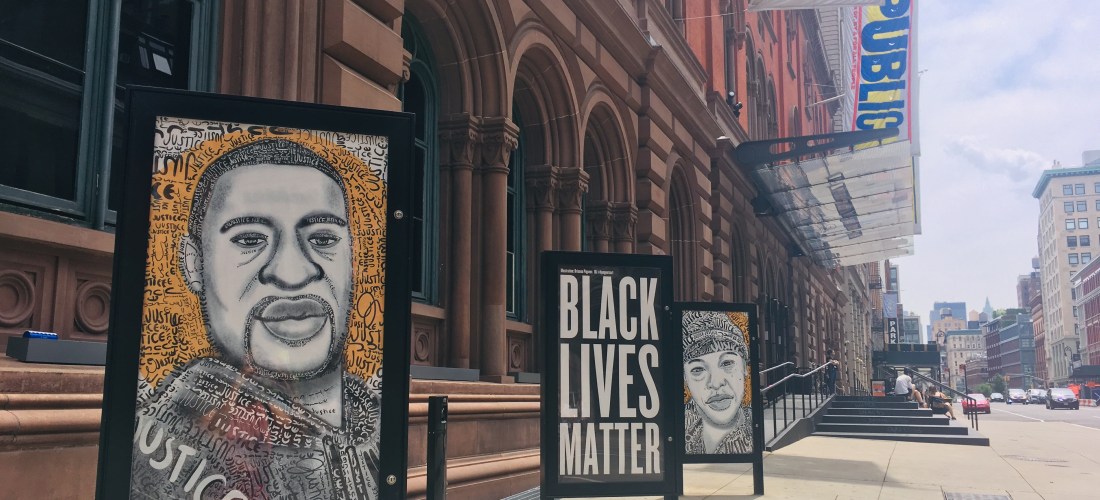
The Public Theater, which has opened its lobby this week to protestors. (Photo: Diep Tran)

“Do you all know the definition of that word witness? I’m not talking about being a passive observer…I’m talking about being a witness in the Black American tradition. Which means you take responsibility for what you see, you’re willing to shoulder that load and put your back into it.”

Daniel Alexander Jones, Black Light

America has ended its second week of protests, which was sparked by the murder of George Floyd by Minneapolis police officer Derek Chauvin but has since grown into a worldwide cry for transformation. In just a week, defunding the police has gone from a farfetched talking point to a rallying cry for millions of people across America, who are calling for an end to police brutality, repercussions for law enforcement who break the law, and defunding the police—taking the billions of dollars allocated to the police and redirecting it towards social services and education. It’s been, to put it mildly, a week

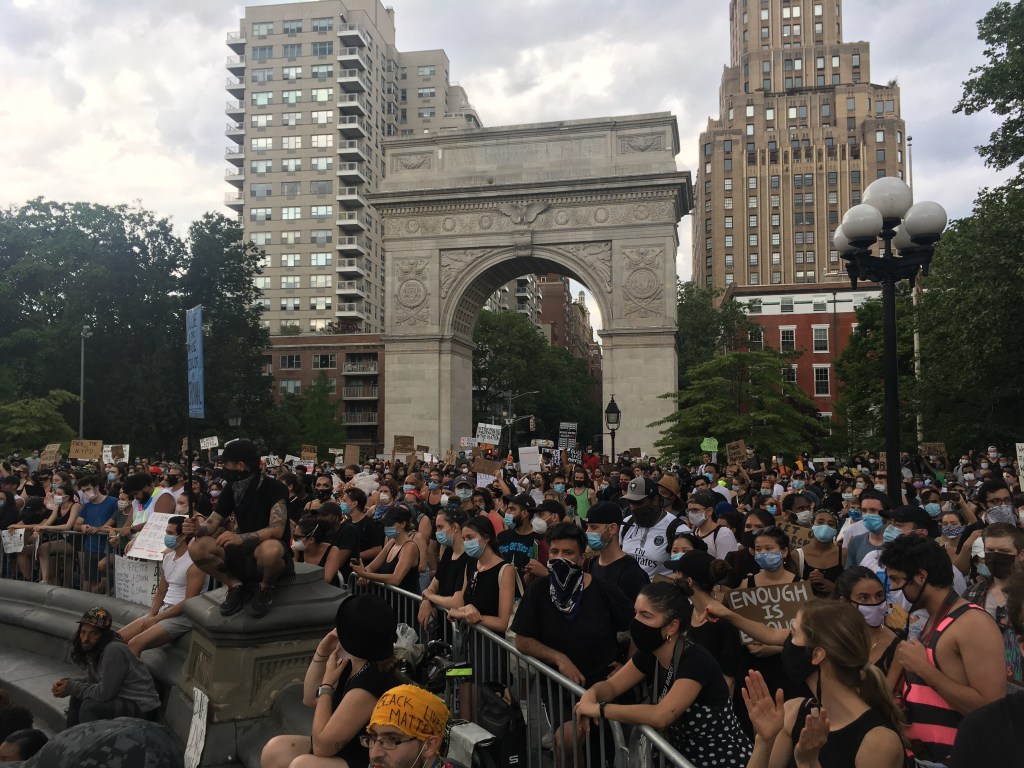
But last night, I came home from a protest in Washington Square Park in Manhattan. While I was resting my feet after a week of marching, I noticed that the Joe’s Pub YouTube channel had posted a show by the artist Daniel Alexander Jones called Black Light. I had seen Black Light in 2018 and I was so moved by it that I saw it twice. It was one of the best shows I saw that year. The play is a series of stories and ruminations by Jones—with original songs performed by Jones and an on stage band interspersed throughout. In the work, Jones references segregation and racial violence, but also family, Prince and change (or as he calls it, “the crossroads”). It’s a work both sobering and beautiful, melancholy and joyful. And it creates hope by telling the audience that a better world is possible if we can imagine it and we can act.

One of the main themes is witnessing, but not in the sense of being a passive observer. It’s what Jones calls in Black Light, “a living witness.” It’s “taking responsibility for what you see.” Millions of people around the world witnessed, through a video, George Floyd being murdered in broad daylight. And instead of brushing it off, like so many have done so many times before, it drove people to act, to shout enough is enough.

And I don’t just mean taking to the streets, though those actions have been the most visible and wildly effective in leading to the arrest of Chauvin. I was talking with a friend, a theater producer who lives in Chicago, and they were telling me that they were on police scanner duty, so they could tell those on the ground protesting if there were SWAT teams nearby. That is being a living witness. So many people have donated to the Minneapolis Freedom Fund and the Brooklyn Community Bail Fund that they were redirecting donations to other organizations. That is being a living witness. The citizens of Los Angeles called in so much that Mayor Eric Garcetti has committed to cutting $150 million from the Los Angeles Police Department budget. That is being a living witness. KPOP fans flooded racist hashtags on Twitter, such as #WhiteLivesMatter, with fancams, drowning out the voices of white supremacists. That is being a living witness, with dance moves.

Here’s my favorite example of living witnesses this week. On June 1, Off-Broadway theater New York Theatre Workshop opened their building for the first time since March (when NYC went dark because of COVID-19). They gave out free water and snacks, gave protestors a place to charge their phones, and allowed people to use their bathroom. Within a day, a Twitter campaign was born: #OpenYourLobby, which was used to persuade other theaters around the country (whose buildings were closed and empty) to follow NYTW’s example. In just four days, 64 theaters around the country are committed to opening their lobbies daily for protestors. And those who couldn’t, like Roundabout Theatre Company, donated water and supplies to the Public Theater, whose lobby in the East Village has been opened since June 3. When I visited the Public, a woman came up and thanked one of the staff members who were there, saying, “You’re doing the right thing.”

The lobby of New York Theatre Workshop. In the background there is a sign: “Stonewall Riots were started by Black & Brown trans folx! Black Lives Matter. Trans Lives Matter.” (Photo: Diep Tran)

I contacted the organizers at the Open Your Lobby Twitter account. They requested anonymity but explained that the campaign was inspired by their own experience as protestors. “This initiative started because we were on the ground during the initial weekend of protests, and we saw people struggling to find refuge in a largely boarded up city,” they said. “Theater spaces came to mind because they are centrally located with bathrooms and resources which haven’t been used for weeks.” Not to mention that New York Theatre Workshop is in a high-traffic area for protestors, being within 10 minutes walking of Washington Square Park and Union Square.

With help from Open Your Lobby, playwright and actor Carolina Do has petitioned Second Stage Theatre (located next to Times Square) to open. She, and two other artists, gathered over 300 signatures for a petition within a day, which they then sent to the theater’s management. Second Stage then gave Do permission to use their space starting June 6 and contributed to buying supplies. For the last two days, Do and a group of volunteers have been greeting protestors whenever they come by. Do sees this as an opportunity for theaters, who have recently been vocal about their support for Black Lives Matter, to take concrete action—not just wait until next year when the industry starts up again and we have all become distracted by other headlines. “It definitely was a lot of work of us going, ‘You put out a BLM statement but what are you really doing?’” she told me.

Though Do noted that she tried petition Broadway theaters to open their doors, especially because there have been multiple large protests around Times Square, but so far none have committed. “My contacts at [Ambassador Theatre Group] and commercial theaters are using the excuse of unions staying in the way/having cut off utilities,” she says. “I personally call BS but haven’t seen any Broadway people take action/initiatives on petitioning them, aside from Jeremy O. Harris calling some theaters out on Twitter.”

As someone who worked at a non-profit theater organization for eight years, I will tell you that those institutions are notoriously slow to respond to any time-sensitive proposal—due to the need to get approval from, usually, at least, three levels of management. And yet, in just a week, what started as one theater opening their doors to 64 theaters around the country opening their doors goes to show how easy you can change an industry. Not by waiting for them to do the right thing, but by artists pressuring them to do so (and in some cases, writing Black Lives Matter messages on their boarded up buildings). As we head into another week of protesting, here is a list from Open Your Lobby, which is updated frequently, of current theaters that are available to protestors.

Opening a lobby, it doesn’t seem like a big action. But like how an avalanche starts with one rolling pebble, if all of us decided to not just be a passive observer, but a living witness, to take an action—to quote one of the speakers I heard yesterday in Washington Square Park, “we will win.” Meanwhile, we can take note of those who are just talk and those who say nothing at all

In the words of Jones in Black Light:

“I come from a long line of people with radical imagination. Stretching back form my grandmother, my aunt Cleotha, across generations, through slavery time—when people imagined a freedom that they themselves have not experienced. But they held it in their mind’s eye, and they prayed and they shouted and they acted and they chose….”

Daniel Alexander Jones, Black Light

What will you choose to do today? How will you be a witness to this time?

The June 6 protest in Washington Square Park. (Photo: Diep Tran)

*This post has been updated throughout.

We Are Not Doing Enough

Features
Photo by Rahul on Pexels.com

In the past week, as protests have raged across the country in reaction to the murder of George Floyd and rampant police brutality, we’ve heard the following things from many non-Black friends and colleagues: “I don’t feel like I’m doing enough.” This is usually accompanied by a heavy sigh and a discussion of what they’ve been doing. Have you been donating to Black Lives Matter, bail funds and other social justice organizations? Have you called your elected representatives to tell them to defund their police department and pass laws demanding accountability for police officers? Have you been speaking up when you encounter racist or insensitive remarks by the people in your life? “Yes, but I still feel so depressed.”

To which we say, good. As Jose said in our recent Token Theatre Friends podcast: “I feel powerless. I feel like I’m not doing enough right now. I wouldn’t want people to tell me, ‘Oh, you’re doing so well,’ this is not what this is about. I think I would be very unhappy with myself if I thought that I was doing enough. So the fact that I’m wondering if I’m too, you know, I take it as a very good sign.”

Here at Token Theatre Friends, we feel like we haven’t done enough. Because if we had, if everyone who has shown support the past week has done enough, George Floyd and Breonna Taylor might still be alive. Our discomfort, our rage, our depression, is overdue. It’s a minor taste of what Black people in America feel every day. Meanwhile, too many people have felt comfortable for way too long. 

That statement applies to both socio-political issues, as well as to our own backyard. We love the arts and we love theater. But recent events have made the industry’s shortcomings, and its hypocrisy, even clearer. On June 1, Dear White People actor Griffin Matthews posted a powerful Facebook video detailing his experience working on his musical Invisible Thread, which was presented Off Broadway at Second Stage Theater in 2005. He started the video saying, “Amy Coopers are alive and well in the American theater,” referencing the white woman who called the police on a Black bird watcher, Christian Cooper, in Central Park.

Matthews then listed the racism he experienced while working on Invisible Thread, including an instance in the rehearsal room: “A song in Act One mentioned the fact that I was the son of slaves, our producers in the middle of a creative team meeting said, ‘Slavery is over, nobody wants to hear about that,’” Matthews recalled. “Not one single person put him in check.” Second Stage also promised to donate money to Matthews’ charity in exchange for him and the cast of Invisible Thread performing at their annual gala; “their donation never came.”

“That is why Broadway is racist,” he said. Second Stage has not commented on the video, which as of press time has been shared more than 5,000 times. But the company did post a statement of solidarity with Black Lives Matter. (Update: Invisible Thread director Diane Paulus also put out a statement.)

Matthews’ experience is not unusual. Because while the industry prides itself on diversity, behind closed doors it’s a different story. Award-winning actor/composer/playwright Daniel Alexander Jones wrote in a Facebook post that he’s been told by: “white artistic directors that: my work had no relevance to the contemporary American theatre, and told that I needed to write a white male into my play because it didn’t make sense that there wasn’t one in it, and being told that no-one would ever want to produce my work, ever, so is there something else I could do?” (We pity any producer who doesn’t understand the beauty of Black Light.)

Actor Cooper Howell wrote, in devastating detail on Facebook, the sexual and racial harassment he experienced at the hands of a white director while acting in Frozen at Disneyland. The first-hand accounts are too numerous to describe, as Black artists have taken to social media to voice their dissatisfaction with the industry, speaking up about negative work environments, microaggressions and outright racism that they’ve experienced while working in the theater. This stands in stark contrast to the many Broadway shows and theaters that have posted up statements supporting Black Lives Matter and vowing to be anti-racist. The Metropolitan Opera posted up a statement, yet it’s never produced an opera by a Black composer. A Black playwright has not won a Tony Award for Best Play since 1987. White actors and playwrights are overrepresented on New York City stages.

A public statement may be heartwarming, but it lets companies pull the curtain on their own hypocrisy. Like a black square on Instagram, the performance can be a substitute for meaningful action. Some of the companies who have released statements have produced primarily white writers at their theaters. They’ve contributed to an erasure of Black and POC voices. They’ve fostered negative work environments for Black artists and hostile viewing experiences for Black audiences. And they punish those who speak up. “I may never make it to Broadway for speaking out against the horrific treatment that I received, and all of the Amy Coopers will be fine,” said Matthews in his video. It echoes what Star Wars actor John Boyega said during a protest in London on June 3: “Look I don’t know if I’m going to have a career after this but, f**k that.” By blacklisting artists who dare to speak up, these so-called liberal institutions contribute to the systemic racism that they disavow.

As COVID-19 has shut down the entertainment industry, we are left with two options: we can either build back better than before or we can continue the status quo, where artists of color are forced to swallow their discomfort for the sake of the white people around them. Theaters and producers who have put out these Black Lives Matter statements need to take this time to listen to the voices of Black artists around them and on social media, who all have important suggestions for change. Director/actor Schele Williams posted a poetic, detailed statement on Facebook with the following suggestion:

Broadway is white.
And white is not bad
But White is not Black

If you mean the words in your statements
Show us your values
Live up to your mission statements
Give us space to breathe and speak without fear of reprisal.
Look around the room and if you only see yourself replicated – CHANGE IT.

Schele Williams

When people are risking their lives to march on the street, a social media statement is not enough. Now is the time to act. Now is the time to look not just outward, and inward. The calls are coming from inside the house.

What do theater companies and producers commit to doing to make sure what happened to Griffin Matthews and countless Black artists does not happen again? Will these companies cater to Black audiences as faithfully as they do white ones? Will they make their work accessible and affordable to the Black community? Will they make sure to spotlight Black voices regularly, and not just once a year and as side characters? Will they help support the Black-led business and theaters in their communities? If their Black artists get criticized by the New York Times, will they stand by their artists? Will they prioritize fair wages so that Black artists can afford to be artists? Will they defend their socio political stances to angry subscribers who just want them to “shut up and sing”? 

To our Black friends and readers: we stand with you and we are sorry for not having done enough, and commit to continue to advocate for justice and anti-racism.

To our non-Black readers: Right now, if you’re feeling comfortable, it means you’re not doing enough. Your discomfort is overdue. Sit with it. Let the discomfort propel you to act and fight for a better world for everyone.